Hi, what do you want to do?






PBS
Map a Model Solar System
Creating a solar system map is a snap thanks to a hands-on activity! Science scholars explore the solar system by building it wherever they choose during an interactive from PBS's Space series. Users pick both the location and scale for...

CK-12 Foundation
Venn Diagrams: Planets and Dwarf Planets of the Solar System
Yes, Venn diagrams are helpful in science, too. Learners use an interactive to classify celestial bodies as having moons, as dwarf plants, as both, or as neither. They answer a set of challenge questions based on the Venn diagrams they...

McGraw Hill
Solar System Builder
Create your own solar system using a simulation. Young scientists explore the components of a stable solar system through trial and error. Using the simulation, they place planets and watch as they orbit safely or cause fatal collisions.

Laboratory for Atmospheric and Space Physics
The Solar Wind Tunnel
The winds of change are blowing in our very own solar system! But what makes some heavenly bodies more affected by solar winds than others? Pupils discover the concept of magnetic forces at work in space in this...

McGraw Hill
Extra Solar Planets Interactive
Studying what you can't see can be challenging. Discover how scientists use indirect measurements to prove the existence of planets and estimate their sizes. The introduction explains the symbiotic movement of planets and stars during an...

CK-12 Foundation
Circles Centered at the Origin: The Map of the Beta Solar System
Calculate galactic orbits in a far-out resource. Pupils drag a point on a circle to graph the orbit of a fictional planet. Using the equation, they find points through which the orbit passes. To finish the simulation, users determine the...

PBS
Why Isn't There an Eclipse Every Month?
Searching for an eclipse activity that sends scholars over the moon? Try an interesting interactive to get their minds active! The resource, part of an extensive Space series from PBS Learning Media, uses modeling and data analysis to...

American Museum of Natural History
What is Astronomy?
Go study the universe. Pupils learn seven aspects about astronomy and astronomers. They begin to learn about constellations; distance and motion between objects; gravity; the electromagnetic spectrum; dark matter and energy; and teams of...

McGraw Hill
Gravity Variations Interactive
What would a baseball game look like on the moon? Probably a lot of home runs! A creative activity explores the motion of a projectile on the surface of different bodies in the solar system. Participants adjust the angle and...

McGraw Hill
Orbital Velocity Interactive
Why does it take Pluto 90,000 days to orbit the sun, but it only takes Mercury 88 days? An interactive lesson helps pupils find a connection between the speed of orbit and distance a planet is from the sun. The simulation allows for...

CK-12 Foundation
Scientific Notation: Light Years to Centaurus Constellation
Connect scientific notation to a real-life situation. Measuring distances in our solar system require large numbers. As pupils make conversions using these large numbers, they begin to see the necessity of scientific notation. They...

PBS
Earth’s Energy Budget
Is Earth's energy flow a little off balance? Explore our energy budget using a click-through interactive. Scholars discover the many factors that move solar energy around the planet and why the system is no longer in equilibrium.

Scholastic
Study Jams! A Day on Earth
It's good thing that it isn't up to RJ to spin the earth on its axis; he can't even keep a basketball spinning! In this video animation, he and viewers learn about Earth's movements in space. One thing to consider before you use this...

NASA
Nasa: Eyes on the Solar System
Are you ready to ride the Curiosity to the surface of Gale crater? This 3-D environment created with NASA mission data allows students to experience space and time. With this website students can also hop on an asteroid, fly a Voyager...
American Museum of Natural History
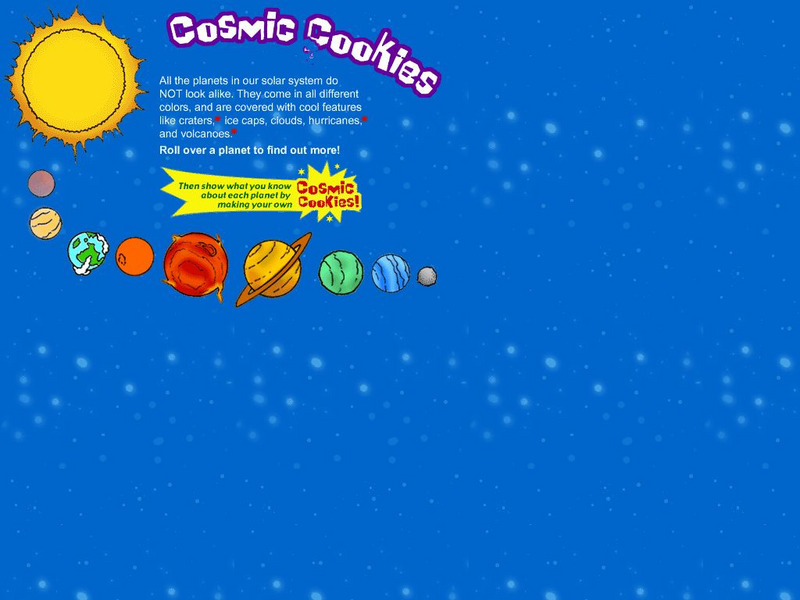
American Museum of Natural History: Ology: Cosmic Cookies
Roll your mouse over the planets in our solar system to read a vignette about each. Then, link to the recipe for directions to create miniature planet cookies that look like the real thing.