Hi, what do you want to do?






Radford University
Sleep and Teen Obesity: Is there a Correlation?
Does the number of calories you eat affect the total time you sleep? Young mathematicians tackle this question by collecting their own data and making comparisons between others in the class through building scatter plots and regression...

Intel
Forensics: Get a Clue
Although the methods are all scientific, forensic science was started by police officers rather than scientists, who relied on observation and common sense. Young detectives use many tools to solve crimes around the school in a...

Intel
What Does This Graph Tell You?
What can math say about natural phenomena? The fifth STEM lesson in this project-based learning series asks collaborative groups to choose a phenomenon of interest and design an experiment to simulate the phenomenon. After collecting...

Cornell Lab of Ornithology
Investigating Evidence
Explore the scientific process through nature. Scholars become scientists as they develop a question, design an experiment, collect data, and analyze their results. A two-week lesson guides your classes through the process and provides...

National Library of Medicine
Your Environment, Your Health: Air Quality
Some scientists argue that air pollution now causes more deaths than smoking. The second unit in a six-part series focuses on air quality. Scholars learn what's in the air, how clean the air around their school is, and what they can do...

National Library of Medicine
Your Environment, Your Health: Runoff, Impervious Surfaces, and Smart Development
Can a sidewalk increase the amount of pollution in local streams? Scholars learn the answer to this question though research and experimentation in the fifth unit in the six-part series. Pupils study runoff, impervious surfaces, and the...

National Library of Medicine
Your Environment, Your Health: Food Safety
Did youknow that chicken causes the greatest risk of food-borne illness. The fourth unit in a six-part series addresses food safety. Scholars research common scenarios of food causing illness through the National Institute for Health....

National Library of Medicine
Your Environment, Your Health: The Great Debate—Bottled Water vs. Tap Water in Our School
Should bottled water be sold in schools, or should they only provide tap water? The summative unit in the six-part series encourages scholars debating this topic. The lessons teach how to build an argument, how to gain background...

Rural Science Education Program
Bees and Flowers – Partners in Pollination
Why are bees so important? After several activities where kids investigate the form and function of flowers, they learn about the different types of bees and label them. They then examine pollen under a microscope and decide which bees...
Texas Education Agency
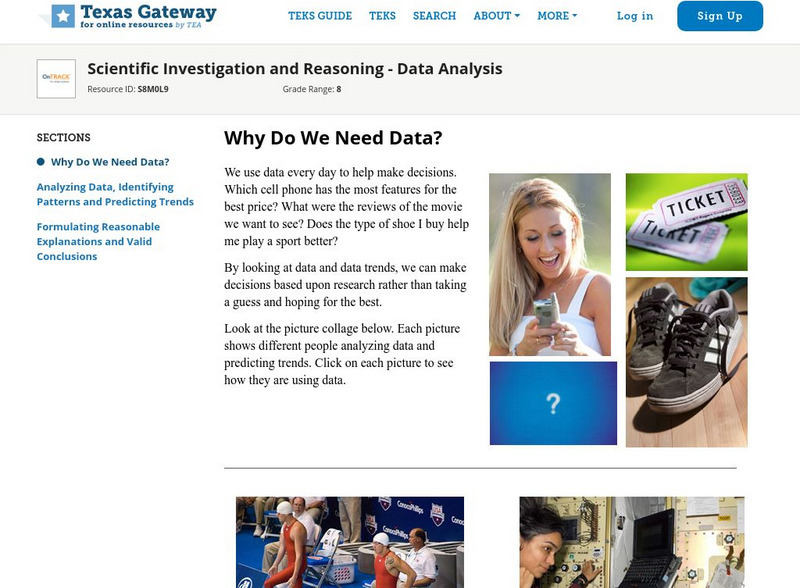
Texas Gateway: Why Do We Need Data?
We use data every day to help make decisions. Which cell phone has the most features for the best price? What were the reviews of the movie we want to see? Does the type of shoe I buy help me play a sport better?By looking at data and...

Vision Learning
Visionlearning: Data: Data Analysis and Interpretation
An explanation of data from collection to analysis. Includes a discussion of how the same data may be interpreted various ways by different individuals.

Vision Learning
Visionlearning: Data: Uncertainty, Error, and Confidence
An explanation of how errors may affect data that has been collected for experimentation. Some examples are given.

Texas Education Agency
Texas Gateway: Scientific Investigation and Reasoning Data Organization
Using interactive exercises, students will review how to construct tables and graphs in order to organize data.
Vision Learning
Visionlearning: General Science: The Scientific Method
Instructional module focusing on the scientific method as a process of investigation into the natural world rather than a linear collection of facts. Site also includes an interactive practice quiz and links relating to the topic.
CK-12 Foundation
Ck 12: Episd: Physics: 1.8 Working With Error
[Free Registration/Login may be required to access all resource tools.] This learning opportunity examines two angles of working with error. Students will practice taking measurements with accuracy and precision and then consider the...
University of California
Ucmp: Adventures at Dry Creek
For this lesson, students embark on an adventure to find out what life was like in Montana 60-70 million years ago. Students "join" a research lab to collect fossils from Montana and analyze them to find direct and indirect evidence of...
TeachEngineering
Teach Engineering: Spectroscopy
Students learn how using a spectrograph helps us understand the composition of light sources. Using simple materials and holographic diffraction gratings (available online at a variety of sites, including Edmund Scientifics and the...