Hi, what do you want to do?






K5 Learning
Musical Instruments to Play
Bring some music to your language arts lesson with a reading comprehension activity. Learners read an informational passage about different musical instruments before answering a series of comprehension and vocabulary questions.

Curated OER
Kindergarten Music Time
Little ones are led through a series of rhythmic songs and chants while they march, clap, and use their tummies as percussive instruments. They work on singing in pitch, chunking, and keeping a steady beat.

Curated OER
Instruments In Action
Young scholars read and demonstrate eight measures of four beats. In this music reading lesson plan, students read and demonstrate through movement their mastery of eight measures of four beats. Young scholars also classify instruments.

Cornell University
Sound Waves
How does sound travel through different mediums? Scholars explore this question by creating and observing sound waves as they learn the difference between transverse and longitudinal wave motion. Using their new knowledge, class members...

Curated OER
Chinese Instruments
Students explore Chinese instruments. In this Chinese instrument music lesson, students listen to a performance by Liu Fang and describe the sounds they hear. Students classify western and Chinese instruments according to their...

Curated OER
Musical Instruments - Woodwinds
Students assemble and examine typical European orchestral woodwind instruments, determine how the instruments change pitch, identify common orchestral woodwind instruments by sound, and research a non-Euro-centric woodwind instrument in...

Curated OER
Types of Popular Music
Students listen to different types of music, such as bluegrass, rap and blues. They identify different styles of music and musical instruments. They discuss how the music reflects culture.

Curated OER
Music in the Common Schools
Students sing songs from the common schools era and compare music from the common schools era and today. In this music lesson plan, students look at pictures, fill out Venn Diagrams, and listen to music.

Curated OER
Who Wants To Be A Mini Maestro?
Students are introduced to classical music. They listen to Beethoven's Fifth Symphony. They interview each other in regards to their feelings about the music and the paintings they produced while listening to the piece.

Curated OER
THE TRAVELS OF BABAR: An Adventure in Scale : The Instruments of the Orchestra
Students classify the classes of instruments of the orchestra: strings, brass, woodwinds and percussion. They aurally and visually identify the instruments of the orchestra. Students become actively engaged in live performances by...

Curated OER
World Percussion Instruments
Fourth graders study percussion instruments from various world cultures. In this percussion instruments lesson, 4th graders listen to percussive sound sources, learn playing techniques, and create compositions for instruments they...

Mt. San Antonio Collage
Postulates, Angles, and Their Relationships
More than a worksheet, learners go through geometry topics example by example on the nicely organized handout. From postulates to classifying angles, there are rules and examples provided for each topic. The ten pages of problems...

Curated OER
Archeologists For a Day
Students listen to a reading about fossils and go on a hunt for items with fossil characteristics. In this cross curricular fossil instructional activity, students will examine their fossil finds and create a graphic...

Curated OER
Strum Along
Learners engage in a lesson which takes something constructed by the class, that would be normally classified as just sound, then work together to make what can be perceived to be music. Students construct a basic stringed instrument...

Curated OER
Investigating the Types of Energy in Different Objects
Students investigate forms of energy. In this physical science energy lesson, students work with a partner classifying household items according to the type of energy they have. Students complete a related worksheet.

Curated OER
Just the Facts, Jack
Third graders listen to music and discuss their responses to different styles separating their comments into facts and opinions. They evaluate a worksheet of statements by classifying the statements into fact and opinion.

Curated OER
Recognizing High and Low Pitch
Students distinguish a high pitch from a low pitch, and demonstrate high/low pitch recognition by creating contrasting movements to high and low music, and use instruments to represent the characters in The Three Little Pigs.

Curated OER
Observing Sound
Second graders study the five senses and the link between pictures and sound. In this sound lesson students discover that sound is vibration, it is described by volume and pitch.

Curated OER
Fun With Sound
Second graders make predictions. In this sound lesson, 2nd graders listen to various sounds, and write down and draw what they think that sound is. Students make a chart of their predictions.

Curated OER
Vibrating Objects Produce Sound
Students use many different materials and resources in order to study and identify sounds that are loud or soft, high or low, pleasant or unpleasant.

Open Curriculum
Open Curriculum: Classifying Musical Instruments
To explain the different instruments and the classification system for all musical instruments

John F. Kennedy Center
The Kennedy Center: Chinese Instruments
Help your students identify and classify Western instruments and traditional Chinese instruments.
Science Education Resource Center at Carleton College
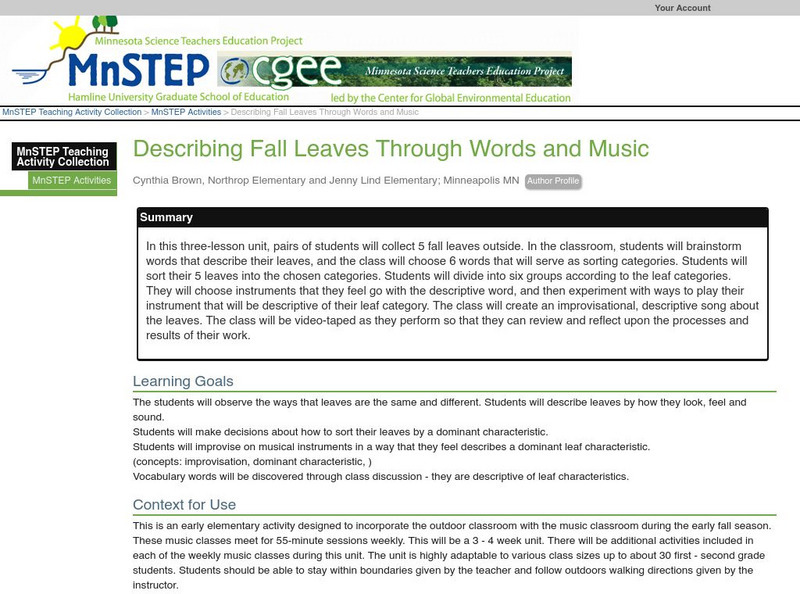
Serc: Describing Fall Leaves Through Words and Music
Students collect, describe, and sort leaves found outside. As a cross-curricular component, they will improvise on musical instruments in a way that they feel describes a dominant leaf characteristic.
Indiana University
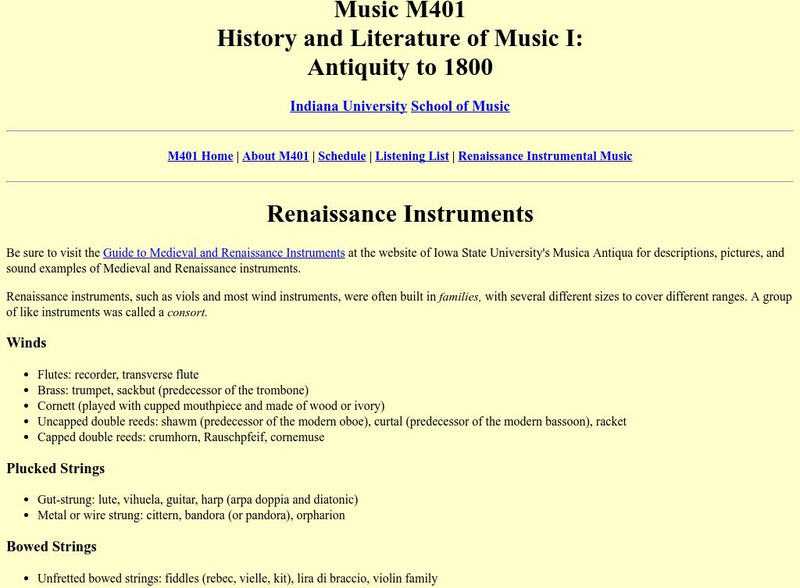
History and Literature of Music: Renaissance Instruments
This resource classifies Renaissance instruments in the following categories: winds, plucked strings, bowed strings, keyboard, and percussion.