Hi, what do you want to do?






PBS
The Diary of Anne Frank
While designed to supplement a viewing of the PBS Masterpiece Classic The Diary of Anne Frank, this resource can also serve as an excellent informational text and activity source for your students on the historical context and timeline...

Smithsonian Institution
Solomon G. Brown: Letter Writing
Personal correspondence in the form of letters is not as common as it once was. This resource presents an opportunity for you to introduce your class to letter writing and cover topics in social studies. Learners read a letter written in...

Minnesota Literacy Council
Scientific Method
Here is a resource with a descriptive approach to explaining the scientific method. It's simple, but effective for both introduction and reinforcement of this concept.

Classroom Law Project
What do cartoonists see in this election?
Cartoons from the 2008 Presidential election provide the text for a activity designed to help learners understand how political cartoonists use persuasive techniques to present a point of view.

National Institute of Open Schooling
Adsorption and Catalysis
Adsorption, not absorption, is when atoms stick to the surface of an object, like water sticking to a grain of sand. An informative lesson delves into adsorption, teaching physical and chemisorption and the factors that affect them....

Scholastic
Point of View
The point of view in a story can dramatically change the story itself. Focus on finding the points of view in various reading passages with a language arts packet, which includes fiction and nonfiction text.

McGraw Hill
Arthropods
Are spiders related to crabs? Study the order of arthropods with a reading selection about animal diversity. It provides details about each class within the order, as well as vivid pictures and explanatory charts.

Library of Congress
Determining Point of View: Paul Revere and the Boston Massacre
If you're teaching point of view, this is the lesson for you! First, decipher the writer's point of view from a primary resource, then compare and contrast the primary source with a secondary source to explore the Paul Revere's...

Road to Grammar
Five Presentation Tips
Talking in front of others can be intimidating, especially when you aren't speaking in your native language. Put your English language learners at ease before a class presentation. They can follow these tips to give relaxed and effective...

Mary Pope Osborne, Classroom Adventures Program
Mummies in the Morning Egyptian pyramids, hieroglyphics
Visit the Magic Treehouse and take your class on a trip through time with a reading of the children's book Mummies in the Morning. Using the story to spark an investigation into Egyptian culture, this literature unit engages...

Walters Art Museum
The Symbolism of Allegorical Art
Introduce learners to allegorical art with four bronze sculptures by Francesco Bertos. After modeling how to recognize bias and allegory in Bertos' Africa, class groups examine the other three sculptures in the series before creating...

Khan Academy
Khan Academy: Organizing Information Quick Guide
Organizing information questions ask you to understand and analyze how a passage works to make an argument. What is the progression of ideas in the passage? or What is the purpose of a specific paragraph?
Scholastic
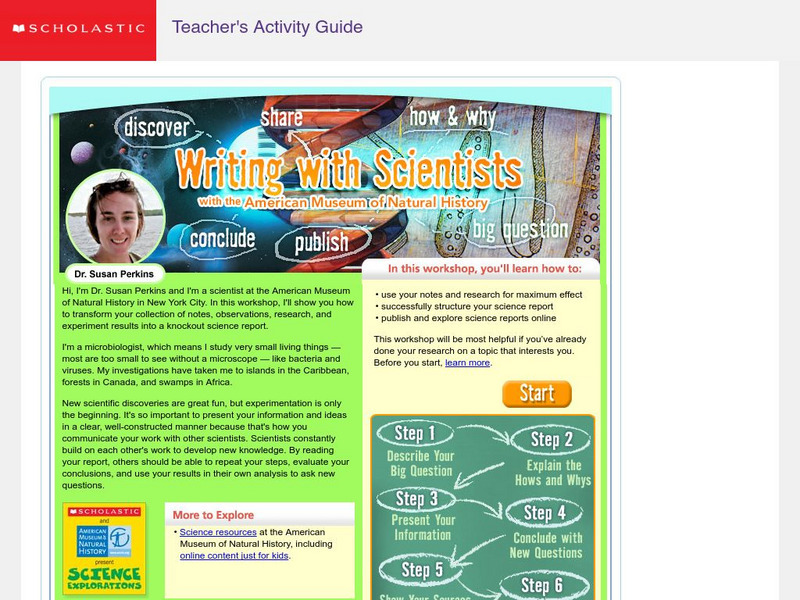
Scholastic: Writing With Scientists With the American Museum of Natural History
Follow this six-step method and you'll have a good understanding of what a good scientific research paper involves and how it is organized. There are plenty of samples for you to look at. This explanation is also very helpful for...