Hi, what do you want to do?






American Museum of Natural History
How Did the Universe Begin?
The Big Bang Theory is more than a television show. Pupils read how Edwin Hubble observed other galaxies and noticed that the galaxies are moving away from each other. Scholars learn about the idea of the big bang and what happened next...

Judicial Learning Center
About Federal Judges
Not just anybody can do the job of a federal judge, but according to the United States Constitution just about anybody can be appointed. The lesson outlines the process and requirements for becoming a federal judge, focusing on the...

American Museum of Natural History
What's the Big Idea About Archeology
The American Museum of Natural History offers a website sure to engage young anthropologists. Learners can dig into a site that offers an explanation of the field of archaeology, the kinds of questions archaeologists ask that launch...

American Museum of Natural History
One-on-One With The Sun
Follow along as Stella Stardust interviews the sun. A fun and informative interview provides scholars with information about the sun.

American Museum of Natural History
Journey to the Stars
Fifteen detailed pictures and informative captions delve deep into the exploration of stars—their life cycle and importance in the universe.

National Constitution Center
Interactive Constitution
Did you know there are seven Articles and 27 Amendments to the US Constitution? Explore each and every one of them, including the Bill of Rights and other rights around the world, in a super neat US Constitution interactive.

ProCon
Tablets vs. Textbooks
Learners decide if tablets should replace textbooks in K-12 schools. They watch four pro and con videos and discover the history of the tablets-versus-textbooks debate. As a bonus, the resource allows them to submit their own comments...

Annenberg Foundation
Geometry 3D Shapes: 3D Shapes
Explore vocabulary related to three-dimensional shapes. An instructional website describes the characteristics of different geometric solids. Learners can use an interactive component to view nets, faces, vertices, and edges of common...

American Museum of Natural History
Up Close With a Zapotec Urn
If a Zapotec urn, buried for over a thousand years in a temple in the lost city of Xoxocotlan in the Valley of Oaxaca in the mountains of southern Mexico could talk image the stories it could tell. That's the set up in a clever resource...

American Museum of Natural History
Paleontology Books
A list of 11 books about paleontology offers titles, authors, and a brief description of the tale.

Shakespeare Globe Trust
Othello
Emilia mocks Bianca, who is in a relationship with Cassio, who attacks Montano. Using the resource, learners explore profiles of the characters from Shakespeare's Othello. They also read a scene-by-scene synopsis and follow a weekly blog...

American Museum of Natural History
Being a Zoologist: Sandra Olsen
Are your students wild about horses? Then introduce them Sandra Olsen, a zooarchaeologist, who has been studying horses and the people who herd them. Ms Olsen responds to 15 interview questions and details how she goes about her...

American Museum of Natural History
What's This?: Early Humans
Early humans crafted shelters out of whatever materials they could find. A one-question quiz asks learners to identify the type of bones used to construct the hut pictured in a display.

American Museum of Natural History
Extreme Mammals
Extreme characteristics can create some unusual mammals. Learners flip through a slide show of some of the most interesting mammals that are both living and extinct. Implement as a remote learning resource or use in-class to review...

Annenberg Foundation
Geometry 3D Shapes: Platonic Solids
From polyhedrons to platonic solids, here is a lesson that will have your classes talking! As an introduction to platonic solids, scholars cut and fold nets to create the three-dimensional solids. They use an interactive component to...

Annenberg Foundation
Geometry 3D Shapes: Euler's Theorem
How do you get a theorem named after you? Euler knows what it takes! The third lesson of five asks pupils to use an interactive activity to compare the faces, vertices, and edges of seven different three-dimensional solids. They use...

Mariners' Museum and Park
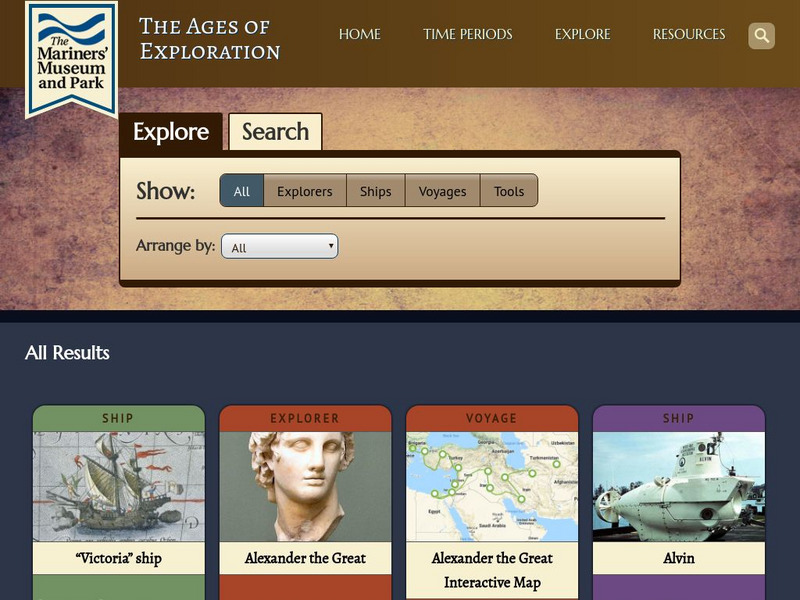
Mariners' Museum: The Ages of Exploration: Ancient
This Ancient Exploration page presents marine technological innovations, types of ships, and information about Alexander the Great. It covers the period of time from 5000 BCE to 476 CE. Each item links to a page of additional information...
Mariners' Museum and Park
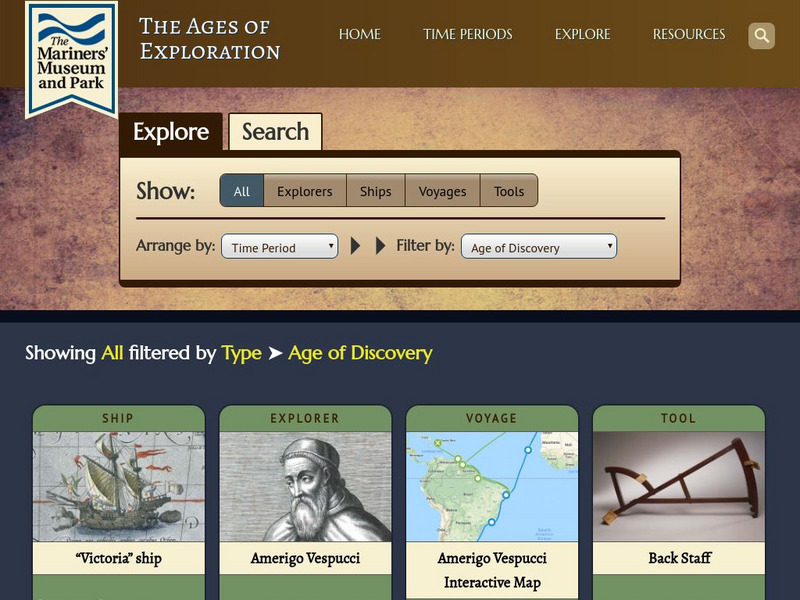
Mariners' Museum: The Ages of Exploration: Age of Discovery
This Age of Discovery page presents naval artifacts and explorers of the 15th century to the early 17th century. It looks at European explorers who journeyed to North and South America, the search for the Northwest Passage, and...
Mariners' Museum and Park
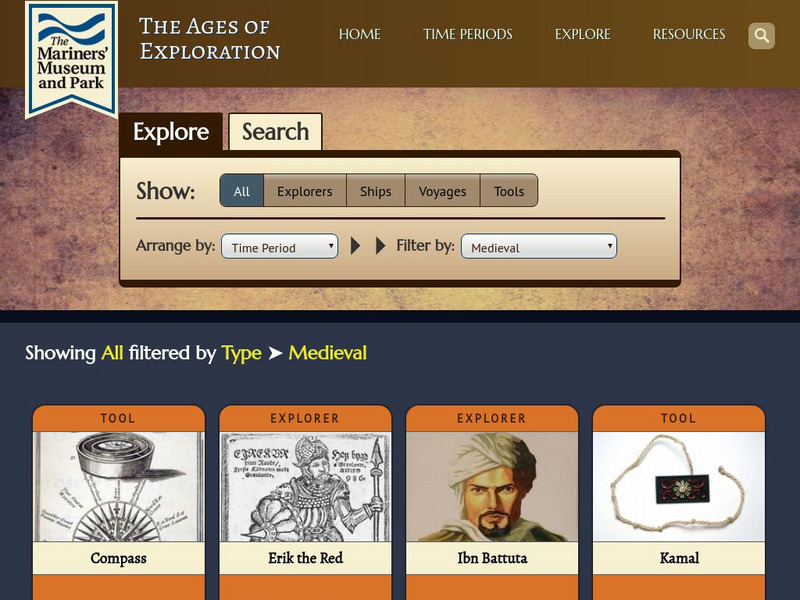
Mariners' Museum: The Ages of Exploration: Medieval
Looks at a few of the key navigational tools and significant individuals during the medieval period of exploration.

The History Cat
The History Cat: Age of Exploration
Examines the Age of Exploration by looking at Christopher Columbus, the Columbian Exchange, the explorer Zheng He, the conquest of Mexico, and pirates who roamed the Caribbean.
Mariners' Museum and Park
Mariners' Museum: Age of Exploration: Tools of Navigation
Sailors improved on many of the tools used in navigation to help them in their long journeys across an ocean. On this site from the Mariners' Museum, find many of these tools, perhaps in use already in the 15th century, but made even...
Library of Congress
Loc: Mediterranean World on the Eve of Conquest
The Library of Congress provides an essay on the reasons for exploration during the 15th century.

Ducksters
Ducksters: Renaissance for Kids: Age of Exploration and Discovery
Kids learn about the Age of Exploration and Discovery of the European Renaissance including Henry the Navigator, Columbus, Portugal, and Spain.
Curated OER
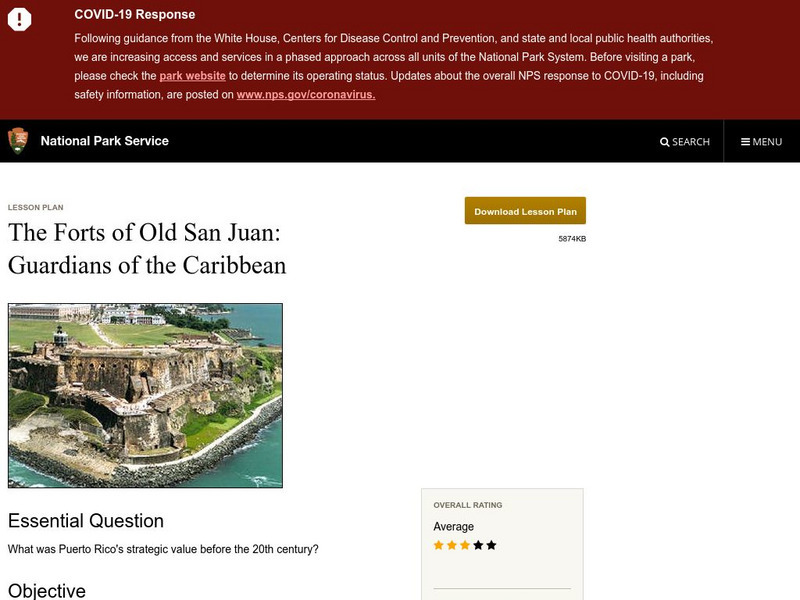
National Park Service: The Forts of Old San Juan: Guardians of the Caribbean
Visit such Spanish sites in Puerto Rico as El Morro, the fort that provided the keystone to protection of the Spanish Empire that spread across the Caribbean. Many photographs and drawings.