Hi, what do you want to do?






EngageNY
End of Unit 3 Assessment: Using Strong Evidence
Young poets view a model two-voice poem while discussing capitalization and punctuation. Pupils also complete an end-of-unit assessment about using strong evidence to support a literary analysis.

Houghton Mifflin Harcourt
We’re a Family: English Language Development Lessons (Theme 3)
Teach your English language learners how to talk about their families with three weeks of lessons. Over the course of the thematic unit, learners pick up new vocabulary so that they can talk about families and relationships, clothing,...

Dorling Kindersley
Question Words
Teaching your primary learners how to ask questions? Then look no further. This worksheet introduces the six essential question words: who, what, where, when, why, and how. Children begin by practicing how to write these words, before...

Get Fluent
Get Fluent in French: Going on Holiday
Take a vacation into French with lots of vocabulary and plenty of activities. This collection of worksheets includes instruction as well as practice and invites French language learners to hone their translation skills.

Southern Nevada Regional Professional Development Program
Pardon Me, Your Modifier is Dangling
Lost! (or misplaced) a modifier. Last seen dangling at the end of a sentence! Reward offered! To underscore the humor, class members are each given a sample sentence to illustrate (A woman passed by, leading a Springer Spaniel, in a...

Mathed Up!
Nets, Plans, and Elevations
A dimensional resource teaches viewers to recognize 2-D views of 3-D objects and how to match nets with their 3-D figures. Individuals draw different views of three-dimensional objects including views from the front, side...

Utah Education Network (UEN)
7th Grade Poetry: Sonnet Poem
Two sonnets provide seventh graders with examples of Shakespearean sonnets. After discussing the story of the poems and analyzing their rhyme scheme and rhythm, young poets craft a Shakespearian sonnet and share their work with two...

Mathed Up!
Recurring Decimals
Explore how to convert repeating decimals to fractions with an informative video that teaches young mathematicians how to translate between decimals and fractions. After viewing, individuals complete a set of problems to practice...

Mathed Up!
Shading Fractions of Rectangles
Learners find the midpoint between two numbers, shade fractional amounts of rectangles as well as decimal amounts of rectangles, and explain their mathematical reasoning in words. The assessment is a great way to check for understanding...

Texas Education Agency
Texas Gateway: Writing: Editing: Punctuation
A learning module that teaches students about the rules of punctuation in six mini-lessons: Introduction, Terminal Punctuation, The Common Comma, Apostrophes and Quotation Marks, Semicolons, and Your Turn.

Roy the Zebra
Roy the Zebra: Reading Games: Full Stop Game (Beginner)
This reading game is designed to teach young readers about how and where to place periods at the end of sentences. They are to click on and drag a snail to where the period belongs; the snail spins and turns into a period.
Other
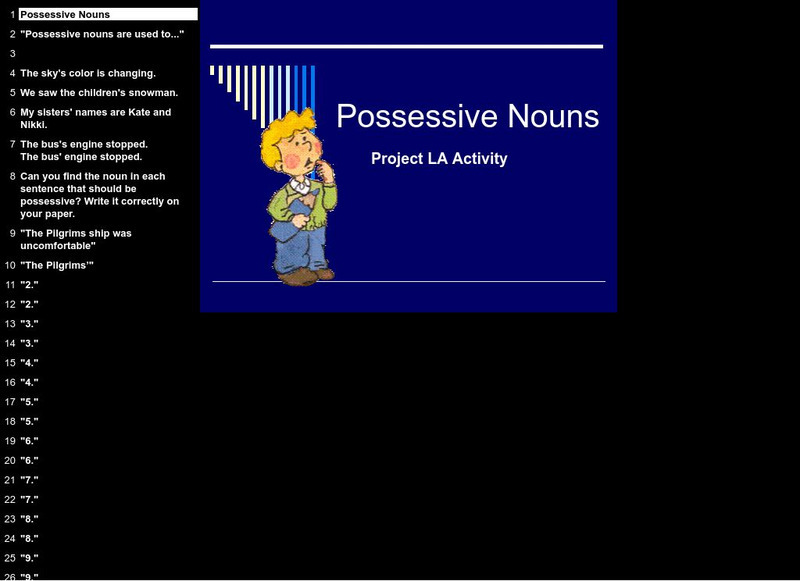
Project l.a.: Possessive Nouns
Designed for elementary students, this Internet viewable slide show explains how to form possessives, then provides practice sentences. At the end are links to an online practice quiz and a printable worksheet.