Hi, what do you want to do?






NOAA
Plate Tectonics I
Young geologists get a glimpse beneath the earth's surface in this plate tectonics investigation. After first learning about the different layers of the earth and the constant movement of its plates, young...

NOAA
Into the Deep
Take young scientists into the depths of the world's ocean with the second lesson of this three-part earth science series. After first drawing pictures representing how they imagine the bottom of the ocean to appear, students...

Curated OER
The Seven Continents Scavenger Hunt
Who doesn't enjoy an engaging scavenger hunt? Here, scholars listen to, and discuss, the informative text, Where is my Continent? by Robin Nelson. They then explore the seven continents and four major oceans using...

Centers for Disease Control and Prevention
Current Cigarette Smoking Among Adults Infographic
Adult cigarette smoking has decreased in recent years, but it is still the number one cause of preventable disease and death in America. An infographic breaks cigarette smoking down by education level, geographical region, gender, race,...

Howard Hughes Medical Institute
Modeling Trophic Cascades
In the ecological game of who eats who, one small change can have a big impact! Individuals create food chains in an array of ecosystems, then determine what happens to organisms in the chain when one organism changes its feeding...

Reed Novel Studies
Hatchet: Novel Study
Thanks to Gary Paulsen's Hatchet, teen readers now know it's possible to survive in the wilderness. A study guide for the novel discusses common topics and vocabulary words found within the text. Additionally, readers get the chance...
E-learning for Kids
E Learning for Kids: Science: Easter Island: What Can We Find in a Pond?
Explore Easter Island in this module to learn about the animals and their habitats.

TED Talks
Ted: Ted Ed: How Did Polynesian Wayfinders Navigate the Pacific Ocean?
Imagine setting sail from Hawaii in a canoe. Your target is a small island thousands of kilometers away in the middle of the Pacific Ocean. For thousands of years, Polynesian navigators managed voyages like this without the help of...
E-learning for Kids
E Learning for Kids: Science: Pacific Ocean: What Can We Find on a Beach?
Josephine lives on the Marshall Islands. Follow her to the beach and find out what kinds of plants and animals live there.
E-learning for Kids
E Learning for Kids: Science: Marshall Islands: How Can We Tell Living Things From Non Living Things?
Andrea lives on the Marshall Islands, and she will teach you about living and nonliving things.
E-learning for Kids
E Learning for Kids: Science: Easter Island: What Makes Up Our Circulatory System?
Help Atua learn how our blood works, and what our circulatory system has to do with this.
E-learning for Kids
E Learning for Kids: Science: Easter Island: Senses: Observation of Living Familiar Things
Students investigate how the senses are used to make observations about objects and things in the environment.
E-learning for Kids
E Learning for Kids: Science: Easter Island: Why Do Young Grow Up to Look Like Their Parents?
Kevin and his grandfather, Omag are going to the zoo. Join them and learn all about animal classification and life cycles.
E-learning for Kids
E Learning for Kids: Science: Chile: What Are the Life Processes in Plants?
Anaken lives with his brother Kiko on a beautiful island. Today they are learning about life processes. Join them and find out what they learn.
CK-12 Foundation
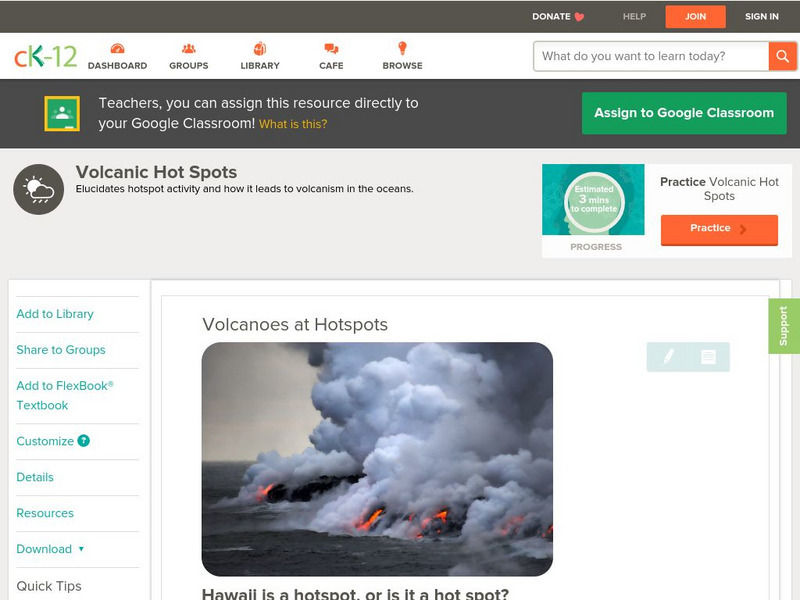
Ck 12: Earth Science: Volcanoes at Hotspots
[Free Registration/Login may be required to access all resource tools.] Volcanoes can form at hotspots away from plate boundaries. This article discusses hotspot activity and how it leads to volcanism in the oceans.
Other popular searches
- Asia & Pacific Islands
- South Pacific Islands
- Pacific Islands New Zealand
- Pacific Islands Art
- Pacific Islands Music
- Imperialism Pacific Islands
- Cultures Pacific Islands
- Mythology Pacific Islands
- Pacific Islands New Zeal And
- Pacific Islands Geography