Hi, what do you want to do?






EngageNY
Complex Number Division 2
Individuals learn to divide and conquer complex numbers with a little help from moduli and conjugates. In the second instructional activity on complex number division, the class takes a closer look at the numerator and denominator of the...

EngageNY
Complex Number Division 1
Conjugating in the math classroom — and we're not talking verbs! The seventh lesson in a series of 32 introduces the class to the building blocks of complex number division. During the instruction, the class learns to find the...

EngageNY
Complex Numbers and Transformations
Your learners combine their knowledge of real and imaginary numbers and matrices in an activity containing thirty lessons, two assessments (mid-module and end module), and their corresponding rubrics. Centered on complex numbers and...

EngageNY
Mid-Module Assessment Task - Precalculus (module 1)
Individuals show what they know about the geometric representations of complex numbers and linearity. Seventeen questions challenge them to demonstrate their knowledge of moduli and operations with complex numbers. The assessment is...

Mathematics Vision Project
Module 3: Numbers and Operations
Bring some concrete reasoning to the skills of multiplying and combining terms. Using various strategies, the six activities in the module provide practice for the skills of adding, subtracting, multiplying, and diving polynomials. The...

Utah Education Network (UEN)
Ch 2: Rational Number Operations
Add an engaging resource to your lessons on rational numbers and watch your pupils' understanding multiply. Learners determine rules for adding, subtracting, multiplying, and dividing integers. Individuals then extend these rules to all...

Laboratory for Atmospheric and Space Physics
Where Are We Going?
Come take a ride on the space bus! Scholars go on an imaginary trip to pick up their peers from the inner and outer planets while reinforcing math skills. First, learners round decimals to identify each planets' distance from Earth....

EngageNY
Polynomial, Rational, and Radical Relationships
This assessment pair goes way beyond simple graphing, factoring and solving polynomial equations, really forcing learners to investigate the math ideas behind the calculations. Short and to-the-point questions build on one another,...
Khan Academy
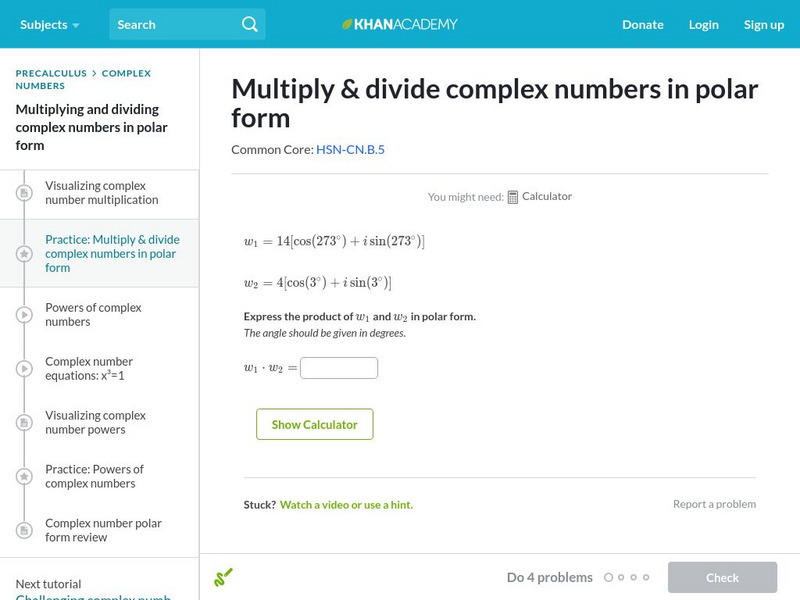
Khan Academy: Multiply & Divide Complex Numbers in Polar Form
Given two complex numbers in polar form, find their product or quotient. Students receive immediate feedback and have the opportunity to try questions repeatedly, watch a video or receive hints.
CK-12 Foundation
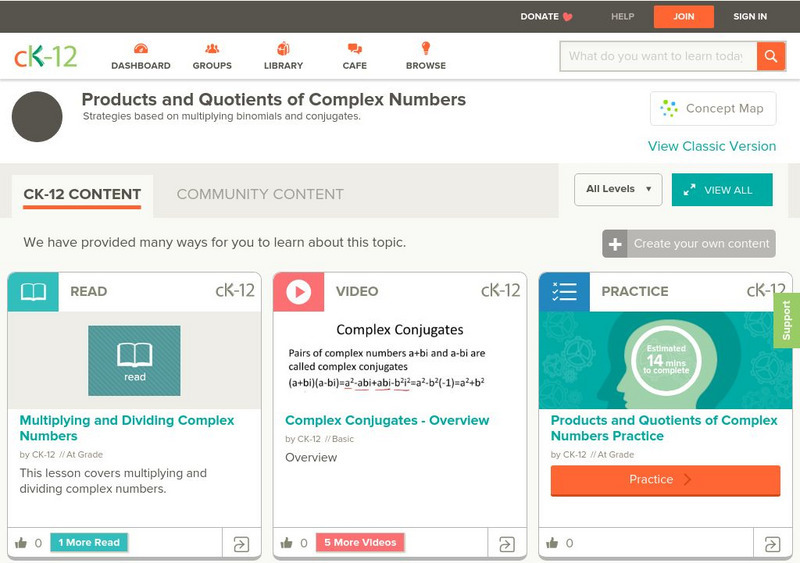
Ck 12: Products and Quotients of Complex Numbers
[Free Registration/Login may be required to access all resource tools.] A collection of resources for learning about and practicing how to multiply and divide complex numbers.
CK-12 Foundation
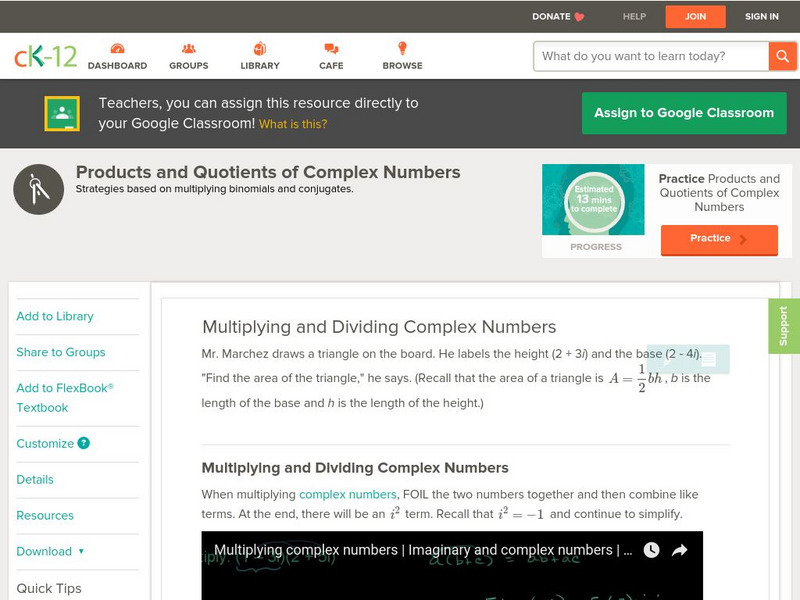
Ck 12: Analysis: Products and Quotients of Complex Numbers
[Free Registration/Login may be required to access all resource tools.] In this lesson, students calculate the products and quotients of complex numbers, identifying conjugates. Students examine guided notes, review guided practice,...
Texas A&M University
Wtamu Virtual Math Lab: College Algebra: Complex Numbers
Use this tutorial to learn what imaginary and complex numbers are, how to write them, and how to perform operations with them. Offers step-by-step examples, video explanations of the examples, and practice questions with answers.
CK-12 Foundation
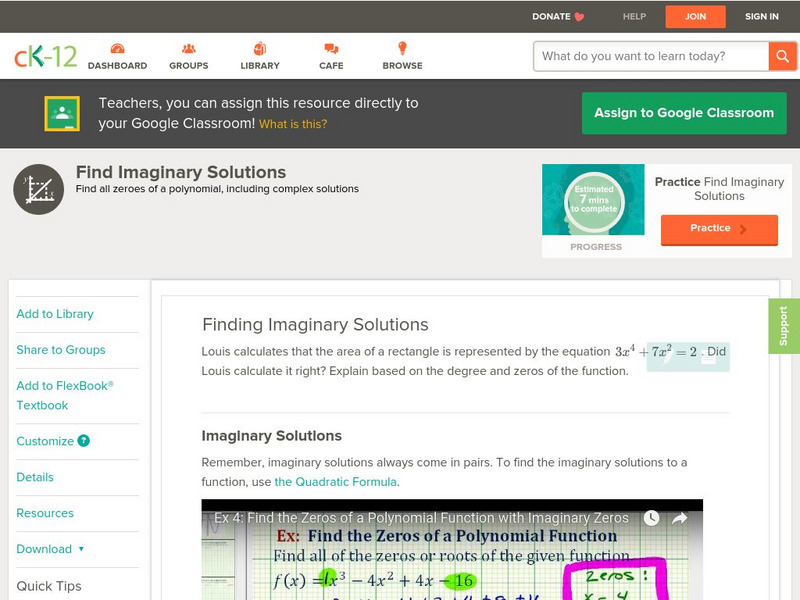
Ck 12: Find Imaginary Solutions
[Free Registration/Login may be required to access all resource tools.] In this lesson, students are finding complex roots of polynomials and applications of the Fundamental Theorem of Algebra. Students examine guided notes, review...

Johan Claeys
Math Abundance: An Introduction to Complex Numbers
A complete explanation of complex numbers that includes lessons on adding, subtracting, multiplying, and dividing them, as well as more advanced topics.
Khan Academy
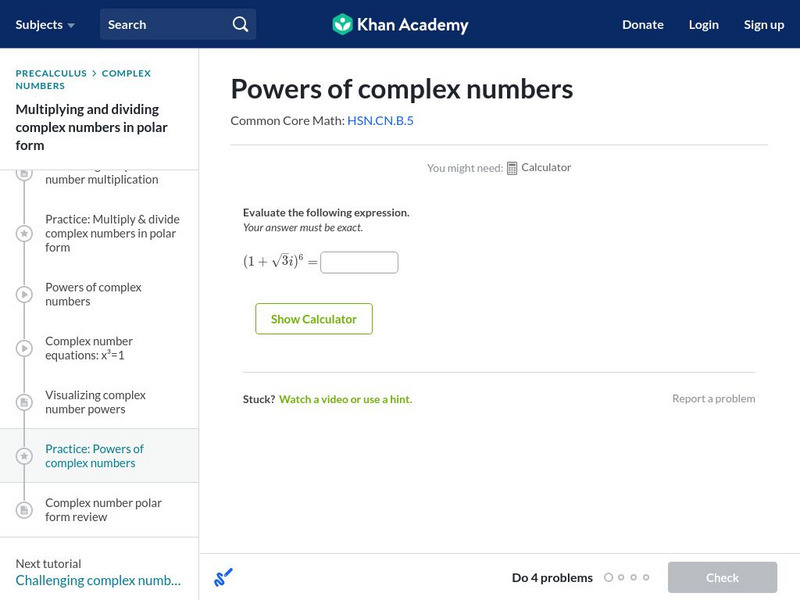
Khan Academy: Powers of Complex Numbers
Simplify a power of a complex number z^n, or solve an equation of the form z^n=k. Students receive immediate feedback and have the opportunity to try questions repeatedly, watch a video or receive hints.