Hi, what do you want to do?






American Museum of Natural History
Drawing Dinos
Five steps walk budding artists through the process of drawing a dinosaur. A drawing guide showcases four dinosaurs—stegosaurus, tyrannosaurus rex, triceratops, and allosaurus.

Project SMART
Dinosaur Trek
Second graders investigate dinosaurs. They explore various websites, submit questions to a paleontologist online, construct cut and paste model dinosaur skeletons, develop a graph to compare dinosaurs, and label pictures from online...

American Museum of Natural History
What Do You Know About T. Rex?
There's so much to learn about dinosaurs. A 10-question quiz tests knowledge of the more detailed characteristics of the Tyrannosaurus Rex. As individuals complete the quiz, they better understand how fossil records helped define some of...

Howard Hughes Medical Institute
Using the Scientific Process to Study Human Evolution
Did humans and dinosaurs coexist? How do we know? Scholars dig in to the tools and methods researchers used to study the process of human evolution by watching a slideshow with embedded video clips. Pupils learn the importance of asking...

American Museum of Natural History
Dress up a T. Rex
Scholars play with an image's color and brightness to predict how tyrannosaurus rex's skin, feathers, and eyes would have appeared. Information and real-world pictures shed light on what evidence guides our assumption of how a...

American Museum of Natural History
Talk to a Titanosaur
Learn all about the Titanosaur with an engaging website that delves deep into the large reptile's physical traits, family history, discovery, and fossil reconstruction.

American Museum of Natural History
Mesozoic Museum
Mini museum curators create an exhibit that showcases the Mesozoic era. Pupils use their knowledge of dinosaurs to make informative posters, drawings, and dioramas. Following three steps to complete the hands-on activity, scholars read...

American Museum of Natural History
Identification Adventure
Put all the pieces together. After a skeleton is put together, pupils play the scientist to determine the type of animal they have by using a classification tree to narrow down the identity. After each decision, they gain advice from an...

American Museum of Natural History
Layer of Time
Dig through the layers for a better understanding of fossils. Scholars learn that fossils form in layers of sedimentary rock. Pupils arrange virtual layers to show the fossil record of different species. Once the layers are correct, they...
American Museum of Natural History
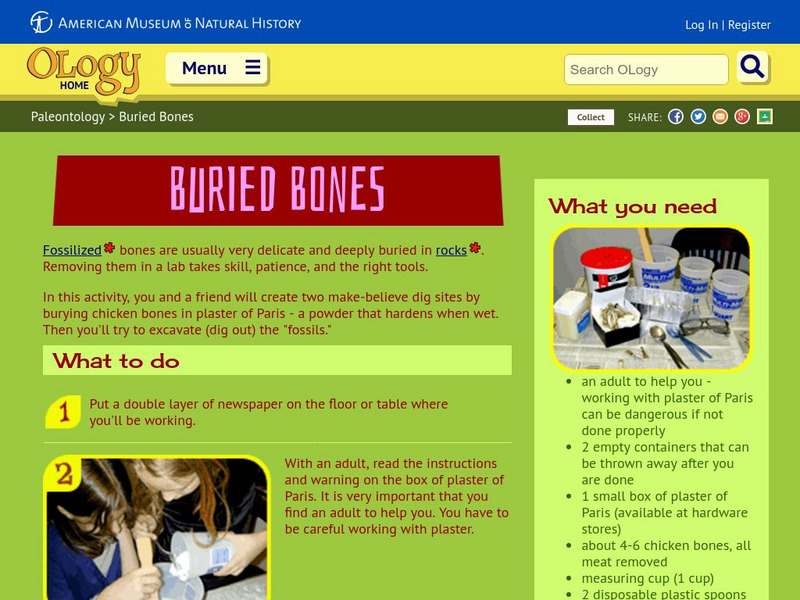
American Museum of Natural History: O Logy: Stuff to Do: Buried Bones
A how-to science project with instructions to make a complete dinosaur bone dig site burying chicken bones in plaster of Paris. Click on the starred words to learn more about the topic.

Illustrative Mathematics
Illustrative Mathematics: N q.a.3: Dinosaur Bones
The purpose of this task is to illustrate through an absurd example the fact that in real life quantities are reported to a certain level of accuracy, and it does not make sense to treat them as having greater accuracy. Aligns with N-Q.A.3.
TVOntario
Tvo Kids: Dino Dig
At this site students play the part of a paleontologist Students must first dig up dinosaur bones using special tools and then reconstruct the dinosaur skeleton back at the lab. Along the way, the students will learn interesting facts...
Other popular searches
- Digging for Dinosaur Bones
- Finding Dinosaur Bones
- Triceratops Dinosaur Bones
- Classifying Dinosaur Bones
- Arranging Dinosaur Bones
- Dinosaur Bones Worksheets
- Dinosaur Bones by Aliki
- Dinosaur Bones by Alika