Hi, what do you want to do?






Student Handouts
The Formation of the U.S. Constitution #3
Finish up your study of the United States Constitution with the third resource in a three-part series. Class members respond to three questions that focus on the relationship between the Articles of Confederation and the Constitution and...

K12 Reader
Slavery in the Constitution
Your young historians will read excerpts from three parts of the United States Constitution—Article One, the Thirteenth Amendment, and the Fourteenth Amendment—and discuss how they each address the issue of slavery.

James Madison Memorial Fellowship Foundation
Those "Other Rights:" The Constitution and Slavery
Did the United States Constitution uphold the institution of slavery, or did it help to destroy it? Young historians study Article 4, Section 2, Clause 3 of the Constitution and evaluate the rights of slaveowners as they compared to...

National Endowment for the Humanities
Slavery and the American Founding: The "Inconsistency Not to Be Excused"
High schoolers examine slavery in the revolutionary and colonial eras of the United States. In this slavery instructional activity, high schoolers investigate the presence of slavery in early America, the language of the Constitution,...

National Constitution Center
Thirteenth Amendment Poster
President Lincoln believed in the Thirteenth Amendment so strongly that he signed 14 copies of it, but died before he could see it passed on December 18, 1965. Explore the text that forever abolished slavery in America with a document...

University of California
Equal Rights? The Women's Movement from Suffrage to Schlafly
If you've never heard of the Equal Rights Amendment, it's probably because there isn't one in the United States Constitution. Delve into the contentious history behind the ERA, its founders and supporters, and reasons for its political...

Judicial Learning Center
Civil Rights and Equal Protection
Almost every American is familiar with the Supreme Court case of Brown vs. Board of Education. Far fewer understand the constitutional reasoning or the wide-ranging consequences of the ruling in the field of criminology. The interesting...

Chicago Historical Society
Are We the People?
Taking on the roles of a fiery Boston patriot, a Philadelphia merchant's wife, and a prominent abolitionist, your young historians will consider the reactions of these early Americans to the creation of the Declaration of...

New York State Education Department
US History and Government Examination: August 2013
While the United States is now one of the strongest countries in the world, at its founding, it was plagued by controversies over the ratification of the Constitution, the Louisiana Purchase, and the expansion of slavery. Using a...

C3 Teachers
Black Genius: How Did Black Genius Help Build American Democracy?
"How did the slavery system undermine the United States' democratic principles?" This question launches a study of how the Preamble to the Declaration of Independence, Article I, Section 2 of the U.S. Constitution, and Article IV,...

Center for History and New Media
The Impact of the Jim Crow Era on Education, 1877–1930s
Even though American slaves were officially emancipated in 1865, the effects of slavery perpetuated throughout the 19th and 20th centuries. Middle and high schoolers learn about the ways that discrimination and the Jim Crow laws...

Constitutional Rights Foundation
History of Immigration Through the 1850s
Everyone living in the United States today is a descendant from an immigrant—even Native Americans. Learn about the tumultuous history of American immigration with a reading passage that discusses the ancient migration over the Bering...

National Constitution Center
Abraham Lincoln's Crossroads
History enthusiasts participate in an interactive website that brings Abraham Lincoln to life as he shares his personal experiences between 1854-1864. Scholars listen and read carefully to form their own opinions and discover if they...

DocsTeach
How Effective were the Efforts of the Freedmen’s Bureau?
Effective or ineffective? As part of a study of post Civil War America, young historians analyze a series of primary sources to evaluate the effectiveness of the Freedmen's Bureau in addressing the challenges faced by the slaves freed by...

Student Handouts
Writing Exercises: Science and Technology II
All revolutions in science and technology have both pros and cons. Kids examine the advent of the Green Revolution, nuclear growth and use, and the countries considered nuclear powers. They'll construct three responses to each of these...

CommonCoreSheets.com
The Civil Rights Movement Timeline
Using this simple worksheet, your learners will have the opportunity to practice reading timelines while learning about key events during the civil rights movement in the United States.

West Virginia Department of Education
A State of Convenience: The Creation of West Virginia
Ever wondered why there is a West Virginia but not an East Virginia? The resource answers questions like this one and more as it takes an in-depth and detailed look at the history of West Virginia and how it became a state. Several...

CommonLit
Common Lit: Petition From the Pennsylvania Society for the Abolition of Slavery
A learning module that begins with "Petition from the Pennsylvania Society for the Abolition of Slavery" by Benjamin Franklin, accompanied by guided reading questions, assessment questions, and discussion questions. The text can be...
Other
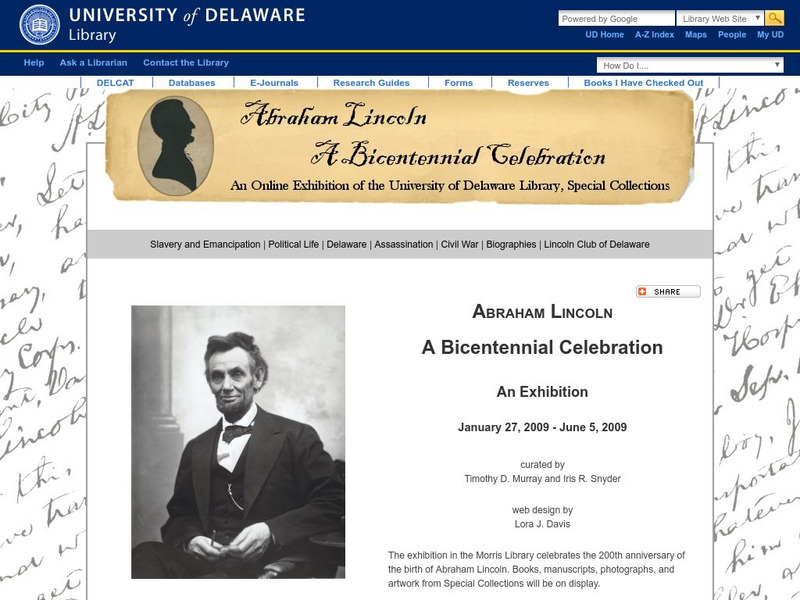
University of Delaware: Abraham Lincoln: A Bicentennial Celebration
Commemorating Abraham Lincoln's 200th birthday, this exhibition provides several documents and photographs remembering the President's life. Resources cover his political career, slavery, the civil war and his assassination.