Hi, what do you want to do?






Center for Learning in Action
Introducing Physical and Chemical Changes
Young scientists investigate chemical and physical changes to the states of matter—gas, liquid, and solid—as well as solutions and suspensions with a variety of demonstrations, grand conversation, and an interactive quiz to check for...

Center for Learning in Action
Investigating Physical and Chemical Changes
Super scientists visit ten stations to predict, observe, and draw conclusions about the physical and chemical changes that occur when different states of matter—liquid, solid, and gas—are placed under a variety of conditions. To...

Mr. E. Science
Chemical Reactions
Once I told a chemistry joke, but there was no reaction. Get young chemists involved in changes and reactions with a presentation that begins with physical and chemical changes and chemical reactions. It moves on to chemical...

Government of South Australia
Don't Waste Your Energy
Don't lift another finger, this physical and environmental science unit has everything you need to begin teaching your class about energy. Starting with a look at the greenhouse effect, these lessons and activities take young scientists...

Mr. E. Science
An Introduction to Matter
What's the matter? Gas, solid, liquid, or plasma. The presentation covers how to describe and identify matter, changes in matter, types of matter, measuring matter, particles of matter, Democritus, and John Dalton's Atomic Theory.

Santa Monica College
Single and Double Displacement Reactions
If you aren't part of the solution, you are part of the precipitate! Young chemists learn about single and double displacement reactions including precipitation reactions, neutralization reactions, and gas forming reactions. They perform...

Serendip
Using Models to Understand Photosynthesis
Is your class in the dark about photosynthesis? Shed some sunlight on an important biological process with a thoughtful activity. After answering questions to help determine their level of knowledge, learners work with chemical equations...

Illinois Valley Community College
STEM Activities for Middle School Students
Use STEM activities within the class to provide connections to concepts. The resource includes activities that range from working with buoyancy to building rockets and launching them. Other activities involve the engineering design...

Royal Society of Chemistry
Equilibria—Gifted and Talented Chemistry
Teaching is a balancing act! Keep things on an even keel with a comprehensive equilibrium lesson plan. The resource covers reversible and irreversible reactions, Le Chatelier's Principle, and the industrial applications of equilibrium...

CCEA
Home Economics: Teen Building
Learners explore the emotional and nutritional needs of teenagers in a six-lesson unit, which covers such topics as food sources, cooking skills, emotional well-being, and the positive effect of food and family occasions.

K12 Reader
Converting Energy to Motion
Combine science and reading skills with a reading comprehension exercise. Kids read four paragraphs about energy conversion and answer some reading comprehension questions about the information they have read.

LABScI
Freezing Point Depression: Why Don’t Oceans Freeze?
Can you go ice fishing in the ocean? Learners examine the freezing point of different saltwater solutions. Each solution has a different concentration of salt. By comparing the freezing points graphically, they make conclusions...
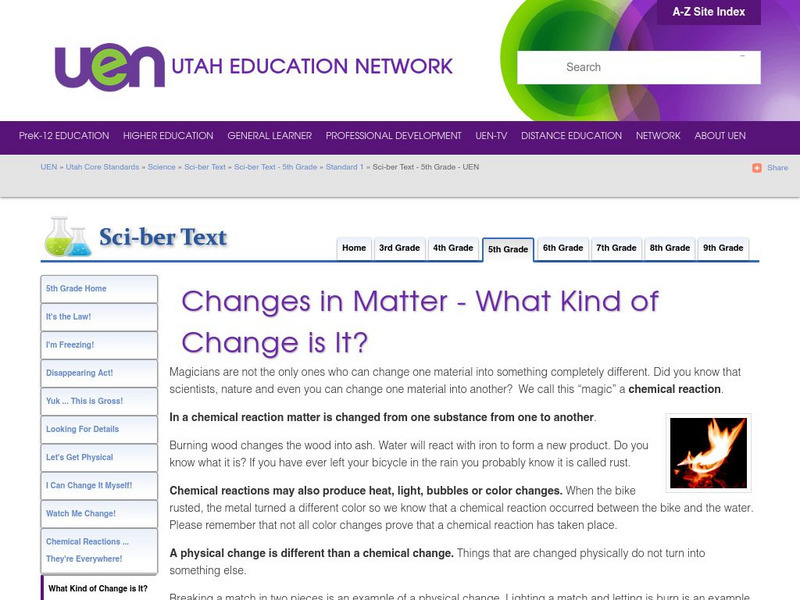
Utah Education Network
Uen: Changes in Matter What Kind of Change Is It?
Can you distinguish physical changes from chemical changes? After reading a brief summary of both types of changes, you'll be presented with some examples and asked to identify them.

Other
Science4 Us: Changes in Matter
Through an instructional video, games, and activities, students explore three types of change matter makes: physical change, in which only the shape of the matter changes; physical phase change in which matter changes to a different form...
American Chemical Society
Middle School Chemistry: Lesson Plans: What Is a Chemical Reaction?
After observing a demonstration of a chemical reaction between a burning candle and the oxygen in the air, young scholars use atom model cut-outs to model the reaction and see that all the atoms in the reactants show up in the products.
CK-12 Foundation
Ck 12: Chemistry Simulation: Camping Chemical and Physical Changes
[Free Registration/Login Required] Explore how heat and temperature relate to phase changes.
E-learning for Kids
E Learning for Kids: Science: Mediterranean Sea: What Are Reversible and Irreversible Changes?
Students will learn about reversible and irreversible changes in materials in this lesson.

E-learning for Kids
E Learning for Kids: Science: Greek Theater: What Are Reversible and Irreversible Changes?
Join Leander in his chemistry lesson, and learn about the change of different types of substances.
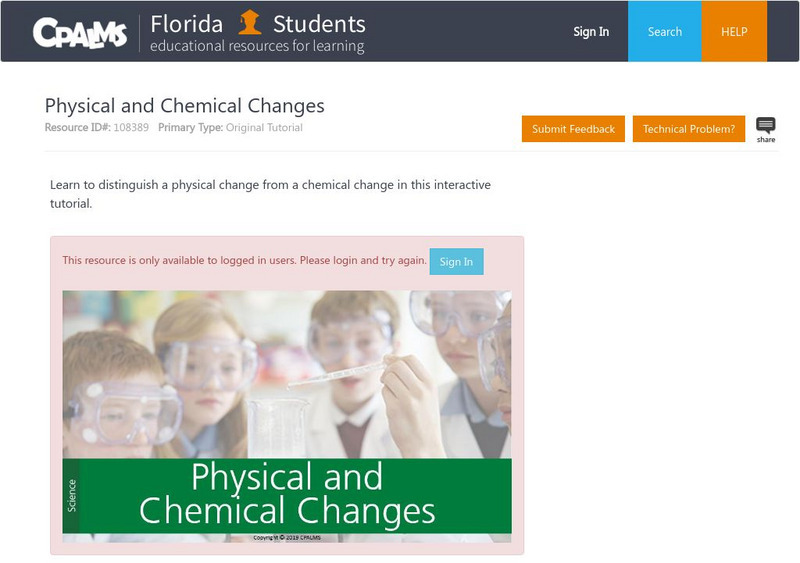
CPALMS
Florida State University Cpalms: Florida Students: Physical and Chemical Changes
Explore the differences between chemical and physical changes, including some examples at the atomic level.
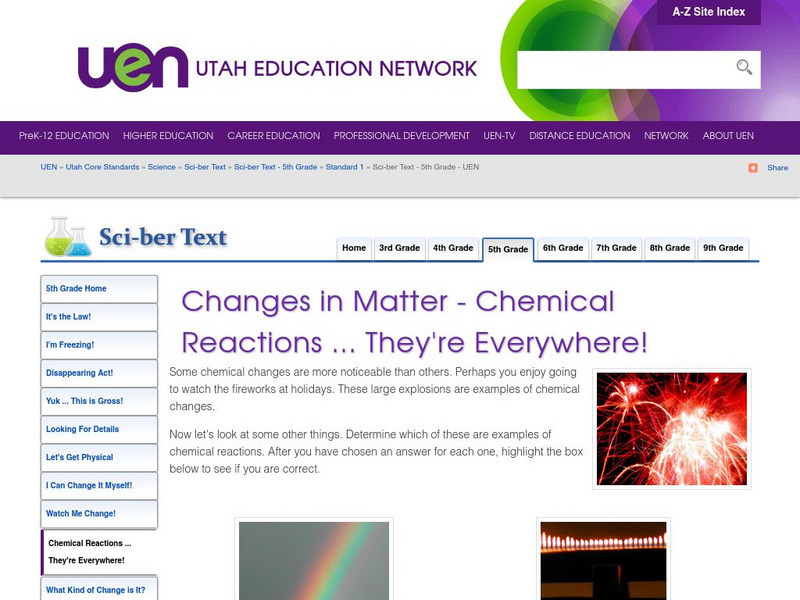
Utah Education Network
Uen: Changes in Matter Chemical Reactions They're Everywhere
Can you distinguish physical changes from chemical reactions? You'll be presented with a number of pictures and asked to identify those which are examples of chemical reactions.
American Chemical Society
Middle School Chemistry: Lesson Plans: Using Chemical Change to Identify Unknown
Students observe reactions of liquids with different known powders in this lesson. Unknown powders are then identified using characteristic chemical changes.Site includes a procedure, teacher instructions, and video instruction.
Texas Education Agency
Texas Gateway: Matter and Energy: Chemical Reactions
Do you know the difference between a physical and a chemical change? This interactive tutorial will explore these concepts!

American Chemical Society
Inquiry in Action: Using Chemical Change to Identify an Unknown
This activity explores how students could use chemical changes to identify unknown substances. Lab activity includes student and teacher worksheets.
American Chemical Society
Middle School Chemistry: Chapter 6: Chemical Change
Twelve interactive chemistry lessons about chemical changes complete with handouts and animations.
Other popular searches
- Physical and Chemical Changes
- Physical Chemical Changes
- Physical/chemical Changes
- Physical & Chemical Changes