Hi, what do you want to do?






Concord Consortium
Non-Bonding
What makes helium so Noble, anyway? Explore the bonding properties of helium versus those of hydrogen using an interactive resource. Science scholars manipulate atoms of each element and observe changes in potential energy as the atoms...

Aquarium of the Pacific
Lego Molecules
Young scientists construct an understanding of molecular compounds in this hands-on science lesson plan. Using LEGO® to model the atoms of different elements, students build molecules based on the chemical formulas of common...

T. Trimpe
Atomic Basics
Get down to basics with these worksheets on the structure of atoms. Challenging young chemists to identify information from the periodic table and create Bohr diagrams and Lewis dot structures for different elements, this...

Concord Consortium
Elements and Polarity
Take a look at some molecules that are so cool, they're polar! Scholars examine the effect polarity has on a molecule's shape and charge. Change up the view and choose between an opaque or transparent molecular surface, complete with...

Royal Society of Chemistry
Shapes of Molecules—Distortion from the Pure Geometry
Ready to introduce the realities of molecular geometry to chemistry pupils? Use a logic-based interactive! Perfect as individual practice, the puzzles explore the bond angles and repulsions present in three common molecular shapes.

Biology Junction
Chemistry Crossword
Scholars complete a crossword puzzle in this chemistry worksheet with 20 questions about chemistry concepts like atoms and chemical reactions.

Royal Society of Chemistry
Electronegativity Values
Finally, an electronegativity resource your class will be strangely drawn to! Skilled scientists manipulate interactive puzzles to gain an understanding of common electronegativity values. The great thing? You can conduct the lesson...

Royal Society of Chemistry
Metals—Gifted and Talented Chemistry
Malleable, magnetic, mesmerizing metals! Pupils love learning about metallic elements, especially through the hands-on activities in an engaging lesson plan. The resource provides thorough instruction on the properties of metals, the...

Rensselaer Polytechnic Institute
Molecules to the Max!—Educators Resource Guide
From molecules to nanotubes, an engaging unit explores the world of tiny science. Fifteen hands-on experiments and lessons engage young scientists as they learn chemistry. Discussions, worksheets, and data analysis reinforce the concepts...

Royal Society of Chemistry
Halide Ion Tests
Young chemists love it when colorful solid products appear in a reaction vessel! Scholars discover the products that form during halide ion tests through a hands-on activity. Users go online and apply chemistry knowledge and reasoning...

Pingry School
Comparing Activities of Selected Metals
Don't overreact! A simple experiment demonstrates chemical reactions as scholars mix chemical solutions and metals in a large well plate. They note all changes to the metals, solutions, precipitate, colors, and more. A full data table...
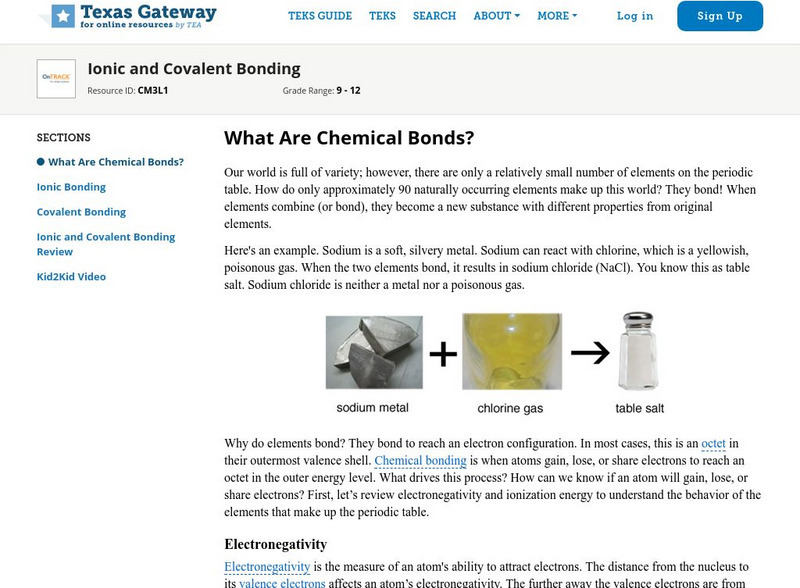
Texas Education Agency
Texas Gateway: Ionic and Covalent Bonding
In this tutorial, students learn about ionic and covalent bonds and predict which elements will form which type of bond. Includes interactive exercises as well as videos.

American Chemical Society
Middle School Chemistry: Chapter 4: The Periodic Table and Bonding
Six middle school chemistry lessons about the periodic table and bonding complete with handouts and animations.
CK-12 Foundation
Ck 12: Physical Science: Covalent Bonding
[Free Registration/Login may be required to access all resource tools.] Definition of covalent bond, the compounds and elements they make up, and why they form.
Ducksters
Ducksters: Chemistry for Kids: Chemical Bonding
Study chemical bonding in chemistry including atoms, valence electrons, ionic and covalent bonding, and how molecules are formed on this site!

Wisc-Online
Wisc Online: Lewis Dot Structures of Covalent Compounds
Short slide show provides basic information about drawing Lewis dot structures for covalent compounds. Starts with anatomy of the atom, and then shows the relationship between atomic particles and the Periodic Table of Elements. Offers...
Museum of Science
The Atom's Family: Mighty Molecules
In this activity, students construct models of molecules using marshmallows and gum drops.

Khan Academy
Khan Academy: Counting Valence Electrons
A short assessment to see if you understand valence electrons in specific elements.