

US House of Representatives
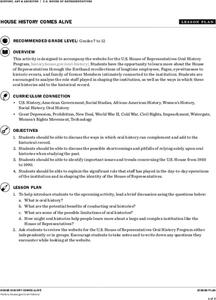
House History Comes Alive
New ReviewHow reliable is oral history? The resource uses the oral history website to help academics understand the pros and cons of using recollections to teach others. Scholars complete a worksheet, draft a letter to a representative, and...

US House of Representatives
The Women of Congress Speak Their Mind
New ReviewA picture may be worth a thousand words, but words can tell many stories. To conclude their study of the women who have served in the US Congress until 2006, groups analyze statements made by these remarkable women.

US House of Representatives
Recent Trends Among Women in Congress, 1977–2006
New ReviewAfter reading the contextual essay, "Assembling, Amplifying, and Ascending: Recent Trends Among Women in Congress 1977–2006," groups select a female senator or representative and research her background and contributions.

US House of Representatives
Women Pioneers on Capital Hill, 1917–1934
New ReviewAs part of a study of the women elected to Congress from 1917 to 1934, groups research and then design a museum exhibit that describes the life and the congressional service of one of these women.

US House of Representatives
Black Americans in Congress Speak Their Mind
New ReviewTo conclude their study of Black Americans in Congress, groups select a statement made by one of the Members, examine the Member's profile on the provided link, and create a display that includes state represented, years of service, an...

US House of Representatives
A Picture is Worth a Thousand Words
New ReviewGroups select a photograph from one of the four eras of African Americans in Congress and develop a five-minute presentation that provides background information about the image as well as its historical significance. The class compares...

US House of Representatives
Objects in Time
New ReviewArtifacts can be used to study people and events of the past. That's the takeaway from the fifth lesson in a unit study of African Americans who served in Congress. Groups select an artifact associated with a Black Congress Member from...

US House of Representatives
Permanent Interests: The Expansion, Organization, and Rising Influence of African Americans in Congress, 1971–2007
New ReviewThe fourth installment of the seven-activity unit focused on African Americans elected to and serving in the US Congress looks at the period from 1971 through 2007. Class members read a contextual essay that provides background...

US House of Representatives
Keeping the Faith: African Americans Return to Congress, 1929–1970
New ReviewThe third lesson in a unit that traces the history of African Americans serving in the US Congress examines the period from 1929 through 1970. After reading a contextual essay that details the few African Americans elected to Congress...

US House of Representatives
“‘The Negroes’ Temporary Farewell,” Jim Crow and the Exclusion of African Americans from Congress, 1887–1929
New ReviewDespite some advances made during the Reconstruction Era following the Civil War, the period from 1887 through 1929, African Americans serving in Congress suffered severe setbacks due to Jim Crow Laws and voter suppression. Class members...

US House of Representatives
“The Fifteenth Amendment in Flesh and Blood,” The Symbolic Generation of Black Americans in Congress, 1870–1887
New ReviewThe reading of a contextual essay launches a study of Black Americans who served in Congress from 1870 through 1887. Young historians identify the African Americans who served during this period, investigate the ways they won national...

Carolina K-12
Battle Behind the Pumps
After considering the role that gasoline plays in our lives and our dependence on it as a society, learners participate in a reading activity discussing why oil prices are increasing. They will then simulate being members of a committee...
Carolina K-12
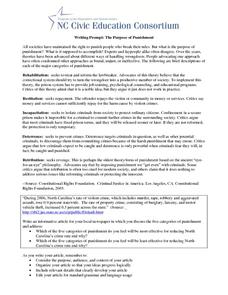
Writing Prompt: The Purpose of Punishment
When punishment is given in a society when a member breaks its rules, what is it meant to accomplish? After summarizing the significant categories of punishment (rehabilitation, restitution, incapacitation, deterrence, and retribution),...

Carolina K-12
Compulsory Voting
Should voting in the United States be compulsory? In 2004, fewer than 60 percent of eligible voters cast ballots in the American national elections. After reviewing arguments for and against compulsory voting, your young citizens will...

Carolina K-12
Marsh v. Chambers and the Establishment Clause
1983 Supreme Court case Marsh v. Chambers, which centers on whether opening a legislative session with a prayer violates the Establishment Clause in the First Amendment to the US Constitution, is the focus of a series of discussions and...
Carolina K-12
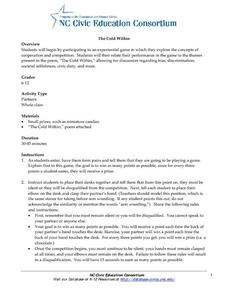
The Cold Within
“. . . one of the great challenges to humanity is acknowledging and overcoming a natural tendency to think less of and discriminate against people who are different from us . . .” Launch an examination of competition and cooperation, of...
Carolina K-12
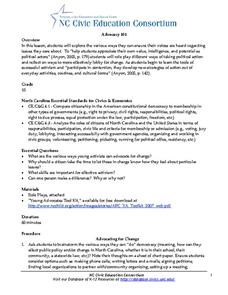
Advocacy 101
Want a change? Become an advocate. As part of a study of the responsibilities of good citizens, class members engage in a series of role plays that model how to lobby for change.
Carolina K-12
The Holocaust: The Art of Memory
Never Forget. As part of a study of the Holocaust, class members watch a PowerPoint about Terezin, read selections from I Never Saw Another Butterfly, Children's Drawings, and Poems from Terezin Concentration Camp, then craft their...

Carolina K-12
“Stealing a Little Freedom”: Slave Runaways in North Carolina
As part of a study of slavery during the US colonial period, class members investigate why enslaved people ran away, the risks inherent in escaping, and the methods used to locate them.

Carolina K-12
Comparing Slave Trades: A Study of the Transatlantic and Trans-Saharan Slave Trades
While most people are familiar with the transatlantic slave trade, there is less knowledge of another major external African slave trade in world history: the trans-Saharan slave trade. Pupils work in groups to read informational texts...

Carolina K-12
NATO: After the Cold War
Why was the North Atlantic Treaty Organization (NATO) formed, and what is its mission? Learners discuss NATO's participation in various events throughout the Cold War and work in groups to analyze whether those responses were appropriate.

North Carolina Civic Education Consortium
The Nineteenth Amendment
Beginning with an exercise of favoritism to engage learners, progressing through image and primary source analysis of the Nineteenth Amendment and the Seneca Falls Declaration, and culminating in a look at a political cartoon called...

Center for Literacy and Disability Studies
Slave Resistance
How did colonial enslaved people in America struggle to defend themselves and maintain their African heritage?

Carolina K-12
An Overview of the Vietnam War
A highly engaging warm-up activity starts this plan for teaching class members about the Vietnam War. After the anticipatory activity, the teacher chooses how to provide an overview of the war (PowerPoint, lecture, textbook, etc.). Next,...