Hi, what do you want to do?






Khan Academy
Khan Academy: Projectile Height Given Time
Video tutorial gives examples showing out how high a ball will get given how long it spends in the air. [8:50]
Khan Academy
Khan Academy: Projectile Motion (Part 2)
Video presents a derivation of a new motion equation. [9:14]
Khan Academy
Khan Academy: Projectile Motion (Part 3)
Video presents an example of solving for the final velocity when you know the change in distance, time, initial velocity, and acceleration. [9:04]
Khan Academy
Khan Academy: Projectile Motion (Part 4)
Video tutorial shows how to solve for time when you are given the change in distance, acceleration, and initial velocity. [8:57]
Khan Academy
Khan Academy: Projectile Motion (Part 5)
Continuing with projectile motion problems, the video shows how to play the game called how fast was the ball that you threw upwards. [9:33]

Khan Academy
Khan Academy: Macrostates and Microstates
An explanation of the differences between macrostates and microstates in regards to thermodynamic equilibrium. [18:30]

Khan Academy
Khan Academy: Calculus: 2011 Calculus Ab Free Response #1A
Video shows how to determine whether the speed of a particle is increasing or decreasing at a given time by using the velocity and acceleration functions and reasoning about the signs of the functions when evaluated at the given time....

Khan Academy
Khan Academy: Calculus: 2011 Calculus Bc Free Response #1A
Video shows how to find the velocity and acceleration vectors of a particle at a given time by using the derivatives of the parametric equations representing the particle. Also shows how to find the magnitude of the velocity vector in...

Sophia Learning
Sophia: Space Sciences: Launch
Created to teach students of the 21st century, SOPHIA is bringing outerspace straight to your fingertips. Become the commander of your own learning experiences as you take part in this interactive tutorial.
Khan Academy
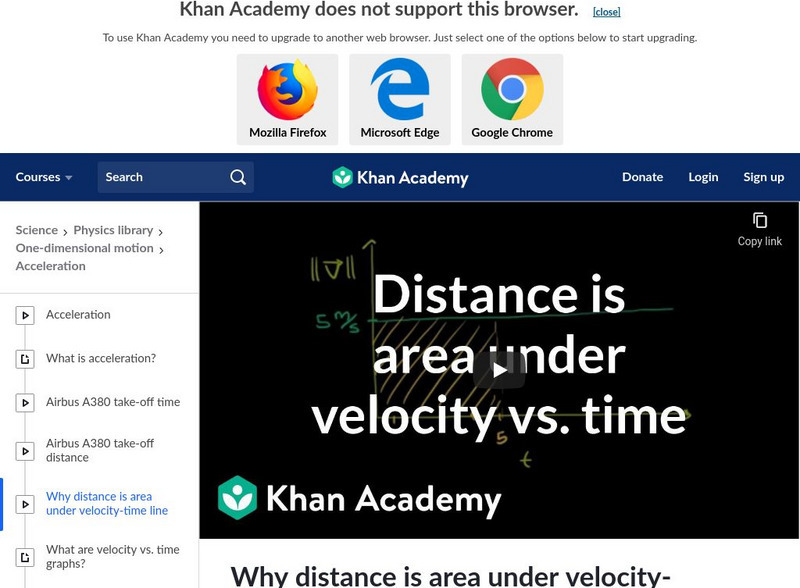
Khan Academy: Distance Is Area Under Velocity Time Line
Video tutorial helps with understanding why distance is area under velocity-time line. [9:25]

Khan Academy
Khan Academy: Projectile Displacement Derivation
Video explores how to derive a formula for maximum projectile displacement as a function of elapsed time. [7:08]
Other
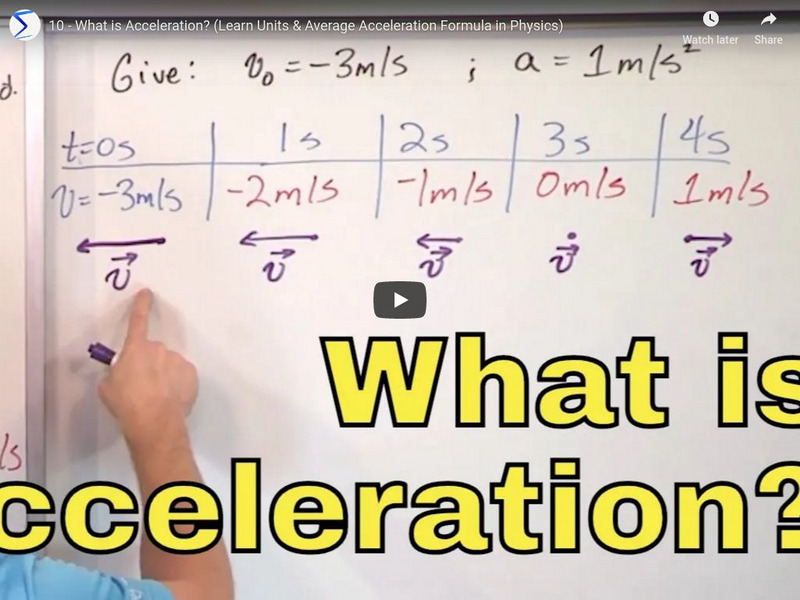
Math Tutor Dvd: What Is Acceleration?
Acceleration is the rate of change of the velocity function. Video tutorial explains the average acceleration formula by means of a conceptual example.

Other
Math Tutor Dvd: Uniform Motion in Physics, Part 1
Watch this video tutorial to learn about the simplest type of motion in physics, uniform motion, in which the acceleration is zero and the velocity during the motion is a constant. [18:24]
Other
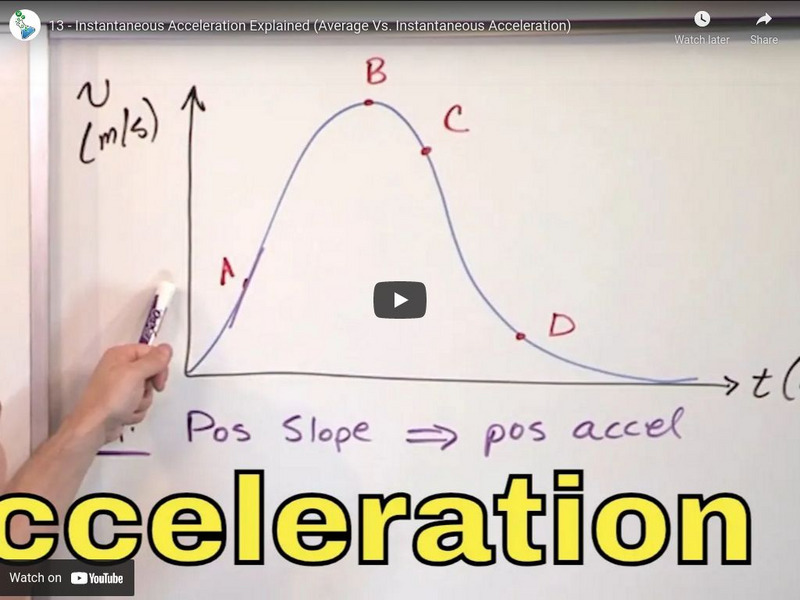
Math Tutor Dvd: Instantaneous Acceleration Explained
Watch this video lesson to learn how instantaneous acceleration compares with average acceleration in physics. [17:48]

Sophia Learning
Sophia: Velocity: Lesson 2
This lesson will introduce the concept of velocity, explaining what it is, how it is calculated, and common units used to represent it. It is 2 of 3 in the series titled "Velocity."

Bozeman Science
Bozeman Science: Motion
Mr. Andersen describes motion as the movement of an object over time. An experiment in motion is used to calculate velocity and acceleration of a tennis ball. [8:46]

Bozeman Science
Bozeman Science: Linear Momentum
In the following video Paul Andersen explains how the linear momentum is equal to the product of the mass of an object and the velocity of the center of mass. He uses video analysis software to calculate the velocity of an object and...

Bozeman Science
Bozeman Science: Force Time Graph
In the following video Paul Andersen explains hot the force-time graph can be used to determine the impulse of an object. Since the impulse and the change in momentum are equivalent the graph can also be used to determine the change in...
Sophia Learning
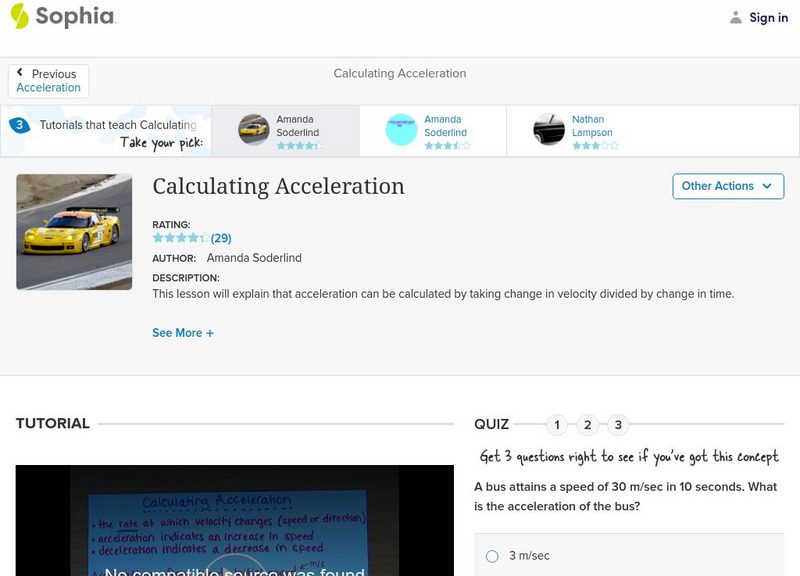
Sophia: Calculating Acceleration: Lesson 3
This lesson will explain that acceleration can be calculated by taking change in velocity divided by change in time. It is 3 of 5 in the series titled "Calculating Acceleration."
Crash Course
Crash Course Physics #1: Motion in a Straight Line
In this Crash Course Physics episode, Dr. Shini Somara introduces us to the ideas of motion in a straight line. She talks about displacement, acceleration, time, velocity, and the definition of acceleration. [10:40]

Planet Nutshell
Planet Nutshell: Centripetal Force
This animated physics video explains what centripetal force is and how it relates to Newton's second law of motion. [1:46]
Bozeman Science
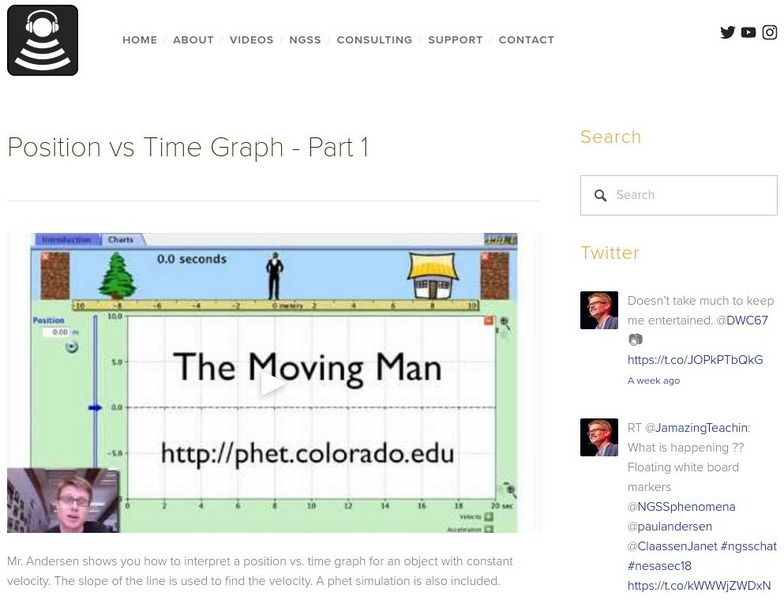
Bozeman Science: Position vs Time Graph Part 1
Mr. Andersen shows you how to interpret a position vs. time graph for an object with constant velocity. The slope of the line is used to find the velocity. A PhET simulation is also included. [12:19]

Crash Course
Crash Course Physics #11: Rotational Motion
Did you know that, at a certain point on a moving wheel, there's no motion? I mean, kind of, it's all relative, right? Prepare to have your mind blown in this video episode of Crash Course Physics where Shini delves into the world of...

Khan Academy
Khan Academy: Unit Conversion: Speed Translation
This video tutorial provides insight on translating speed units from feet per minute to inches per second.