Hi, what do you want to do?






American Museum of Natural History
What Do You Know About Astronomy
Develop an understanding of the universe. Learners answer 10 multiple choice questions about several topics in astronomy. Questions contain information about the age of the universe, gravitational attraction, galaxies, planets and comets...

American Museum of Natural History
What is Astronomy?
Go study the universe. Pupils learn seven aspects about astronomy and astronomers. They begin to learn about constellations; distance and motion between objects; gravity; the electromagnetic spectrum; dark matter and energy; and teams of...

Laboratory for Atmospheric and Space Physics
The Solar Wind Tunnel
The winds of change are blowing in our very own solar system! But what makes some heavenly bodies more affected by solar winds than others? Pupils discover the concept of magnetic forces at work in space in this...

American Museum of Natural History
Planetary Mysteries
A website all about planetary mysteries—it's a one-stop-shop for all things, stars, planets, and space travel. Scholars read an astronomy overview to discover the page's big ideas, then choose from the plethora of resources, including...

American Museum of Natural History
What's This? Life at the Limits
There are some amazing ways species evolve to survive. From large ears to sneezing salt, learners read about these interesting adaptations in an interactive lesson. Great to supplement an in-class lesson, it also works well as a remote...

Curated OER
Sunspots and the Sun's Rotation
In this sun worksheet, students use a Sunspotter to observe the rotation of the sun by identifying the presence of sunspots and watching them rotate over time. Students calculate how many days it takes to see the sunspots they observe in...

Curated OER
Safety Grounding
In this grounding activity, students answer 12 questions about electrical power systems, the importance of grounding and electric shock.

Curated OER
Ecology Vocabulary Exercise: Wetlands
In this ecology vocabulary exercise: wetlands worksheet, students read the definitions of 8 words, then categorize a species found in a wetland in their region. This page has numerous links to helpful web resources.

Curated OER
Classification of Life
In this classification of life activity, students use an on line source to answer questions about how species are classified, named and grouped. They give the classification of a bear, an orchid and a sea cucumber.

Curated OER
Ecology Vocabulary
In this ecology worksheet, learners read the vocabulary words and then categorize a species found in a field, meadow, or fencerow in their state or region. Students complete 6 problems.

Curated OER
Galileo Galilei Questions for Study
In this online interactive philosophy worksheet, students respond to 10 short answer and essay questions about Galileo's contributions to science.

Curated OER
Bluebirds Ecology Vocabulary Exercise
In this bluebirds worksheet, students categorize bluebird species found in their state and define vocabulary related to it. Students complete 6 vocabulary words.

Curated OER
Easter: Reading Comprehension
In this Easter comprehension worksheet, students read 5 short paragraphs about Easter, then answer a set of 8 multiple choice questions. Worksheet labeled ESL, but not exclusive.

American Museum of Natural History
American Museum of Natural History: Ology: Astronomy: In Pictures: Beyond Planet Earth
What would it be like to travel across the solar system and explore space? Take a look at some of the places that humans might go to someday, and the questions that scientists are asking.
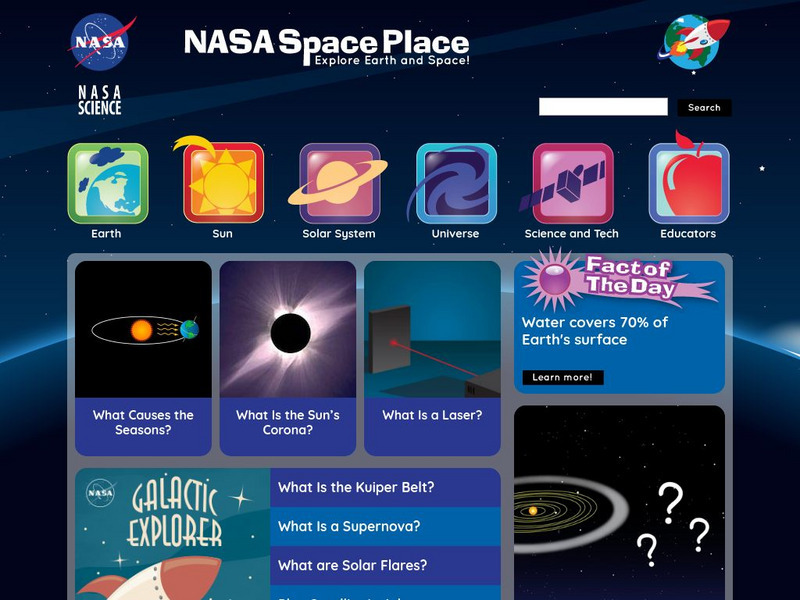
NASA
Nasa: The Space Place
This site from the National Aeronautics and Space Administration allows students to explore topics related to planet earth and outer space. A number of games and interactive features are available.
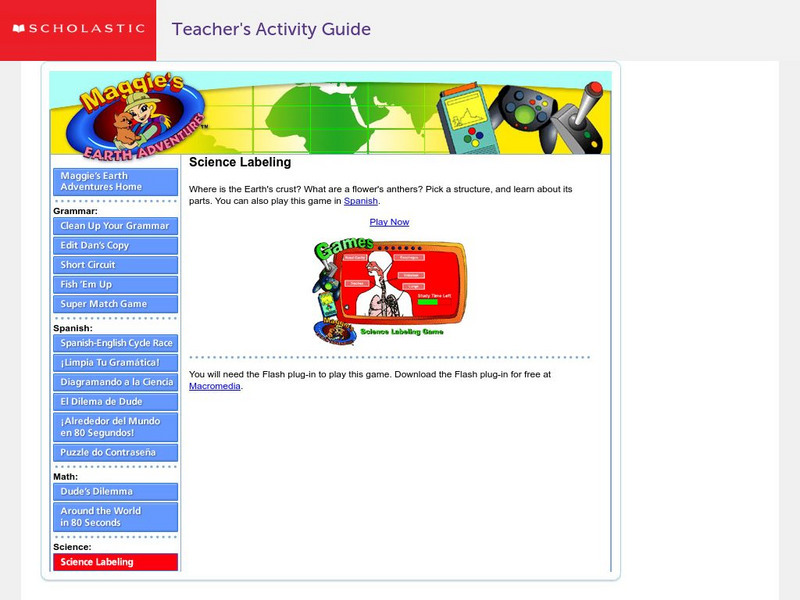
Scholastic
Scholastic: Science Labelling Game
In a series of five interactive science games, students first study labeled diagrams to learn the names of the Earth's layers, of a flower's parts, of a fish's anatomy, of the human respiratory system, and of layers of the atmosphere....