Hi, what do you want to do?






Safe Drinking Water Foundation
Types of Water Pollution
In groups, young environmentalists investigate water samples that are contaminated with different types of pollutants. Each group presents their findings to the class and fills out the "Types of Pollutants Chart." This lesson plan is...

National Institute of Food and Agriculture
Water Pollution Demonstration
Water pollution is everywhere, and pollutants range from oil to fertilizers. Bring the concept to life by demonstrating the difficulties in getting particular pollutants out of water.

University of Florida
Protecting Our Water Resources
Teach young environmentalists to protect their planet's resources with a set of interactive experiments. Kindergartners and other youngsters learn about watersheds and the water cycle, while older elementary learners focus on fertilizer...

US Environmental Protection Agency
Water Purification by Evaporation and Condensation
This easy-to-perform demonstration shows students how the water cycle, specifically the processes of condensation and evaporation, purifies Earth's water supply. Just mix up some water, dirt, and gravel in a glass bowl, place a cup in...

US Environmental Protection Agency
Aquifer in a Cup
Young scientists create their very own aquifers in this science lesson on ground water. After learning about how some people get their drinking water from underground wells, young learners use sand, modeling clay, and aquarium rocks to...

DiscoverE
Build a Watershed
What's the best way to learn how watersheds work? Build one! Combining engineering, the water cycle, and ecology concerns, the activity is the perfect fit for an interdisciplinary unit. Teams construct a model watershed with simple...

US Department of Energy
Solar Distiller
Explore the sun's ability to distill contaminated water with this simple set of classroom experiments. After filling two glass bowls, one with muddy water and the other with salt water, they are covered with plastic wrap and placed...

US Environmental Protection Agency
Building an Model Aquifer
With almost half of Americans relying on groundwater supplies, it is more important than ever to protect aquifers from possible contaminants. Working in small groups, young environmentalists explore this problem as they create an aquifer...

US Environmental Protection Agency
A Mock Town Meeting on a Proposed Tank Farm
Intended as a follow up to the Protecting Your Drinking Water activity, young environmentalists use their assessment of the a hypothetical town's water supply to debate the installation of underground chemical storage tanks. With...

Teach Engineering
Microbes Know How to Work!
Scholars harness the power of microbes with an engaging activity that uses yeast to break down sugar in water. Multiple setups of the same experiment lets learners determine which temperature results in the fastest rate of...

Curated OER
Rain Garden
High schoolers build rain gardens. In this community service lesson, students study the effectiveness of rain gardens in allowing water to run off. High schoolers build a community rain garden at their school.

Teach Engineering
Chromatography Lab
Groups use alcohol and chromatography paper to separate the color components of black ink. The purpose of the activity is to allow the class to become aware that mixtures exist in hidden places.

Teach Engineering
Optimize! Cleaner Energy Options for Rural China
What are the trade-offs when looking to get the most benefit from an energy source? Small groups compare the cost-to-emission levels of several energy sources by looking at the information graphically. The groups utilize this...

NOAA
Make an Edible Coral Reef
Coral reefs are full of an abundance of life and color. Why not celebrate it with an edible coral reef? Learners and teachers alike use cake, icing, and candies to create a tasty version of a coral reef that's complete with colors,...
TeachEngineering
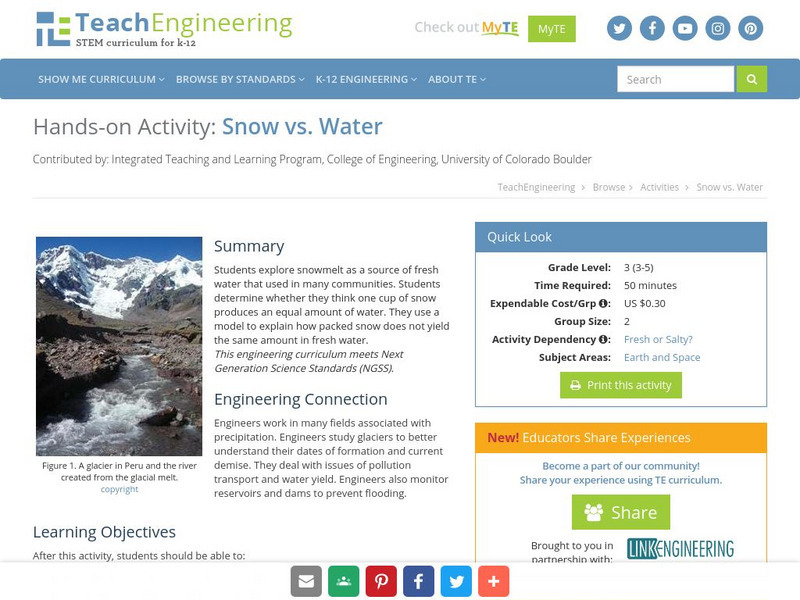
Teach Engineering: Snow vs. Water
Engineers work in many fields associated with precipitation. Engineers study glaciers to better understand their dates of formation and current demise. They deal with issues of pollution transport and water yield, and they monitor...

Read Works
Read Works: Ryan's Well
[Free Registration/Login Required] Students read about 15-year-old Ryan Hreljac who created a foundation that has raised over $1.5 million to build wells in Africa. A question sheet is available to help students build skills in comparing...
TeachEngineering
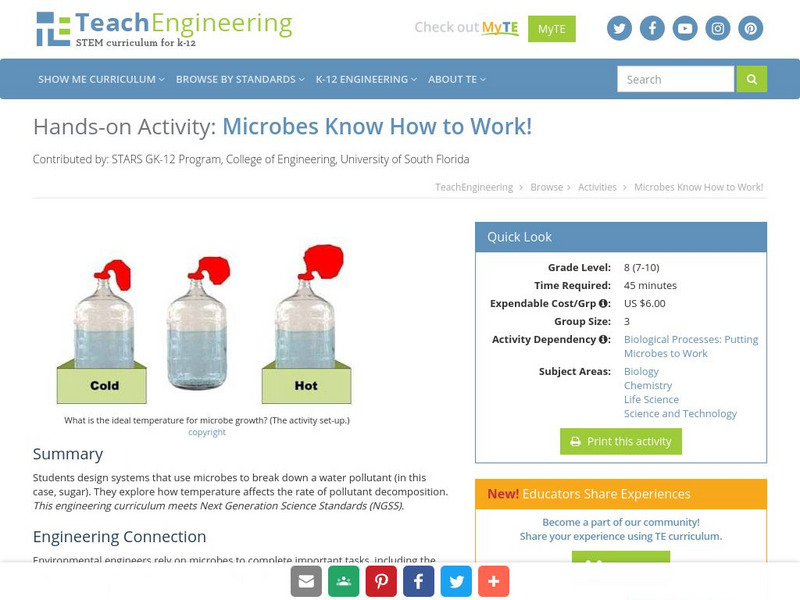
Teach Engineering: Microbes Know How to Work!
Students design systems that use microbes to break down a water pollutant (in this case, sugar). They explore how temperature affects the rate of pollutant decomposition.
Read Works
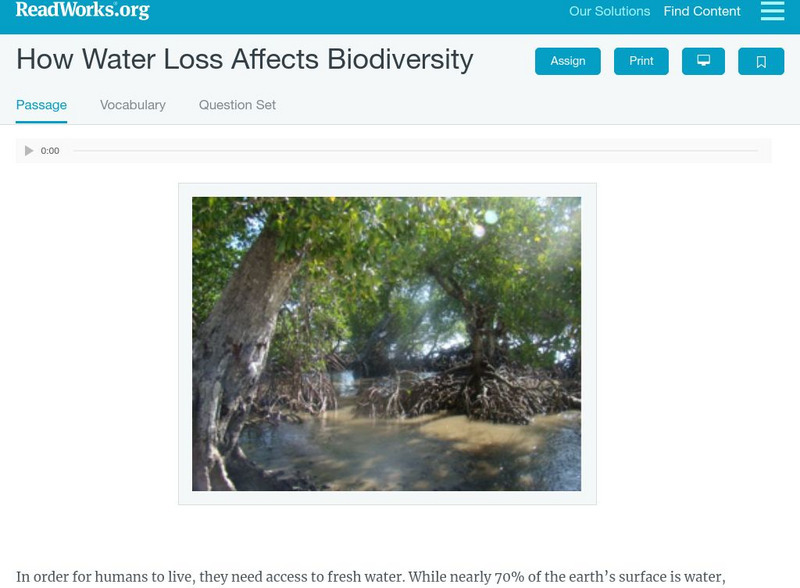
Read Works: How Water Loss Affects Biodiversity
[Free Registration/Login Required] Students read about how varying amounts of fresh water can affect biodiversity in a region. A question sheet is available to help students build skills in reading comprehension.
TeachEngineering
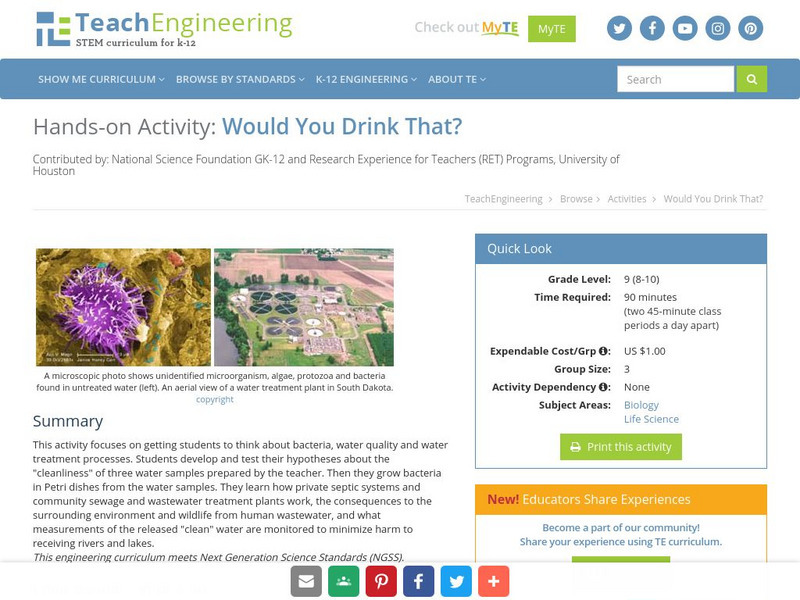
Teach Engineering: Would You Drink That?
This activity focuses on getting students to think about bacteria, water quality and water treatment processes. Students develop and test their hypotheses about the "cleanliness" of three water samples prepared by the teacher. Then they...
Read Works
Read Works: Dead Zone
[Free Registration/Login Required] Students read about the "dead zone," an area in the Guld of Mexico where no fish can live due to pollution from fertilizer. A question sheet is available to help students build skills in cause and effect.
TeachEngineering
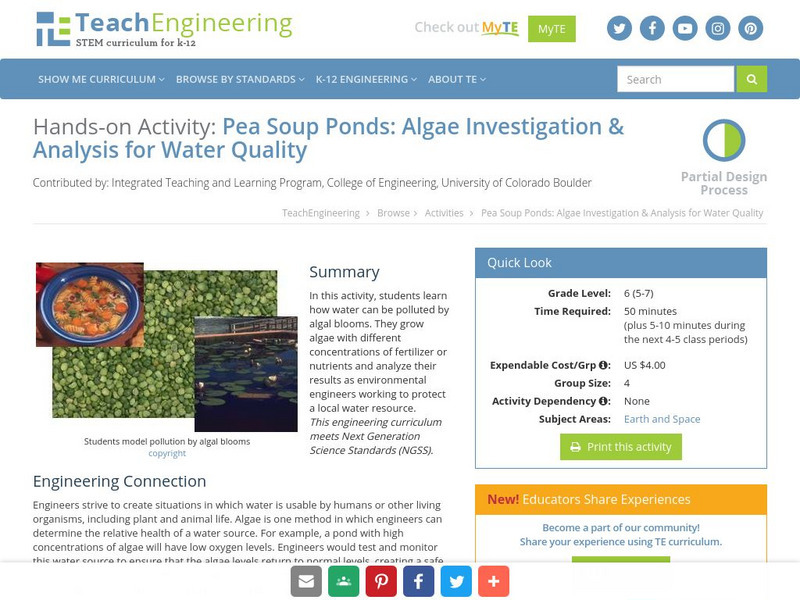
Teach Engineering: Pea Soup Ponds
In this activity, students will learn how water can be polluted by algal blooms. They will grow algae with different concentrations of fertilizer or nutrients and analyze their results as environmental engineers working to protect a...
![Coalition of Oregon School Administrators (Cosa): Microbeads, Mega Problem [Pdf] Activity](https://static.lp.lexp.cloud/images/attachment_defaults/resource/large/FPO-knovation.png "Coalition of Oregon School Administrators (Cosa): Microbeads, Mega Problem [Pdf] Activity")
Other
Coalition of Oregon School Administrators (Cosa): Microbeads, Mega Problem [Pdf]
A textbook activity where students work in teams to design a device or technique that will prevent plastic microbeads from entering local lakes and streams. They will use the engineering process to design a solution and then present...
TeachEngineering
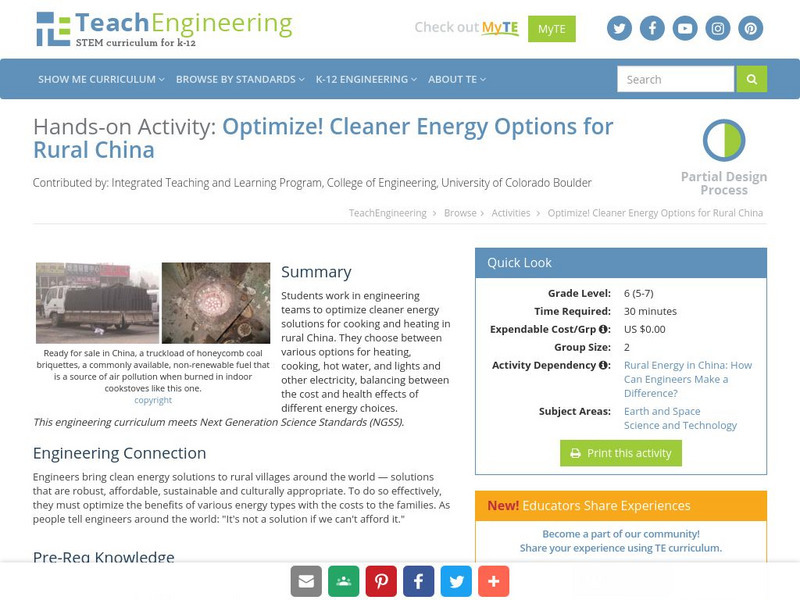
Teach Engineering: Optimize! Cleaner Energy Options for Rural China
Students work in engineering teams to optimize cleaner energy solutions for cooking and heating in rural China. They choose between various options for heating, cooking, hot water, and lights and other electricity, balancing between the...
Read Works
Read Works: A Day to Celebrate Earth
[Free Registration/Login Required] Students read about Earth Day and ways students can help the Earth. A question sheet is available to help students build skills in author's purpose.