Hi, what do you want to do?






NASA
The Electromagnetic Spectrum
Did you realize the visible light spectrum is less than three percent of the electromagnetic spectrum? A hands-onlesson includes five activities and experiments for scholars to explore and discover many advanced science concepts. They...

Intel
Help Wanted! Physicist
Groups discover physics as they take an assigned scenario, perform research about different aspects of the subject matter, and present their findings to the class. From the presentations, learners must develop and support a point of view...

Columbus City Schools
Earthly Waves
How did scientists discover what lies beneath the earth's surface? Dig a hole? X-ray vision? Guide your class through the types of seismic waves and how these waves helped shed light on Earth's many layers. The included resources provide...

Columbus City Schools
Making Waves
Learning about waves can have its ups and downs, but a demo-packed tool kit has the class "standing" for more! Learners gain experience with several different wave types, organizing observations and data, and wave...

Curated OER
Geometrical Optics: Reflection and Refraction of Light
Students define and discus the concepts of wave fronts and rays. In groups, they distinguish between specular and diffuse reflections and use Snell's Law to predict the path of light rays. They calculate the speed of light through...
University of New South Wales (Australia)
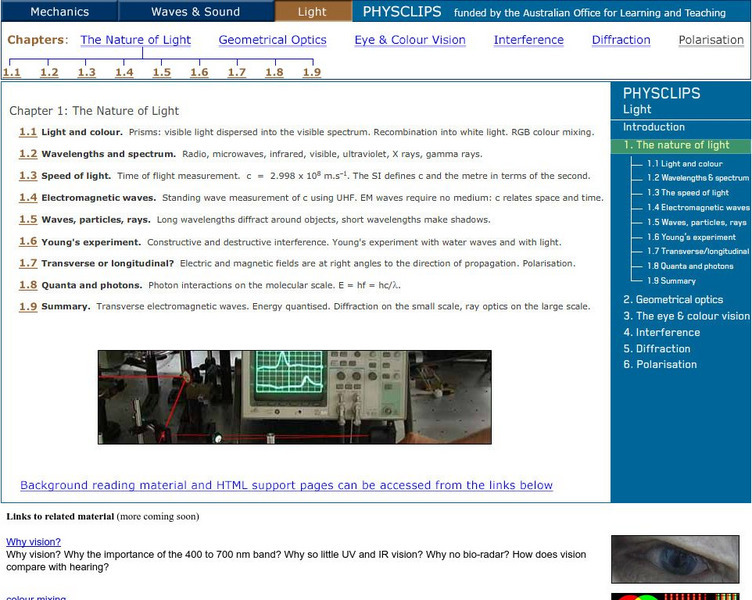
University of New South Wales: School of Physics: Physclips:the Nature of Light
Physiclips thoroughly presents mechanics concepts about light with animations and film clips. Learn about light and color, wavelengths, speed of light, electromagnetic waves, Young's experiment, and photons.
CK-12 Foundation
Ck 12: The Quantum Mechanical Model
[Free Registration/Login may be required to access all resource tools.] In the following online tutorial students will calculate the wavelength, frequency, and energy of light using Planck's constant and the speed of light. They will...
BBC
Bbc: Gcse Bitesize: General Properties of Waves
Light travels as waves. Waves can be described by their amplitude, wavelength and frequency. The speed of a wave can be calculated from its frequency and wavelength.

Physics Classroom
The Physics Classroom: Optical Density and Light Speed
A tutorial page explaining how the speed of light is dependent upon the optical density of the material through which it moves. Optical density is related to the index of refraction; sample values are given.
TED Talks
Ted: Ted Ed: The Fundamentals of Space Time: Part 2
In this second installment of a three-part series on space-time, CERN scientists Andrew Pontzen and Tom Whyntie use a space-time diagram to analyze the sometimes confounding motion of light. [4:50]
CK-12 Foundation
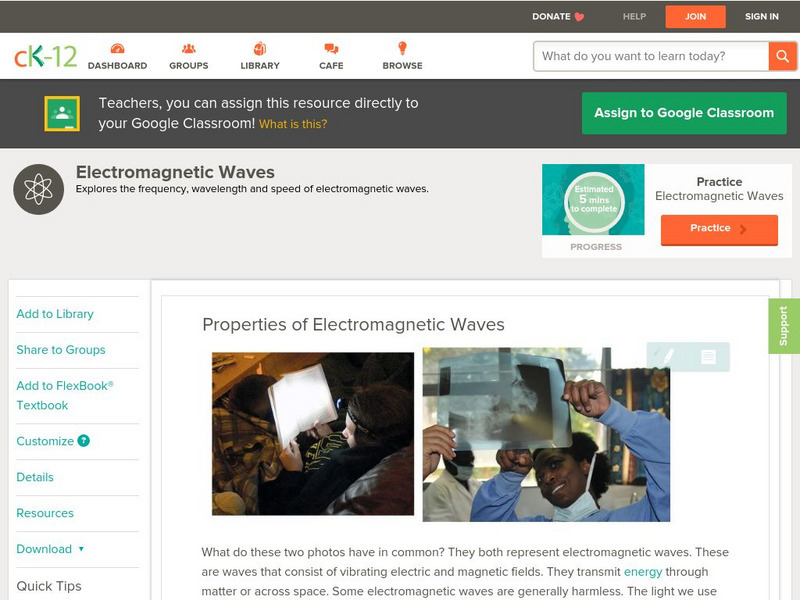
Ck 12: Physical Science: Properties of Electromagnetic Waves
[Free Registration/Login may be required to access all resource tools.] The speed of electromagnetic waves, their wavelengths and frequencies and how to calculate wavelength or wave frequency.
CK-12 Foundation
Ck 12: Physical Science: Refraction of Light
[Free Registration/Login may be required to access all resource tools.] Discusses refraction of light in matter and how light changes its speed and angle of refraction according to the type of medium it is travelling through.
University of New South Wales (Australia)
University of New South Wales: Einstein Light
Einstein Light highlights the Theory of Special Relativity and related topics. Learn how Galileo, Maxwell, and Einstein contributed to our knowledge of relativity, electricity, magnetism, and time by watching fun, interactive modules.
CK-12 Foundation
Ck 12: Light
[Free Registration/Login may be required to access all resource tools.] In the following tutorial students will describe the relationships between speed, wavelength, and frequency of light. They will understand the photoelectric effect...
CK-12 Foundation
Ck 12: Wave Speed Calculations
[Free Registration/Login may be required to access all resource tools.] Students investigate and analyze characteristics of waves, including velocity, and calculate the relationship between wave speed, frequency, and wavelength.
TED Talks
Ted: Ted Ed: How Simple Ideas Lead to Scientific Discoveries
Educator, Adam Savage, shares two astounding examples of profound scientific discoveries that came from simple, creative procedures: Eratosthenes' calculation of the Earth's circumference and Hippolyte Fizeau's measurement of the speed...
Synopsys
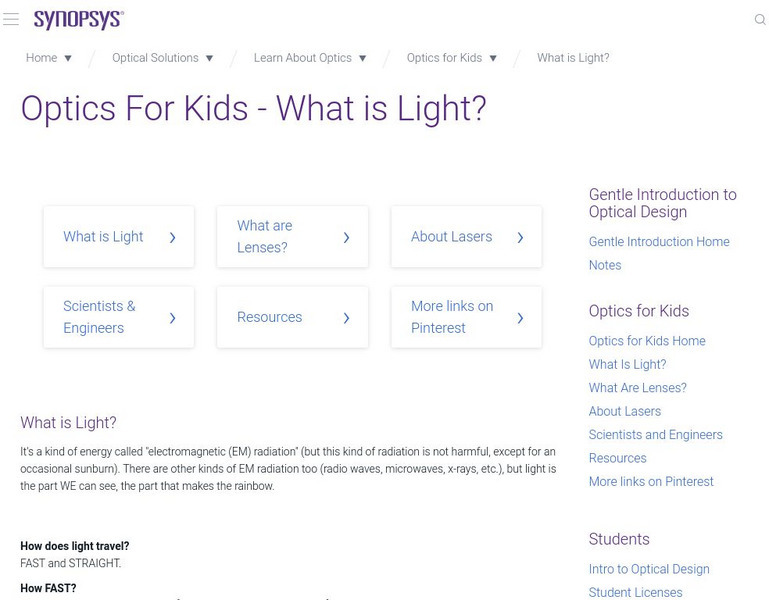
Synopsys: Optics for Kids: What Is Light?
This site provides a short explanation of light, how it travels, and the speed in which it travels. Many other concepts related to optics can be found on this site as well.
Texas Education Agency
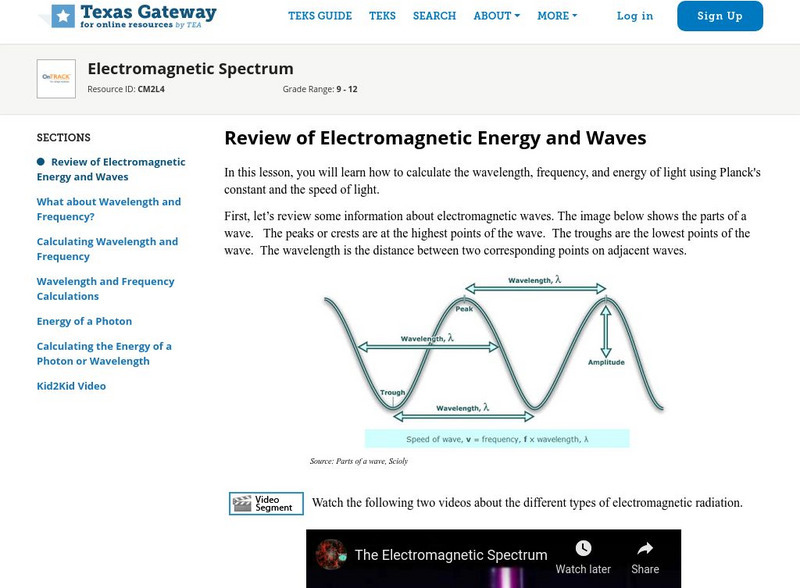
Texas Gateway: Electromagnetic Spectrum
This tutorial explores using Planck's constant and the speed of light to calculate the wavelength, frequency, and energy of light.
TED Talks
Ted: Ted Ed: Sunlight Is Way Older Than You Think
It takes light a zippy eight minutes to reach Earth from the surface of the Sun. But how long does it take that same light to travel from the Sun's core to its surface? Oddly enough, the answer is many thousands of years. Sten Odenwald...
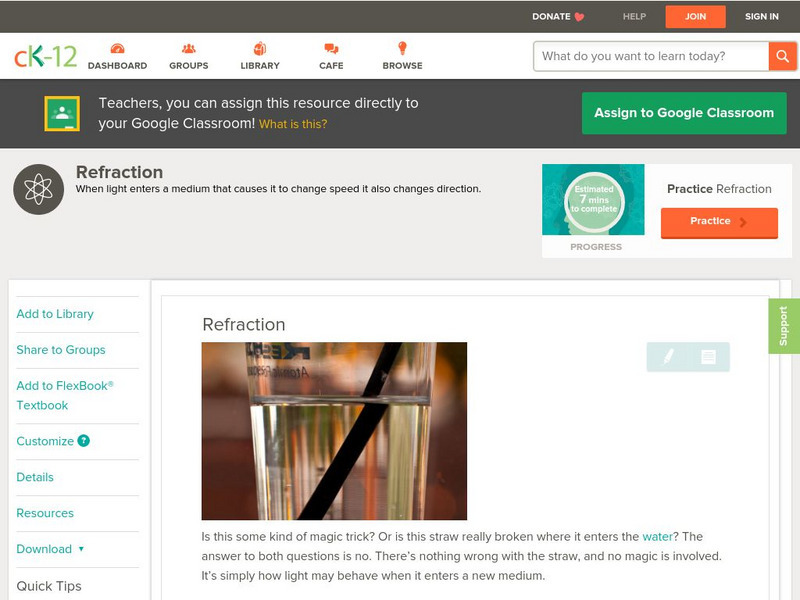
CK-12 Foundation
Ck 12: Physical Science: Refraction
[Free Registration/Login may be required to access all resource tools.] Refraction of light in matter and how light changes its speed and angle of refraction according to the type of medium it is travelling through.
TED Talks
Ted: Ted Ed: What Are Gravitational Waves?
In September 2015, scientists witnessed something never seen before: two black holes colliding. Both about 30 times as big as our Sun, they had been orbiting each other for millions of years. A fraction of a second before the crash, they...
TED Talks
Ted: Ted Ed: Praseodymium: Periodic Table of Videos
The team at Periodicvideos has created a TED-Ed Lesson for every element of the periodic table. This one is about praseodymium, an element used to filter harmful light. Praseodymium has even helped slow light's speed down to a mere 300...
TED Talks
Ted: Ted Ed: How to Take a Great Picture
For manual photography, the aperture, shutter speed, and ISO sensitivity can all be manipulated to get just the right amount of light. Carolina Molinari suggests the best exposure for an action photo, a stunning portrait, or a nighttime...

TED Talks
Ted: Ted Ed: How False News Can Spread
In previous decades, most news with global reach came from several major newspapers and networks with the resources to gather information directly. The speed with which information spreads now, however, has created the ideal conditions...