Hi, what do you want to do?






Kenan Fellows
Unit 2: DNA Analysis
Ever wonder how they solve those mysterious murders in TV crime dramas? The second of four units in a Biotechnology series introduces scholars to the many methods of DNA analysis. Pupils create and run their own gel electrophoresis...

Steinhardt Apps
Kinetic Molecular Theory
Building off young chemists' knowledge of the states of matter, kinetic molecular theory is the focus of the unit. Eight days of lessons including multiple demonstrations, one lab experiment, directed instruction, and worksheets,...

Curated OER
The Brain’s Inner Workings
Do you want to learn about how you learn? Help pupils become the best learners they can be by teaching them how their brain works. The resources available include videos about brain structure and a study guide full of activities that...

CCEA
Home Economics: Teen Building
Learners explore the emotional and nutritional needs of teenagers in a six-lesson unit, which covers such topics as food sources, cooking skills, emotional well-being, and the positive effect of food and family occasions.
CK-12 Foundation
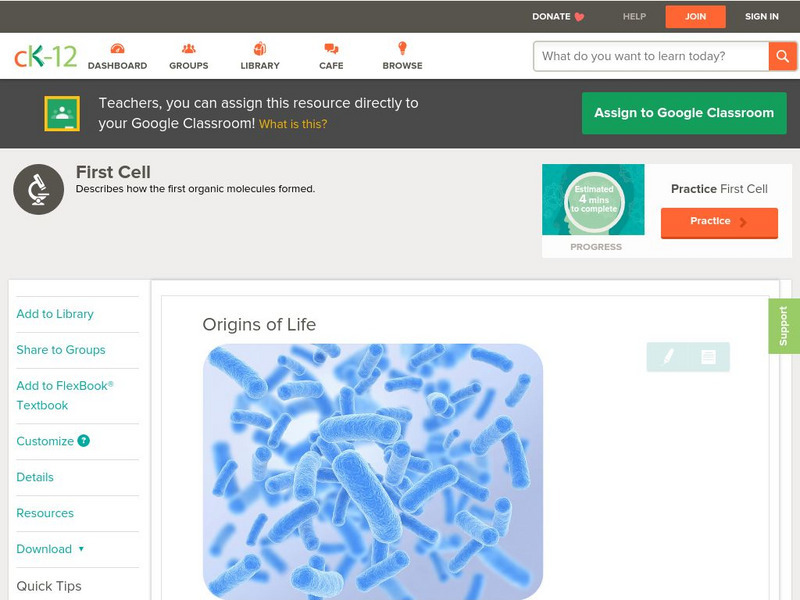
Ck 12: Life Science: Origins of Life
[Free Registration/Login may be required to access all resource tools.] There is good evidence that life has probably existed on Earth for most of Earth's history. Fossils of blue-green algae found in Australia are the oldest fossils of...

Georgia Department of Education
Ga Virtual Learning: Ap Biology: Chemistry of Life
Through informational text, interactive activities, animations, and video clips, students examine the chemistry of living things, and they learn how interactions from atoms are fundamental to life as we know it.
Concord Consortium
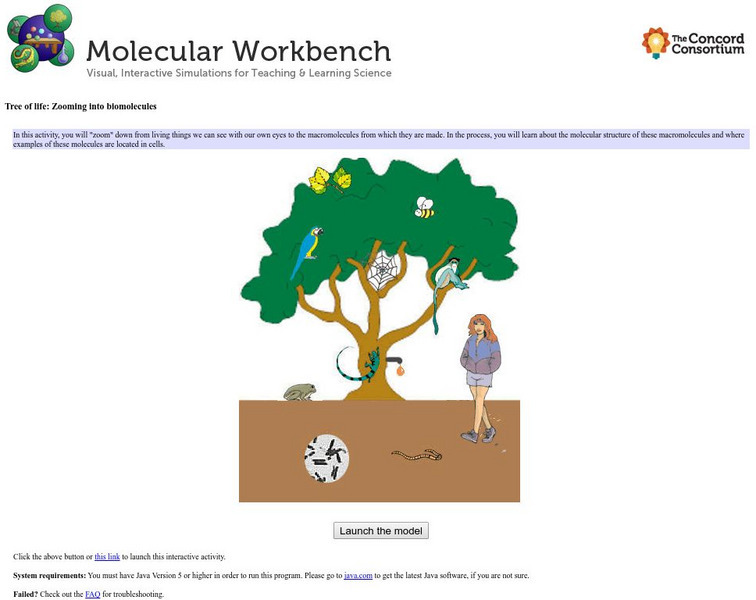
Concord Consortium: Molecular Workbench Showcase: The Tree of Life's Molecules
Explore macromolecules and the smaller molecules that make up living organisms in this module.

University of Utah
University of Utah: Learn Genetics: Bringing Rna Into View
What molecules were involved in the origin of life? This series explores the roles of RNA, DNA, and protein. Special attention is given to RNA because of its ability to perform several tasks necessary for life processes. All of the...

Cold Spring Harbor Laboratory
Dna Interactive: Genome
This site is provided for by DNA Interactive. The genome is the entire endowment of genetic information. It is the "Book of life," on an organism. This site demonstrates the methods used to map and sequence the human genome and to...
CK-12 Foundation
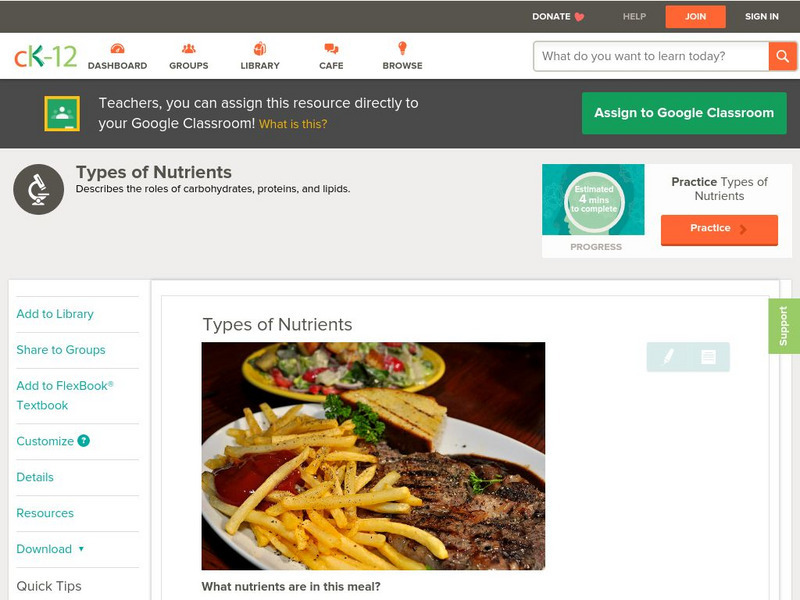
Ck 12: Life Science: Types of Nutrients
[Free Registration/Login may be required to access all resource tools.] Carbohydrates, proteins, and lipids contain energy. When your body digests food, it breaks down the molecules of these nutrients. This releases the energy so your...

NBC
Nbc Learn: Chemistry of Water
This video/lesson series explains how the structure and behavior of H2O in liquid form gives water its properties, and make it a chemical essential for life. Also in this collection: a Victorian-era depiction of the water molecule; news...

CK-12 Foundation
Ck 12: Life Science: Enzymes in the Digestive System
[Free Registration/Login may be required to access all resource tools.] Chemical digestion could not take place without the help of digestive enzymes. An enzyme is a protein that speeds up chemical reactions in the body. Digestive...
CK-12 Foundation
Ck 12: Life Science: Transcription of Dna to Rna
[Free Registration/Login may be required to access all resource tools.] DNA is located in the nucleus. Proteins are made on ribosomes in the cytoplasm. Remember that information in a gene is converted into mRNA, which carries the...
CK-12 Foundation
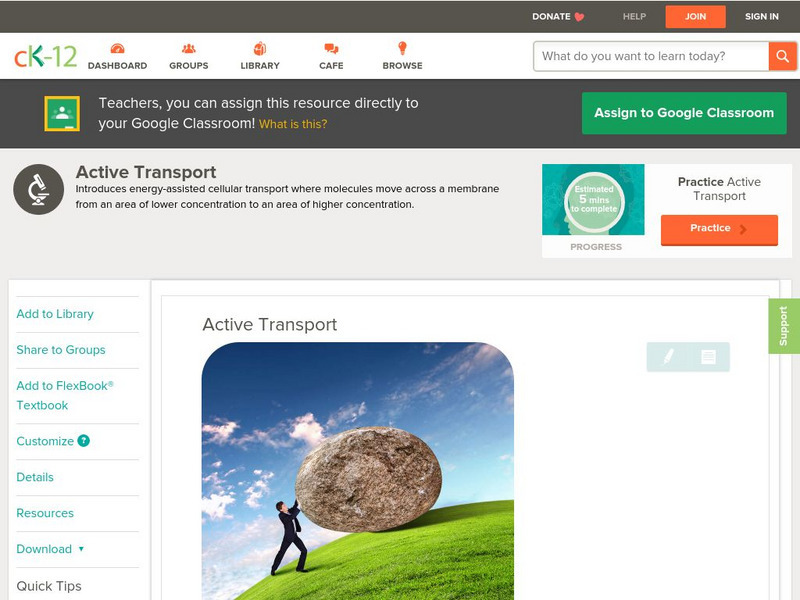
Ck 12: Life Science: Active Transport
[Free Registration/Login may be required to access all resource tools.] During active transport, molecules move from an area of low concentration to an area of high concentration. This is the opposite of diffusion, and these molecules...
CK-12 Foundation
Ck 12: Biology: Water and Life
[Free Registration/Login may be required to access all resource tools.] Covers the structure and properties of water.
CK-12 Foundation
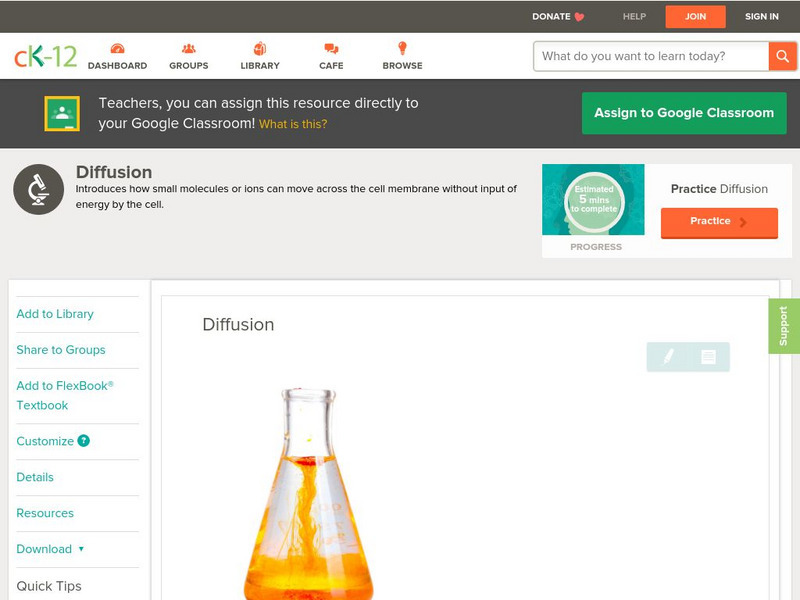
Ck 12: Life Science: Diffusion
[Free Registration/Login may be required to access all resource tools.] The process of molecules moving from an area where there are lots of molecules to an area where there are fewer molecules is known as diffusion. The diffusion of...
CK-12 Foundation
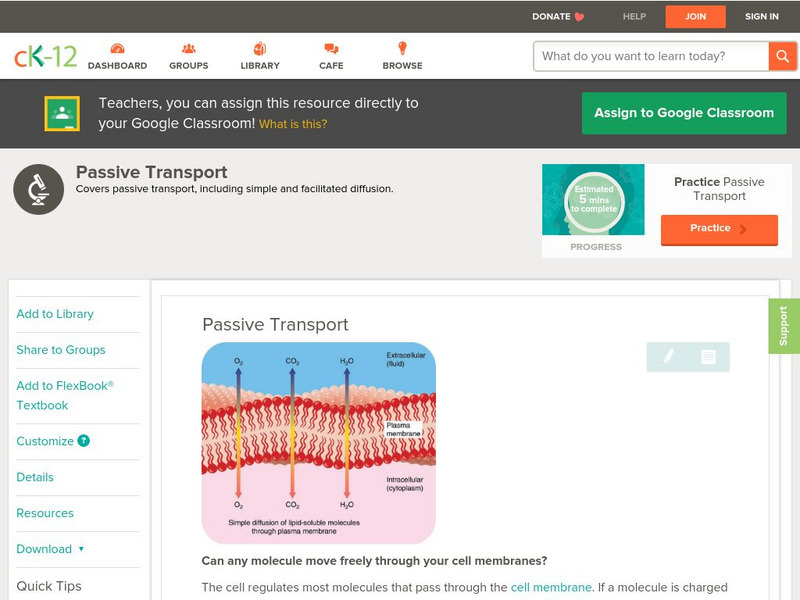
Ck 12: Life Science: Passive Transport
[Free Registration/Login may be required to access all resource tools.] The cell membrane is semi-permeable. Sometimes molecules need the help of special transport proteins or an input of energy to help them move across it. When an input...
CK-12 Foundation
Ck 12: Life Science: Dna Structure and Replication
[Free Registration/Login may be required to access all resource tools.] DNA must replicate (copy) itself so that each resulting cell after mitosis and cell division has the same DNA as the parent cell. DNA replication occurs during the S...
CK-12 Foundation
Ck 12: Biology: First Organic Molecules
[Free Registration/Login may be required to access all resource tools.] Examines how the first organic molecules were formed.
Sophia Learning
Sophia: 8 Levels of Organization: Lesson 2
This lesson will show the 8 levels of organization in living organisms, ranging from smallest to largest. It is 2 of 4 in the series titled "8 Levels of Organization."
Sophia Learning
Sophia: 8 Levels of Organization: Lesson 4
This lesson will show the 8 levels of organization in living organisms, ranging from smallest to largest. It is 4 of 4 in the series titled "8 Levels of Organization."
CK-12 Foundation
Ck 12: Life Science: Carbon Cycle
[Free Registration/Login may be required to access all resource tools.] Carbon is one of the most common elements found in living organisms. Chains of carbon molecules form the backbones of many molecules, such as carbohydrates,...

CK-12 Foundation
Ck 12: Life Science: Organic Compounds
[Free Registration/Login may be required to access all resource tools.] The main chemical components of living organisms are known as organic compounds and are built around the element carbon. Living things are made up of very large...
Concord Consortium
How Are Interactions With Water Important for Maintaining My Life?
An investigation of how polar and nonpolar interactions affect shapes of biological molecules and their function. Modules explore the following: 1. Why don't oil and water mix? 2. Can a substance dissolve in both a nonpolar and a polar...