Hi, what do you want to do?






Texas State Energy Conservation Office
Investigation: Gas Laws in Action - Propane
Using helium as an example of propane, physical science middle schoolers experiment with and graph the relationship between temperature and volume in gases. In a whole-class demonstration, they show how molecules behave under different...

Teach Engineering
Cartesian Diver
Amaze your scholars with an activity that uses a Cartesian diver to demonstrate Pascal's Law, Archimedes' Principle, and the Ideal Gas Law. Groups then repeat the process and make their own diver move up and down in a bottle.

Wake Forest University
Authentic Activities for Connecting Mathematics to the Real World
Check out the handout from a presentation that contains a collection of high school algebra projects connecting a variety of mathematics to the real world. Activities range from simple probabilities to calculus. The activities...

Colorado State University
What Causes Pressure?
Are you feeling the pressure? Let loose a little with a kinesthetic activity that models molecular motion in a closed space! The activity varies conditions such as volume and temperature and examines the effects on molecules.

Teach Engineering
Enough Energy? Play the Renew-a-Bead Game
Pairs simulate the energy usage of different countries by drawing beads from a bag, which contain different beginning ratios of non-renewable and renewable energy resources. The activity concludes with a series of questions to tie...

Teach Engineering
Energy Storage Derby and Proposal
Small groups use the engineering design process to build and test a vehicle capable of carrying 250 grams a distance of five meters. The design must allow for the storage of potential energy and turn it into motion,...

Chymist
Pressure-Volume Relationships: Experiments with 140-mL Syringe
Learners examine Boyle's Law by analyzing experimental results with a hands-on lesson that provides a set of four experiments that illustrate the relationship between pressure and volume of gases. Groups analyze results using...

US Department of Energy
The Thermodynamics of Pizza
Middle schoolers investigate the laws of thermodynamics. They observe demonstrations of each law, read a summary, and analyze how pizza demonstrates the laws of thermodynamics.

Teach Engineering
Efficiency of a Water Heating System
Tired of waiting for hot water? Groups of three determine the efficiency of an electric water-heating device. They calculate the amount of energy it takes to heat the water and the theoretical amount of energy required to heat the water....

Teach Engineering
Efficiency of an Electromechanical System
How efficient is a motor in a LEGO set? Future engineers conduct an activity where a LEGO motor-generator system raises an object to a specified height. They then show what they learned and use their measurements to calculate the energy...

Perkins School for the Blind
Conservation of Mass
How do you teach a student with visual impairments about the conservation of mass? You use tactile models that represent the theoretical concept. Baking soda and vinegar are used to add gas to a deflated balloon. Learners will feel the...

Teach Engineering
Aerogels in Action
Model an oil spill cleanup. An engaging engineering lesson has groups using aerogels to simulate an oil spill cleanup (vegetable oil in water). Along the way, they learn about nanotechnology and hydrophilia/hydrophobia.

Teach Engineering
Energy Choices Game
Here's a fun game on a very serious matter. Scholars play a board game to learn about personal energy use and consumption. They see how various choices affect their energy use and costs, and then apply this knowledge to brainstorm ways...

University Corporation for Atmospheric Research
Ucar: The Ideal Gas Law
The Ideal Gas Law describes how pressure, temperature, density, and volume are related to each other and helps us explain how weather works.
University of Maryland
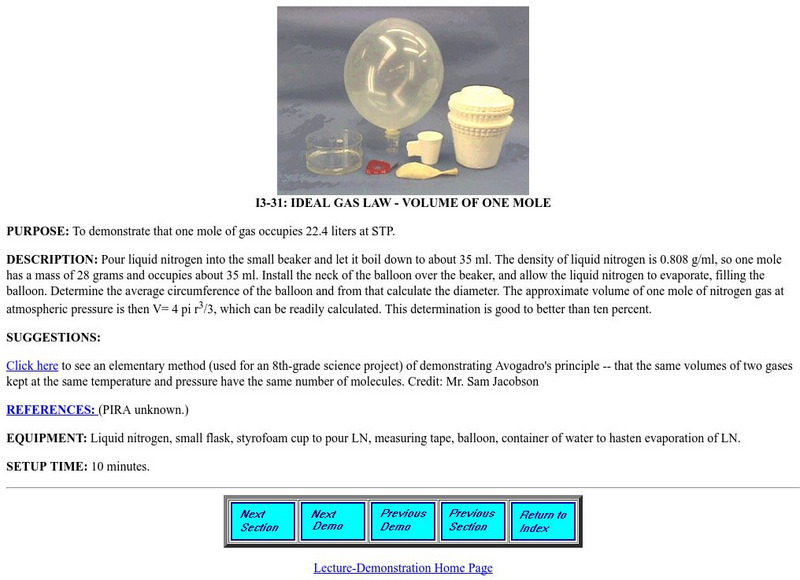
University of Maryland: Ideal Gas Law Volume of One Mole
A page from the University of Maryland Physics Lecture Demonstration Facility. Provides directions for a teacher demonstration of the ideal gas law. Shows apparatus and set-up; provides suggestions. Easily adaptable as a student project...
Texas Instruments
Texas Instruments: Gas Lab
Students determine the molecular weight of a pure gas in a balloon by using gas laws and trapping the gas in a glass bottle. Students watch the instructor demonstrate the lab on day one. On day two and three they practice the lab. On day...
Science Buddies
Science Buddies: Charles's Law
This is a modern version of a classic experiment by Jacques Charles on the volume of a gas at different temperatures. Charles discovered the relationship between volume and temperature of gases that now bears his name. This project shows...
Science Buddies
Science Buddies: Boyle's Law
This is a modern version of a classic experiment by Robert Boyle on the compressibility of gases. Boyle discovered the relationship between pressure and volume of gases that now bears his name. This project shows you a simple method for...
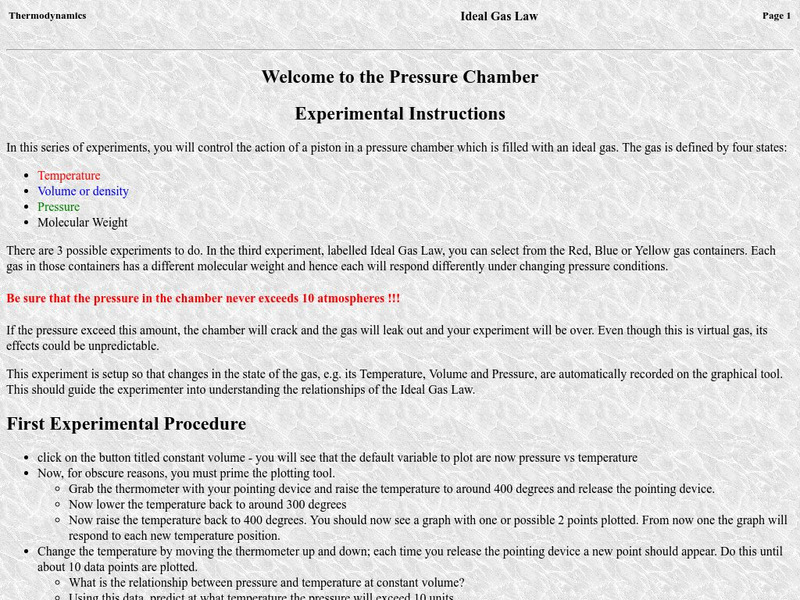
University of Oregon
Welcome to the Pressure Chamber
This site has an online experiment for testing the ideal gas law.
Texas Instruments
Texas Instruments: Vernier Boyle's Law
The primary objective of this experiment is to determine the relationship between the pressure and volume of a confined gas. The gas we use will be air, and it will be confined in a syringe connected to a Pressure Sensor (see Figure 1)....
Other
1728 Software Systems: Boyle's Law Calculator
This online calculator allows the student to solve for either Pressure or Volume. Other features include a tutorial explaining Boyle's law.
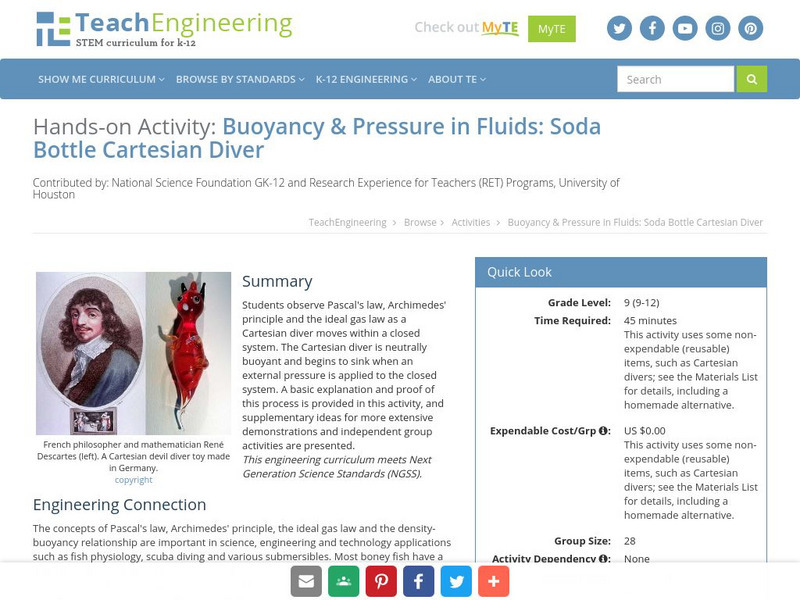
TeachEngineering
Teach Engineering: Cartesian Diver
Students observe Pascal's law, Archimedes' principle, and the ideal gas law as a Cartesian diver moves within a closed system.
Science Buddies
Science Buddies: Balloon Morphing: How Gases Contract and Expand
Expanding gases are everywhere, from the kitchen to the cosmos. You've tasted their pleasures every time you've eaten a slice of bread, bitten into a cookie, or sipped a glass of soda. In this chemistry science fair project, you'll...
Other
The Science House: Floating Candles
In this experiment students observe a combustion reaction and deduce the components necessary for the reaction to occur. They also see the relationship between pressure, volume, and number of molecules for gases.