Hi, what do you want to do?






Classroom Law Project
What does the Constitution say about voting? Constitutional Amendments and the Electoral College
As part of a study of voting rights in the US, class members examine Constitutional amendments connected with voting and the role of the Electoral College in the election process.

iCivics
The Road to Civil Rights
Here is a fantastic resource on the civil rights movement! It includes reading materials and worksheets, and particularly highlights major legislation and the role of the judicial branch in the federal government in addressing the...

Deliberating in a Democracy
Free and Independent Press
Students determine how free press principles can be compromised. For this global studies lesson, students read an article titled "Free and Independent Press." Students respond to discussion questions regarding the article.

Classroom Law Project
What are some of today’s voting issues? Voting in Oregon, youth vote, and technology
The youth vote. Rock the Vote. Vote-By-Mail. Electronic voting. Class members investigate issues facing today's voters, and the ways they have adapted over the years to optimize voter turnout.

Curated OER
Churches and Taxes
Churches have been tax-exempt since the founding of America, but should they be? Pupils ponder the question as they browse the website in preparation for a class debate or discussion. They research the history of tax-exemption for...

ProCon
National Anthem Protests
San Francisco 49ers quarterback Colin Kaepernick refused to stand for the National Anthem in 2016 as a form of protest. Were his actions appropriate? Using the provided website, pupils attempt to decide for themselves by reading the main...
Thomson Reuters
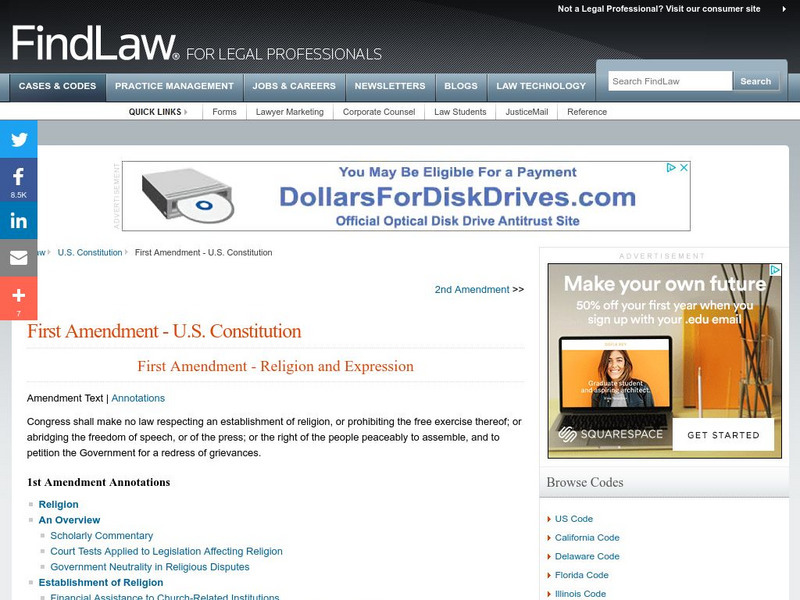
Find Law: u.s. Constitution: First Amendment Protections
This resource contains an annotated look at the different topics covered within the First Amendment of the U.S. Constitution. Click on any subtopic link for in-depth information about that part of the First Amendment.

Annenberg Foundation
Annenberg Classroom: Twenty First Amendment
Actual text of the 21st Amendment along with an explanation of its meaning. Part of the Annenberg Classroom Civics Education. Links to related resources.
Khan Academy
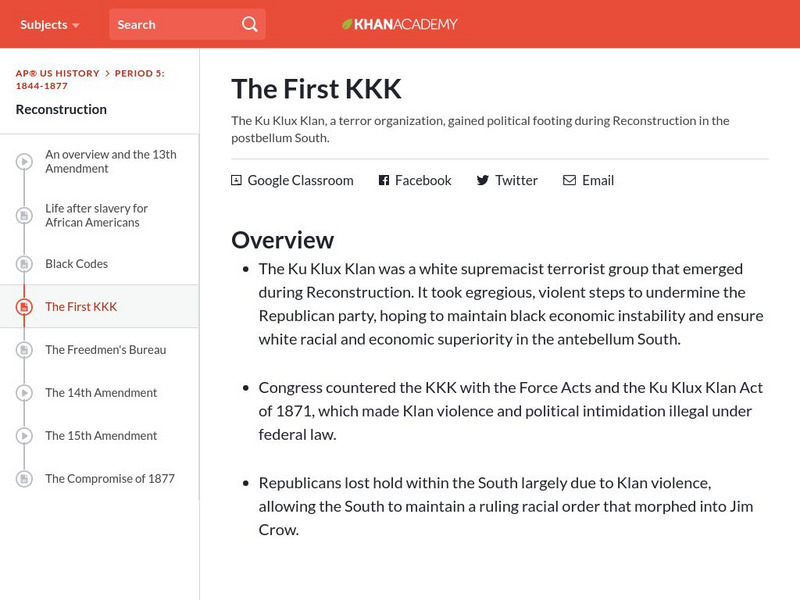
Khan Academy: Ap Us History: 1844 1877: Reconstruction: The First Kkk
Explains how the Ku Klux Klan came into existence and how they terrorized African Americans as well as those who sympathized with them. The Klan would suppress the black vote so that Democrats had a better chance of winning an election...
Wikimedia
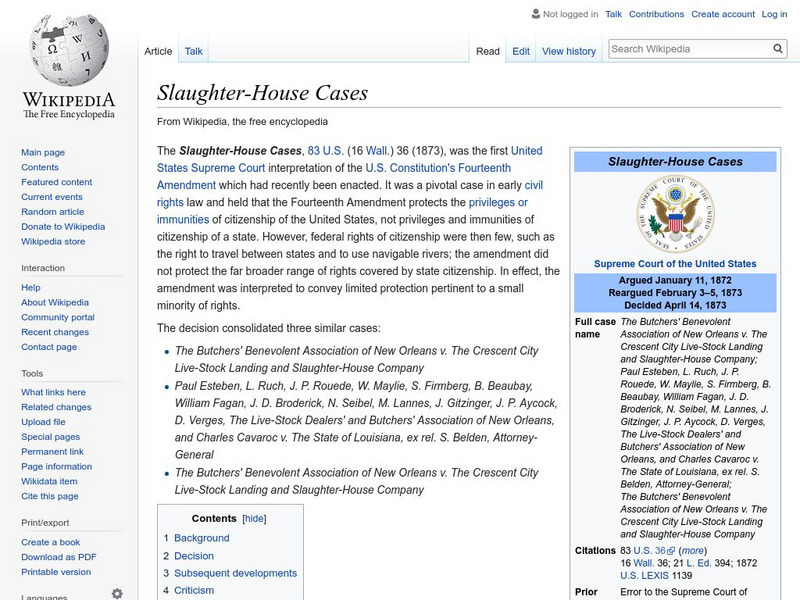
Wikipedia: The Slaughter House Cases
Learn about the historically important 1873 Slaughter-House Cases on civil rights, which became the first Supreme Court interpretation of the Fourteenth Amendment.
Other
Civil Liberties: Lyng v. Northwest Indian Cemetery Protective Association
How does the constitution resolve a conflict between the government's property rights and the right of groups to engage in religious practices on lands they consider sacred? The Supreme Court answered that question in favor of the...

Khan Academy
Khan Academy: Prohibition
Looks at the Prohibition Era in the United States when it was illegal to sell or import alcoholic beverages. The ban was lifted when the 21st Amendment was passed in 1933.
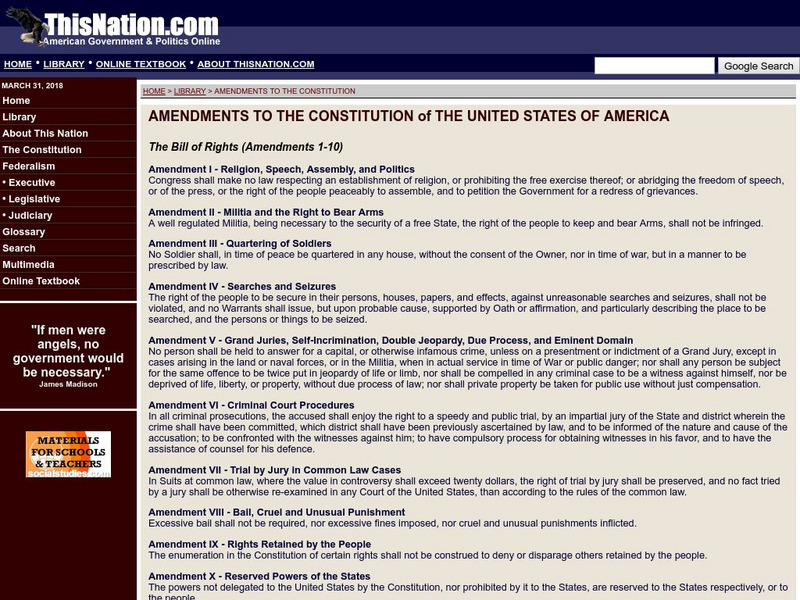
This Nation
This nation.com: Amendments to the u.s. Constitution
This site provides the text of all the amendments to the U.S. Constitution. The first ten are the Bill of Rights.
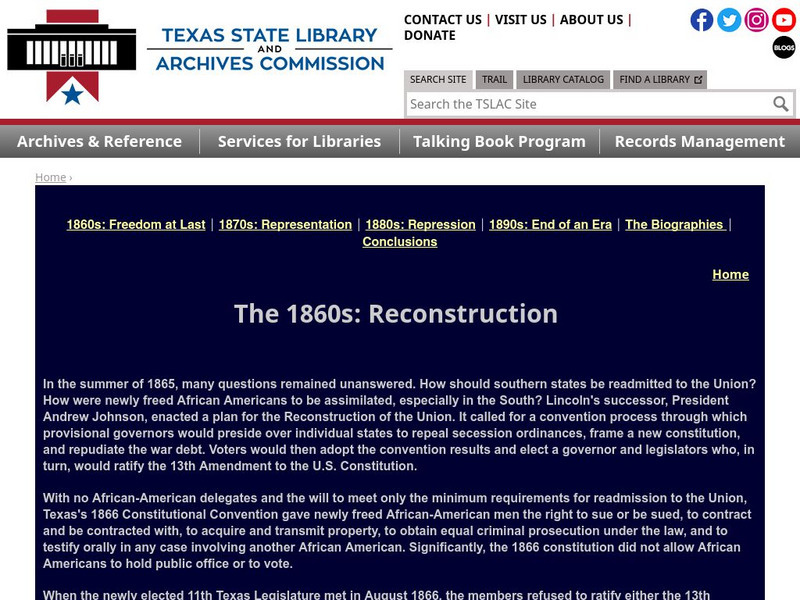
Texas State Library and Archives Commission
Texas State Library and Archives Commission: The 1860s: Reconstruction
Here is an article on the Reconstruction, which touches briefly on several issues that arose during this period, specifically in Texas: President Johnson's Reconstruction plan, assimilation and rights of freed slaves, the 13th and 14th...
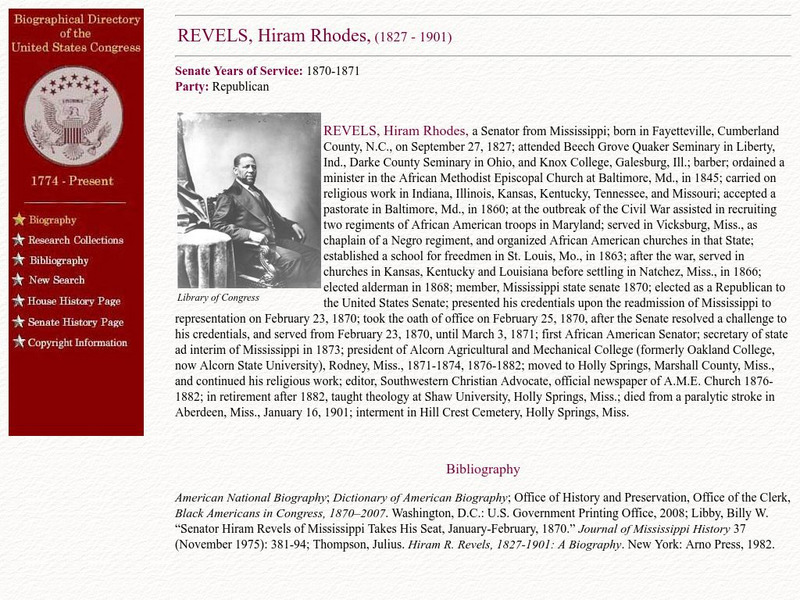
Library of Congress
Loc: Biographical Directory of the u.s. Congress: Hiram Revels
The United States Congress offers a biography of Hiram Revels, the first African-American Senator.

Other
Landmark Cases: Tinker v. Des Moines (1969)
A fantastic teacher resource site for helping students explore the main issues of the landmark case of Tinker v. Des Moines. It includes background summaries, excerpts of opinions, activities, and in-depth lessons.
Illinois Institute of Technology
Oyez.org: Oyez Directory
The OYEZ Directory offers hyperlinks to Supreme Court cases. Choose the topic you'd like to search under, like "Attorneys," or "Civil rights," for example.
Thomson Reuters
Find Law: Article Iii: Categories of Contempt
An in-depth look at the different types of contempt of court, in the United States legal system.
Thomson Reuters
Find Law: u.s. Supreme Court: Lynch v. Donnelly (1984)
The city of Pawtucket, R. I., annually erects a Christmas display in a park owned by a nonprofit organization and located in the heart of the city's shopping district. The display includes, in addition to such objects as a Santa Claus...

Other
United States Courts: Facts and Case Summary Texas v. Johnson
Facts and case summary for Texas v. Johnson, 491 U.S. 397 (1989). Flag burning constitutes symbolic speech that is protected by the First Amendment.
Alabama Humanities Foundation
Encyclopedia of Alabama: Naacp v. Alabama
An overview of the NAACP v. Alabama case, which charged Alabama with violating the First Amendment. The NAACP sued the state for not allowing the organization to exist within the state.
Bill of Rights Institute
Bill of Rights Institute: Texas v. Johnson
This Landmark Supreme Court Cases and the Constitution eLesson focuses on a case involving expressive conduct, and what is for many a deeply cherished symbol of America, the U.S. flag. In a closely divided (5-4) ruling, the Supreme Court...
Wikimedia
Wikipedia: United States Bill of Rights
This encyclopedia article from Wikipedia gives some background history to the creation of the Bill of Rights and contains a transcription of the first ten amendments to the Constitution in their original form.
Library of Congress
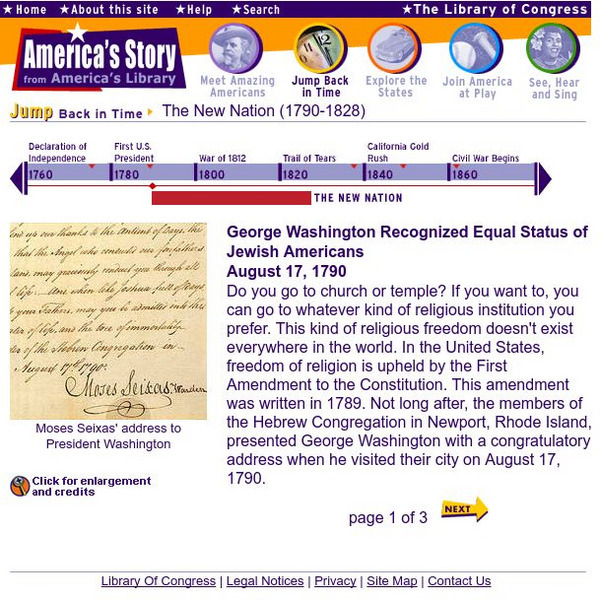
Loc: America's Story: Equal Status of Jewish Americans
This 3-page article provides a general overview of George Washington recognizing the equal status of Jewish Americans in 1790.