Hi, what do you want to do?






American Museum of Natural History
How Did the Universe Begin?
The Big Bang Theory is more than a television show. Pupils read how Edwin Hubble observed other galaxies and noticed that the galaxies are moving away from each other. Scholars learn about the idea of the big bang and what happened next...

American Museum of Natural History
Planetary Mysteries
A website all about planetary mysteries—it's a one-stop-shop for all things, stars, planets, and space travel. Scholars read an astronomy overview to discover the page's big ideas, then choose from the plethora of resources, including...

PBS
Pbs Learning Media: Evidence for the Big Bang Theory
This video segment adapted from NOVA tells the story of two scientists who inadvertently discovered microwave radiation, now believed to be heat left over from the Big Bang. [4:58]
University of Michigan
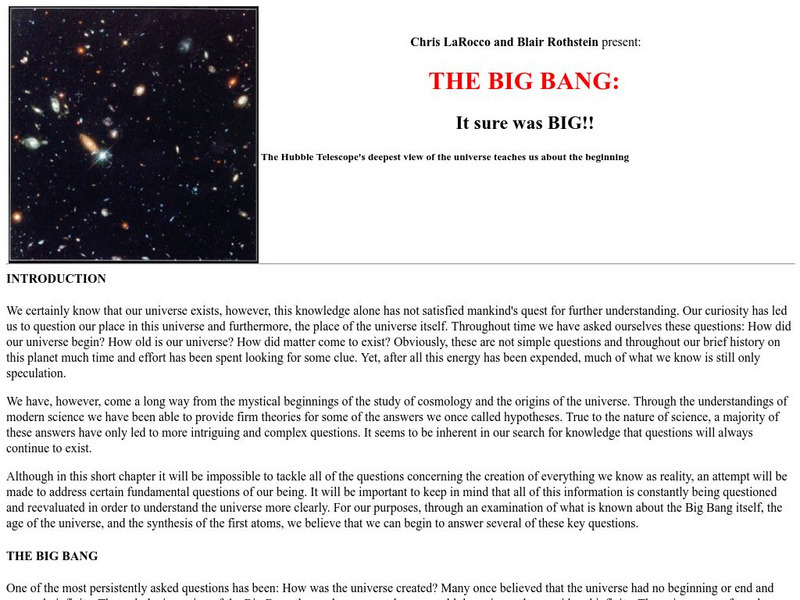
University of Michigan: The Big Bang It Sure Was Big!
A detailed examination of "what is known about the Big Bang itself, the age of the universe, and the synthesis of the first atoms."
NASA
Nasa Cosmology: The Study of the Universe
Cosmology is the study of the "large scale properties of the universe as a whole." In this set of sites, NASA provides information on the Big Bang Theory in a simplified language. The beginning, evolution, structure, fluctuations and...
NASA
Nasa Star Child: The Universe (Level 1)
This site provides an introduction to the origin of the universe for the young child and the Big Bang theory. There is also a song about the Doppler Shift. Vocabulary glossary and printable version available.
Other
American Institute of Physics: Ideas of Cosmology: Big Bang or Steady State?
Find out about the Steady State Theory of the origin of the universe. Learn about the scientific thinking and historical findings supporting this theory which states that new matter is continuously being created.
American Museum of Natural History
American Museum of Natural History: O Logy: How Did the Universe Begin?
Bite-size introduction to two scientists-Hubble and Lemaitre-who played key roles in formulating the theory of the origin of the universe known as the big bang. Includes an interactive timeline on which you can plot out the approximate...
American Museum of Natural History
American Museum of Natural History: Profile: Georges Lemaitre
Find out about the life and work of the father of the Big Bang theory, Georges Lemaitre. This article describes the origin of the cosmology theory and its growing acceptance among scientists. This is an excerpt from COSMIC HORIZONS:...
BBC
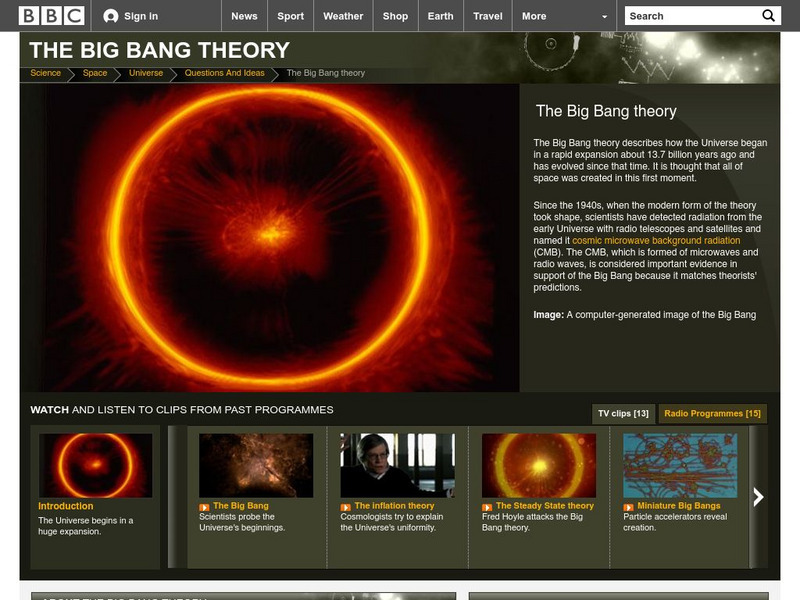
Bbc: Origin of the Universe
Try this introduction to ideas about how the universe began and how it might end. Topics include; the big bang and its echoes, antimatter, and inflation/expansion of the universe.
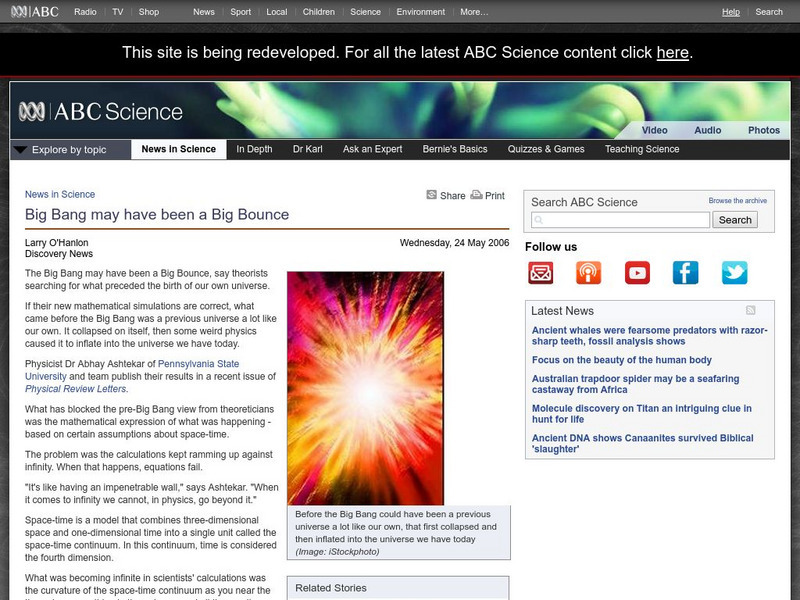
Australian Broadcasting Corporation
Australian Broadcasting Corporation: News in Science: Big Bang May Have Been a Big Bounce
From ABC News in Science, Larry O'Hanlon's article suggests the possibility of the Big Bang having been created out of the remains of a previous universe which collapsed upon itself.
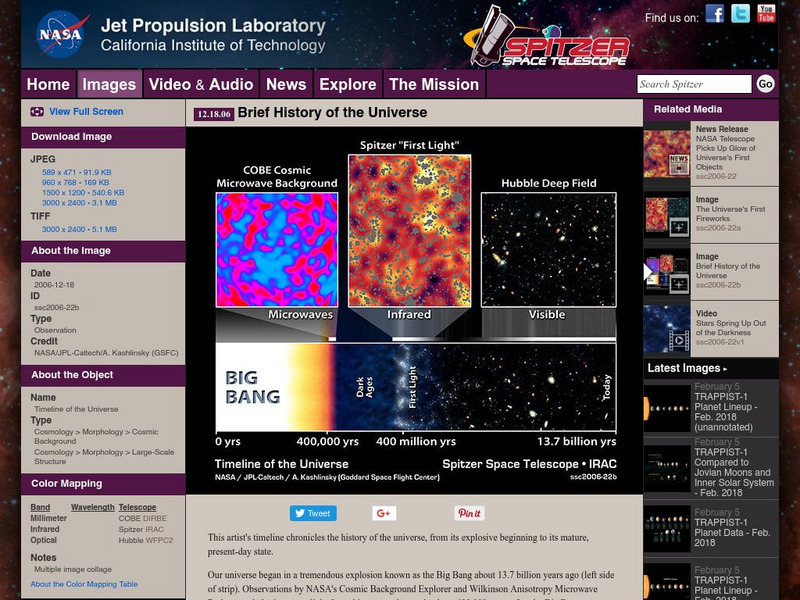
California Institute of Technology
Spitzer Science Center: Brief History of the Universe
Beginning with an image termed the "Brief History of the Universe" this site examines (briefly, as noted) a timeline of the universe as dictated by the image. The timeline includes information on the big bang theory, the dark ages, the...
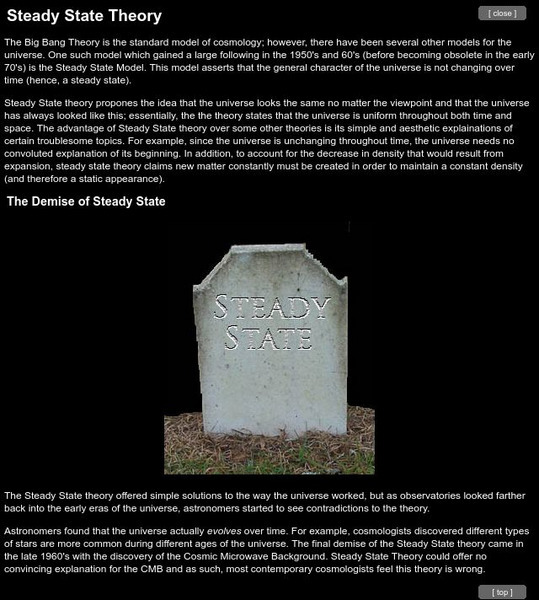
Other
Universe Adventure: Steady State Theory
We have all heard of the Big Bang Theory for the beginning of the universe, but there are other theories of how it all began. Here is a brief explanation of the Steady State Theory, a theory which is no longer thought to be a possibility.
PBS
Pbs Teachers:origins Back to the Beginning
This hour long program by NOVA is split into six segments and examines a issues influencing scientists' current understanding of how the universe was formed. This includes The Big Bang and its lasting effects.
Other
Montana State Univ.: Expanding Universe (Lesson Plan)
This site has a lesson plan in which students gather evidence supporting the Big Bang Theory using a balloon model of the expanding universe.
NASA
Nasa Star Child: The Universe (Level 2)
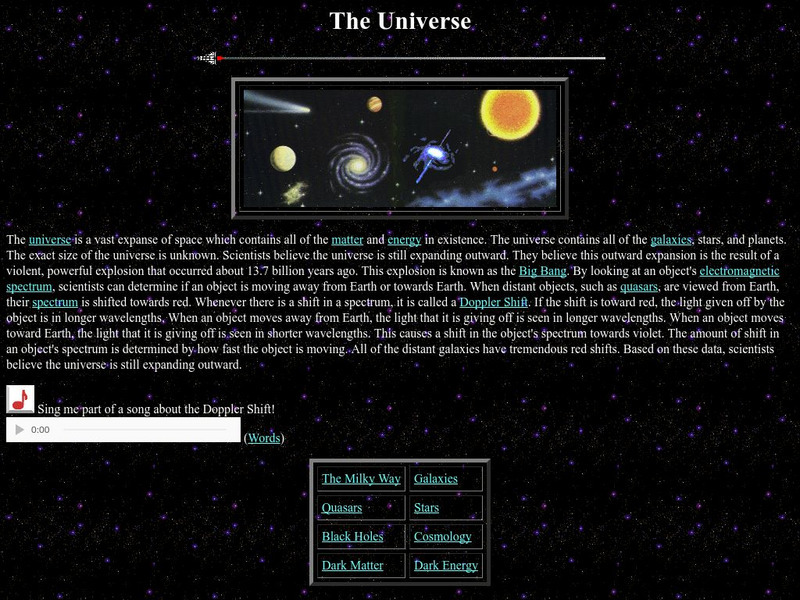
This site provides a description of the universe and what it contains. Includes links to definitions, activities, and an audio song. Printable version available.
National Science Foundation
National Science Foundation: Astronomy and Space: Research Overview
Explore some of our most fundamental questions about space exploration with this research overview collected by scientists at the National Science Foundation. Additionally, experience deep space first-hand with telescope interactives.
Cosmos 4 kids
Cosmos4 Kids: Universe: Origins of the Universe
How did our universe get here? A beginner's research page answers this question for young learners.