Hi, what do you want to do?






W. W. Norton
W.w. Norton & Company: The Writing Process: Revising
Information about the process of revision including three steps to keep in mind: play the role of the reader, think in terms of strength and weakness, and take advantage of computer capabilities. Use the links on the right for other...

A&E Television
History.com: How the 2000 Election Came Down to a Supreme Court Decision
As Florida's electoral votes became too close to call, controversy ensued over hanging chads, dimpled chads and butterfly bullets. Five hundred thirty-seven votes. That's all that separated Democrat Al Gore and his Republican challenger...
Colorado State University
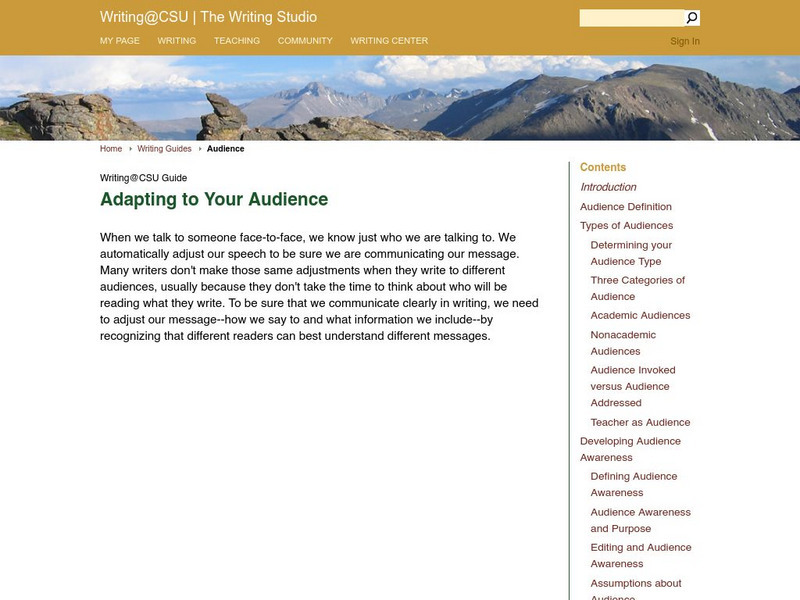
Colorado State Writing Center: Adapting to Your Audience
A clear guide to understanding the audience for your writing, this site leads you through steps to help you identify your audience, then structure your writing to meet that audience's needs and expectations. Use links on the right....
Love To Know Media
Your Dictionary: Using Reflective Writing in the Classroom
This article discusses the use of reflective writing in class including the uses such as summarize what was learned, writing about what they read, and keeping a reflective journal and the benefits of reflective writing.
University of Sydney (Australia)
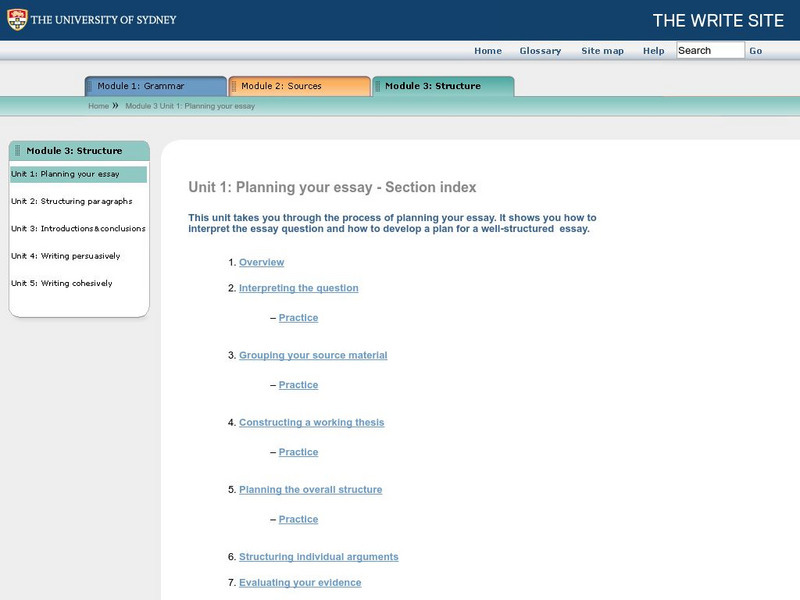
University of Sydney: Module 3 Unit 1: Planning Your Essay
This unit index contains links with to guide students through the process of planning a multi-paragraph argumentative essay. Students will learn how to interpret the essay question, develop a writing plan, thesis, writing the argument,...
Better Lesson
Better Lesson: Learn a Word: Science Vocabulary Acquisition
In this lesson, students use multiple sources to learn the meanings of science words, collaborating to create useful resources for learning and retaining science vocabulary.
Columbia University
Columbia: Tips for Effective Presentations Using Four Important Design Concepts
Excellent, clear guidelines to aid you in using visual aids in a presentation. Curser down to find the information. W.9-10.6 Techno, SL.11-12.5 Audio Visuals
ReadWriteThink
Read Write Think: Once Upon a Fairy Tale Teaching Revision as a Concept
Contains plans for five lessons that teach the difference between revision and editing using fractured fairy tales. In addition to objectives and standards, this instructional plan contains links to sites used in the lessons as well as...
Wisconsin Response to Intervention Center
Wisconsin Rt I Center: Writing to Learn [Pdf]
Teachers will learn how to use Writing to Learn as a formative assessment tool. Teachers will learn how to implement the strategy, measure progress, and find research to support writing to learn. A list of Writing to Learn activities is...
Wisconsin Response to Intervention Center
Wisconsin Rt I Center: Interactive Word Walls [Pdf]
Classroom teachers will learn about interactive word walls, an engaging instructional strategy. Teachers will learn how to implement word walls, find research that supports the practice, and find examples.
Sophia Learning
Sophia: Narratives: Organization
This slideshow lesson focuses on organizational structures for narratives including a review of narratives and a list of possible organizational structure types: chronological or sequential order, climactic order, in media, and...
Online Writing Lab at Purdue University
Purdue University Owl: Teaching Resource: Writing Process: Power Point
A PowerPoint presentation that introduces the processes of inventing, composing, and revising written works. W.9-10.5 Writing Process, W.11-12.5 Writing Process

ReadWriteThink
Read Write Think: Making Connections to Myth and Folktale
Excellent online lesson based on N. Scott Momaday's The Way to Rainy Mountain. Students create a three-voice narrative based on the novel in studying and learning about myths and folktales. W.9-10.3a,3b,3d,3e Narratives, W.9-10.5 Writing...
ReadWriteThink
Read Write Think: Collaborative Revising
Lesson in which learners engage in an entire-group revising process, using a story which has already been written by the group. An excellent follow-up lesson to the "prewriting and drafting" lesson.
ReadWriteThink
Read Write Think: Writing Good Endings
This lesson plan explores endings and conclusions to children's literature in an attempt to teach how to successfully write a good ending. Included in the lesson plan are an overview, practice, objectives, resources, preparation, and more.
Read Works
Read Works: Genre Studies: Informational Text Kindergarten Unit: Labeled Diagrams
[Free Registration/Login Required] Lesson uses Bats by Gail Gibbons to teach students how to identify facts learned from labeled diagrams within an informational text. Ideas for direct teaching, guided practice, and independent practice...
Other
Cleveland State University: Introductions & Conclusions
Briefly explains how the introduction and the conclusion work together. Then gives bulleted lists dealing with the introduction and conclusion separately. The conclusion list explains how to make a conclusion go beyond a mere summary...
Sophia Learning
Sophia: Word Choice: Lesson 2
A slideshow introducing the topic of word choice and discussing its importance.

Sophia Learning
Sophia: Chronological Transition Words
This slideshow lesson focuses on chronological transition words; it defines and lists the categories of transition words. It defines chronological transition words, states their purpose, provides a list of them, and shows how to write...
BBC
Bbc Bitesize Revision: Openings and Endings
As part of a revision and writing section of BBC Bitesize, this site goes over several tips involved in writing both openings and endings.
Other popular searches
- The Five Ws
- The Five W's
- The 5 W's
- The 5 Ws
- Writing the Number 5
- The 5 W S
- Reading the Five W's
- Writing Using the Five Senses