Hi, what do you want to do?






Curated OER
Consumerism Scavenger Hunt
In this social studies worksheet, students discover how to be an informed consumer by first reading 10 questions pertaining to marketing, advertising and purchasing choices. Students use Internet searches to find the answers. There are...

Curated OER
Searching the Internet
For this computer research worksheet, students read 9 detailed instructions on how to properly conduct an Internet search. There are no questions.

Teach Engineering
Designing a Robotic Surgical Device
The engineering design process meets laparoscopic surgical robots with an activity that is the last part in a series of 10 and brings all the lessons of the unit together. Teams design and build a remotely controlled laparoscopic device....

Teach Engineering
Incoming Asteroid! What's the Problem?
Oh, no! An asteroid is on a collision course with Earth!. Class members must rise to the challenge of designing a shelter that will protect people from the impact and permit them to live in this shelter for one year. In this first lesson...

Grid Games Galore
Math Games Students Like to Play
These may not all be your cup of tea, but you'll likely find some gold in this math games packet. Find brief, easy-to-execute games (like Integer Football) and that are perfect for review or even a substitute teacher plan.

Teach Engineering
Searching for Bigfoot and Others Like Him
Individuals create a GIS data layer in Google Earth that displays information about where one might find seven different cryptids. The class members research to find data on cryptid sightings they can include in their data...

Curated OER
Jeopardy Development Team Project
Students study the criteria for evaluating web sites and use information found in authoritative web sites to create questions for a game of Jeopardy. They evaluate three different web sites, some with minor errors and some with major...

Curated OER
How Gear Systems Work: A Research Project
Students apply information regarding simple machines along with the math concept "ratios." The teacher introduces the concept that technology is the application of scientific knowledge and mathematics concepts to solve a problem. This is...

Cherokee County Schools
Simple Machines Project
The choice is simple: create a PowerPoint presentation, write a book, or invent a compound machine. Whichever project your young scientists choose, they will be engaged in creatively demonstrating their knowledge of simple...

Washington Township Public Schools
Using Paired Text
Paired reading passages frequently appear on standardized exams, but finding text sets to use in the classroom is sometimes a challenge. A lesson plan on using paired texts includes a selection of passages and a graphic organizer for...

Teach Engineering
Ranking the Rocks for Desired Properties
Math rocks! Cavern design teams determine the rankings of rock types based upon desirability points. The points are connected to the properties of the rocks and their usefulness in building a cavern.

Teach Engineering
Rocks, Rocks, Rocks: Test, Identify Properties and Classify
Time is growing short. Teams work together to identify physical properties of rocks in order to determine the properties that would best suit their cavern shelter design.

Teach Engineering
How Big? Necessary Area and Volume for Shelter
Teams must determine the size of cavern needed to house the citizens of Alabraska to protect them from the asteroid impact. Using scaling properties, teams first determining the number of people that could sleep in a classroom and then...

Learning for Life
Career Education
As part of a career exploration and investigation, learners research the Internet for possible career options and identify what type of educational preparation is required for those careers, as well as possible salary options,...

Teach Engineering
Seeing All Sides: Orthographic Drawing
How can your draw three-dimensional figures on paper? The lesson shows pupils how to draw orthographic projections of three-dimensional figures composed of cubes. After viewing a PowerPoint presentation, they practice this skill with...

Teach Engineering
What's Wrong with the Coordinates at the North Pole?
Here is an activity that merges technology with life skills as individuals use Google Earth to explore the differences between coordinate systems and map projections. The self-guided worksheet is the fourth segment in a nine-part unit....

Teach Engineering
Get the Word Out at McDonald's!
To get the word out that the Great Pacific garbage patch (GPGP) contains millions of pounds of non-biodegrading plastics, individuals research the GPGP and write an article for a newsletter. Researchers present their facts in a...

DiscoverE
Coding Without Computers
See what it feels like to be a robot. Scholars use programming vocabulary to program a human robot and test out their codes by acting them out. The code should result in stacking six cups into a pyramid.
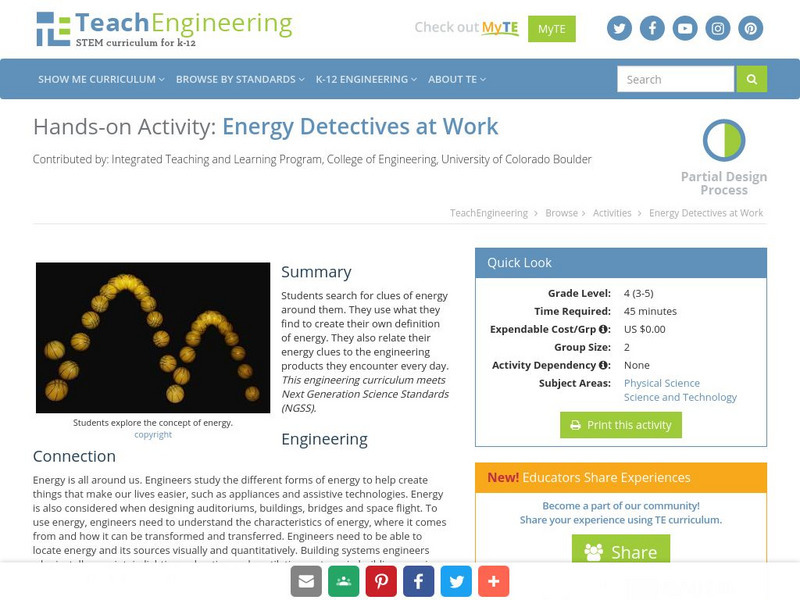
TeachEngineering
Teach Engineering: Energy Detectives at Work
Students search for clues of energy around them. They use what they find to create their own definition of energy. They also relate their energy clues to the engineering products they encounter every day.
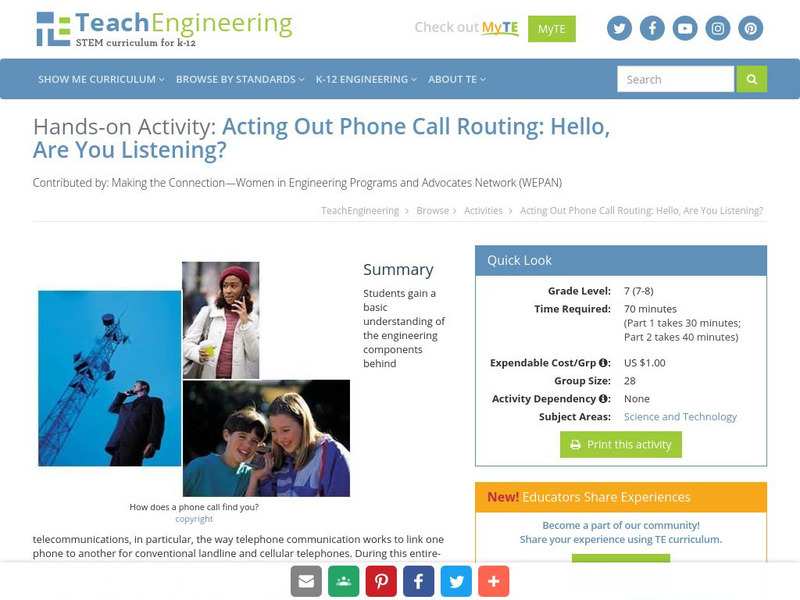
TeachEngineering
Teach Engineering: Hello, Are You Listening?
Students gain a basic understanding of the engineering components behind telecommunications, in particular, the way telephone communication works to link one phone to another for conventional landline and cellular telephones. During this...
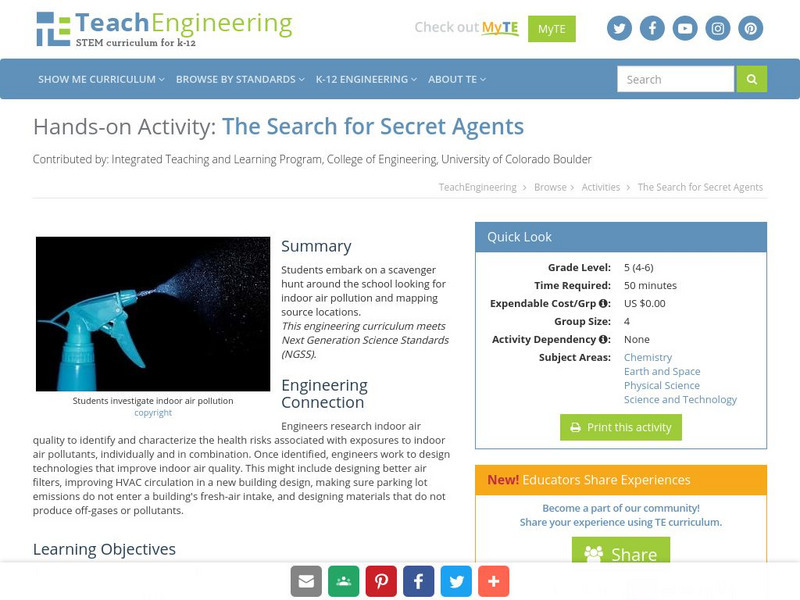
TeachEngineering
Teach Engineering: The Search for Secret Agents
Students embark on a scavenger hunt around the school looking for indoor air pollution and mapping source locations.
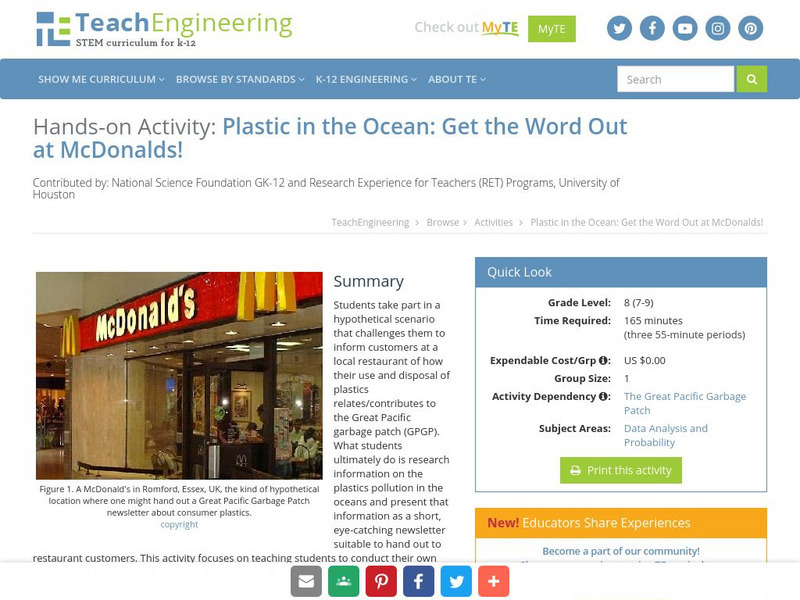
TeachEngineering
Teach Engineering: Get the Word Out at Mc Donalds!
Students take part in a hypothetical scenario that challenges them to inform customers at a local restaurant of how their use and disposal of plastics relates/contributes to the Great Pacific garbage patch (GPGP). What students...
TeachEngineering
Teach Engineering: Searching for Bigfoot and Others Like Him
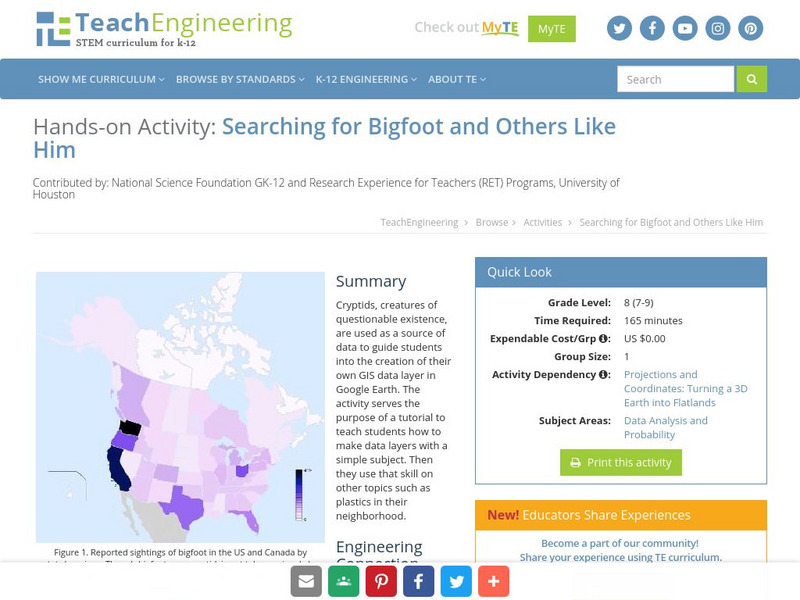
Cryptids, creatures of questionable existence, are used as a source of data to guide students into the creation of their own GIS data layer in Google Earth. The activity serves the purpose of a tutorial to teach students how to make data...
Education Place
Houghton Mifflin: Eduplace: Using the Web
The World Wide Web is a great place to find more information about a topic. But there are a lot of sites out there - some are good and some are not so good. Here are some steps to help students use the Web to do research.