Hi, what do you want to do?






NASA
NASA Engineering Design Challenges - Spacecraft Structures
What kind of design challenges are there in building structures to support rocket engines? The unit takes design teams through the process of building the lightest possible thrust support structure that can withstand the necessary forces...

Intel
Designer Genes: One Size Fits All?
In this STEM group of 10 activities, lesson two focuses on the question, "Just because we can, should we?" when considering genetically engineered food. Classes hear a scenario and, as young scientists and geneticists, must determine if...

National Park Service
Biodiversity—Bee Week
If you want scholars to fall in love with bees, this is the unit for you! Celebrate bees with a full week of material—designed for the Next Generation Science Standards—that addresses the importance of pollination and fertilization....

Curated OER
Watershed Works: Unit 2
The second of a three-unit lesson plan, this focuses on how human-made structures affect watersheds. Using watershed models that were built during the first unit, junior geologists now place buildings, dams, or levees into the models and...

Kenan Fellows
Unit 1: Introduction to Biotechnology
Biotechnology is big! Introduce the uses of biotechnology to science scholars with a fascinating, fact-filled unit. The first installment in a series of four biotechnology units covers the role biotechnology plays in human and...

American Institute of Architects
Architecture: It's Elementary!—Fifth Grade
Young citizens construct an understanding of urban planning in this cross-curricular unit. Covering every aspect of city development from the political, economic, and social influences to sustainable building practices, this...

Curated OER
Verbs Rule!
Students practice writing and speaking using conventional grammar, usage, and sentence structure. Students practice as a whole class and then demonstrate their knowledge in written activities. Handouts and worksheets are imbedded within...

Tech Museum of Innovation
Human Body Exhibit
Explore human anatomy and physiology using models. Scholars study systems of the human body and design a display for a museum exhibit. To complete the activity, individuals create analogous models of their chosen human body systems.

RAND Corporation
Project ALERT
Why do people use drugs? What are the consequences? The alternatives? How can young people resist the pressures to use drugs? The Project Alert drug prevention program provides middle schoolers with the information they need and the...

TeachEngineering
Teach Engineering: Teaching the Engineering Design Process
Students follow the steps of the engineering design process (EDP) while learning about assistive devices and biomedical engineering. They first go through a design-build-test activity to learn the steps of the cyclical engineering design...
TeachEngineering
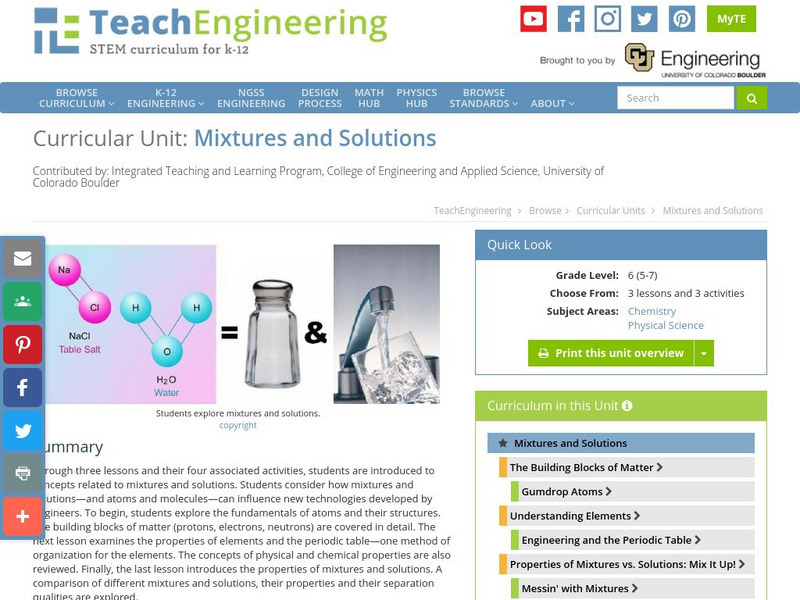
Teach Engineering: Mixtures and Solutions
This unit covers introductory concepts of mixtures and solutions. Students think about how mixtures and solutions, and atoms and molecules can influence new technologies developed by engineers. The first lesson explores the fundamentals...

University of Virginia
University of Virgina: Structural Behavior and Design Approaches
From the Introduction to Structural Design web site. A page of well-written lecture notes on the various structural qualities of building materials. A comparison is made of the strength, stiffness, stability and ductility of materials,...
PBS
Pbs: Building Big: Skyscrapers
Information about the basics of skyscrapers, with profiles of nine big-building wonders. Extras include a loads lab, which illustrates how and why skyscrapers stand up and keep standing up, and interviews with builders, engineers, and...
TeachEngineering
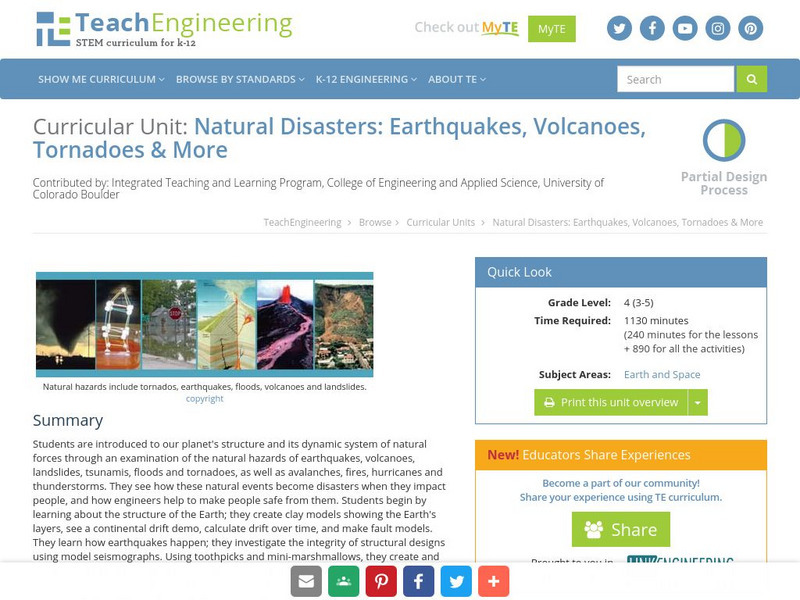
Teach Engineering: Natural Disasters
Students are introduced to our planet's structure and its dynamic system of natural forces through an examination of the natural hazards of earthquakes, volcanoes, landslides, tsunamis, floods and tornados, as well as avalanches, fires,...
TeachEngineering
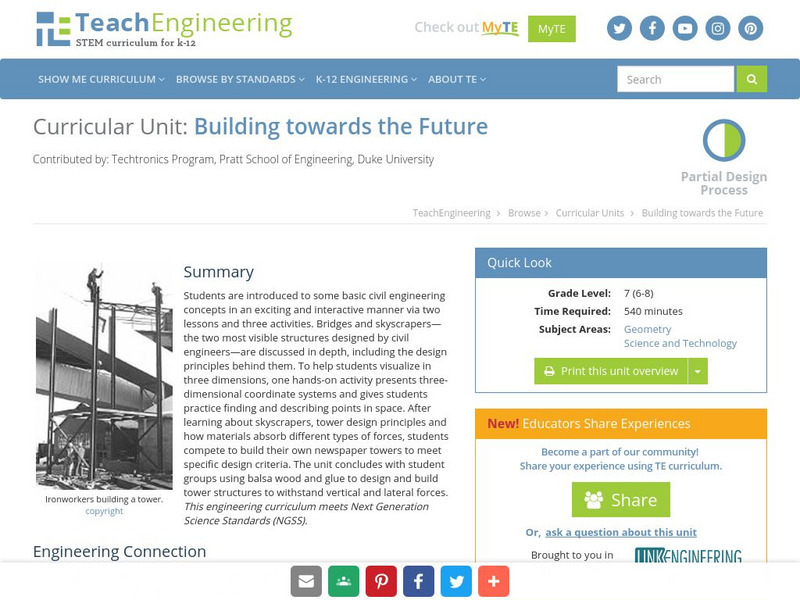
Teach Engineering: Building Towards the Future
This curricular unit introduces students to basic Civil Engineering concepts in an exciting and interactive manner. Bridges and skyscrapers, the two most visible products of Civil Engineers, will be discussed in depth. Students will have...
TeachEngineering
Teach Engineering: Bridges
Through a five-lesson series that includes numerous hands-on activities, students are introduced to the importance and pervasiveness of bridges for connecting people to resources, places and other people, with references to many...
TeachEngineering
Teach Engineering: Engineering Nature: Dna Visualization and Manipulation
Students are introduced to genetic techniques such as DNA electrophoresis and imaging technologies used for molecular and DNA structure visualization. In the field of molecular biology and genetics, biomedical engineering plays an...

TeachEngineering
Teach Engineering: Environment
Through 10 lessons and more than 20 hands-on activities, students are introduced to the concept of an environment and the many interactions within it. As they learn about natural and human-made environments, as well as renewable and...
TeachEngineering
Teach Engineering: Keepers of the Gate
Through two lessons and five activities, students explore the structure and function of cell membranes. Specific transport functions, including active and passive transport, are presented. In the legacy cycle tradition, students are...
TeachEngineering
Teach Engineering: Robotics Peripheral Vision
This unit is designed for advanced programming classes. It leads students through a study of human vision and computer programming simulation. Students apply their previous knowledge of arrays and looping structures to implement a new...
TeachEngineering
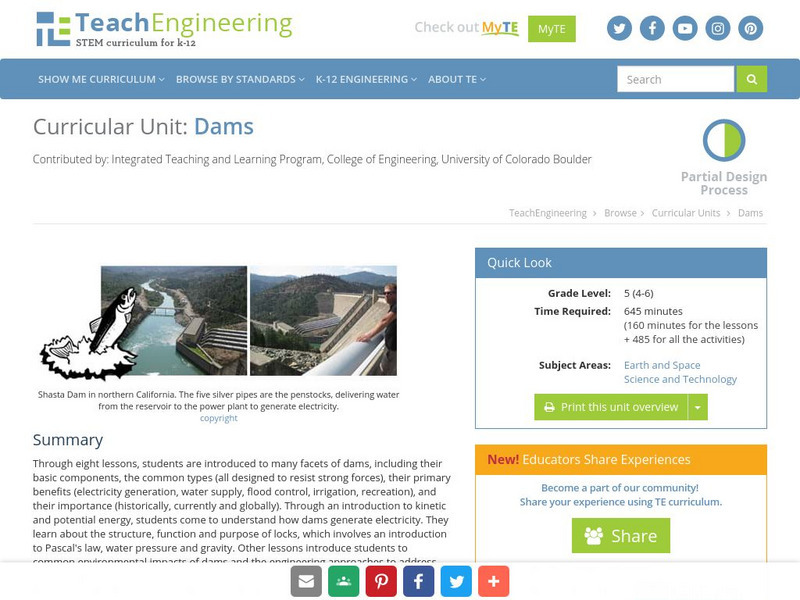
Teach Engineering: Dams
Through eight lessons, students are introduced to many facets of dams, including their basic components, the common types (all designed to resist strong forces), their primary benefits (electricity generation, water supply, flood...

TeachEngineering
Teach Engineering: Cells
In this unit, students look at the components of cells and their functions and discover the controversy behind stem cell research. The first lesson focuses on the difference between prokaryotic and eukaryotic cells. In the second lesson,...

Georgia Department of Education
Ga Virtual Learning: Biology: Dna, Rna, and Protein Synthesis
In this online mini-course learners distinguish between the structure, functions, and processes involved with DNA and RNA.
TeachEngineering
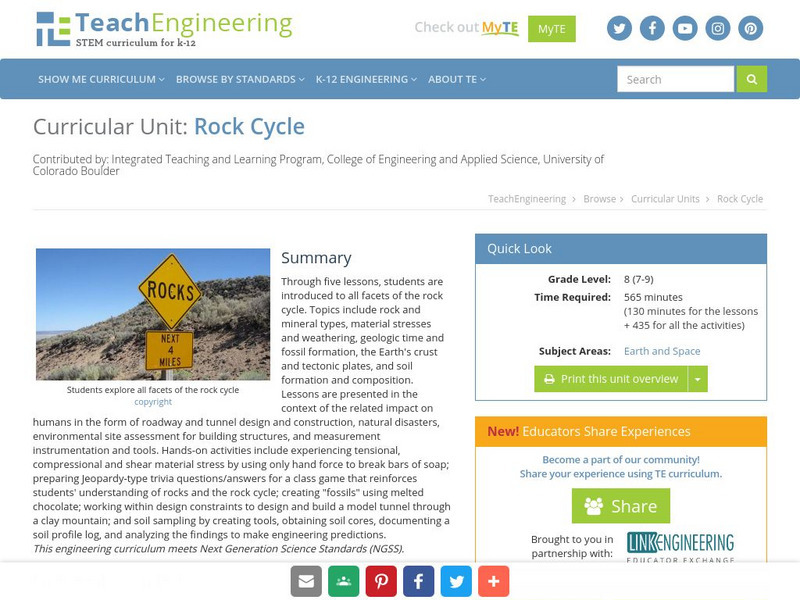
Teach Engineering: Rock Cycle
Through five lessons, students are introduced to all facets of the rock cycle. Topics include rock and mineral types, material stresses and weathering, geologic time and fossil formation, the Earth's crust and tectonic plates, and soil...