Hi, what do you want to do?





TeachEngineering
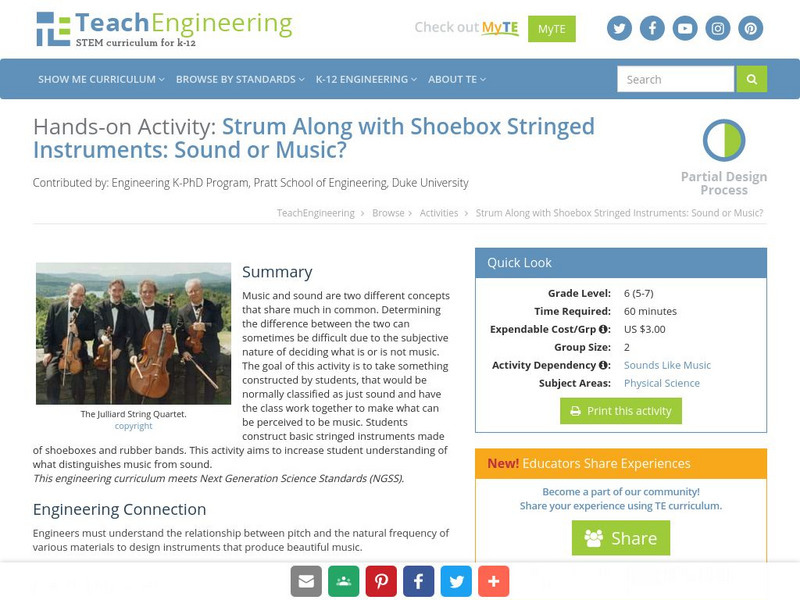
Teach Engineering: Strum Along
Music and sound are two different concepts that share much in common. Determining the difference between the two can sometimes be difficult due to the subjective nature of deciding what is or is not music. The goal of this activity is to...
TeachEngineering
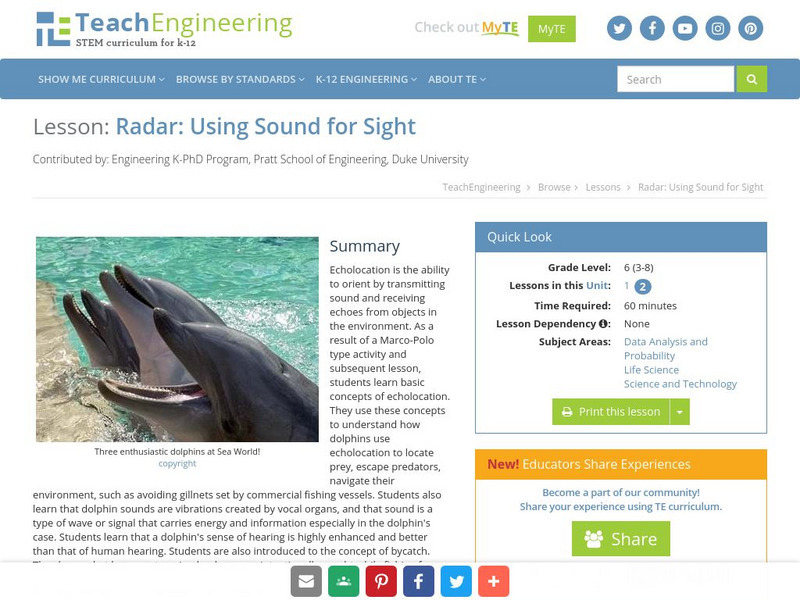
Teach Engineering: Sound for Sight
Echolocation is the ability to orient by transmitting sound and receiving echoes from objects in the environment. As a result of a Marco-Polo type activity and subsequent lesson, students learn basic concepts of echolocation. They use...
TeachEngineering
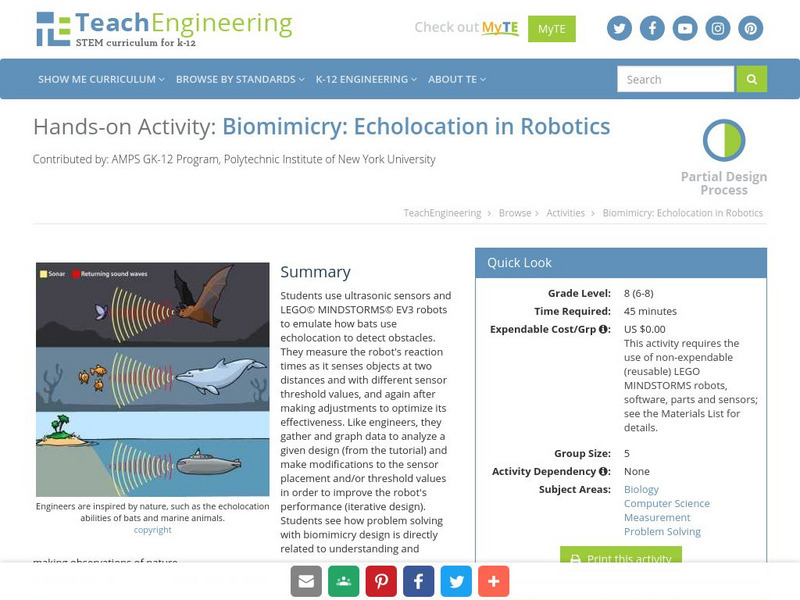
Teach Engineering: Biomimicry: Echolocation in Robotics
Students use ultrasonic sensors and LEGO MINDSTORMS NXT robots to emulate how bats use echolocation to detect obstacles. They measure the robot's reaction times as it senses objects at two distances and with different sensor threshold...
Science Buddies
Science Buddies: The Unconstrained Truth About Constrained Layer Damping
This science fair project shows you how to transform a noisy piece of metal into a sound-muffling constrained-layer damper. You will record the sound of a controlled impact on a piece of metal with a microphone, a computer, and some free...
Other
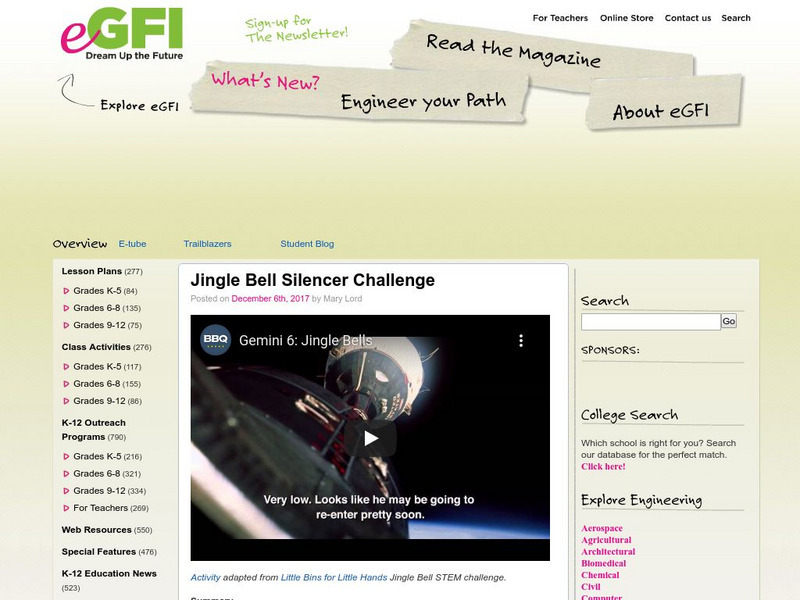
American Society for Engineering Education: E Gfi: Jingle Bell Silencer Challenge
Can you muffle the sound of a jingle bell using a variety of Christmas-themed items? Explore your sense of hearing in this simple activity. Includes a video of Gemini astronauts playing Jingle Bells while in space in 1965. [1:22]
TeachEngineering
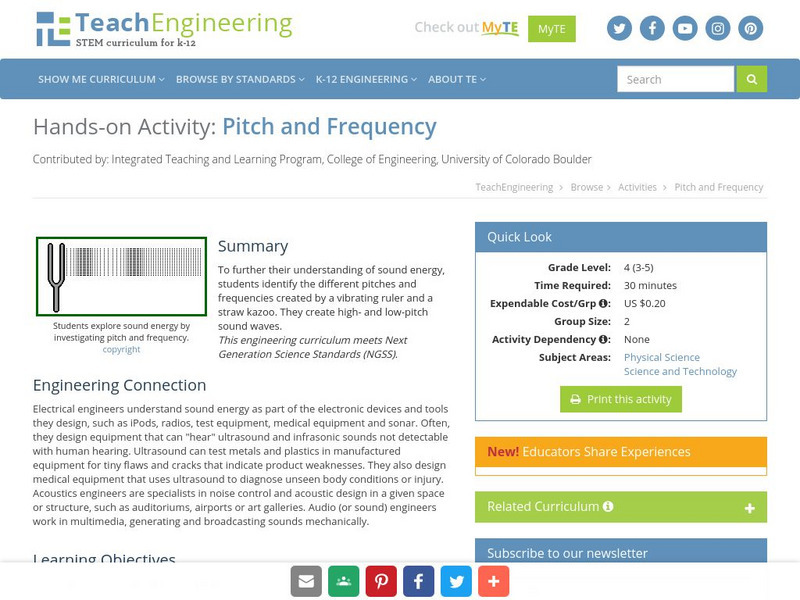
Teach Engineering: Pitch and Frequency
To further their understanding of sound energy, students identify the different pitches and frequencies created by a vibrating ruler and a straw kazoo. They create high- and low-pitch sound waves.
TeachEngineering
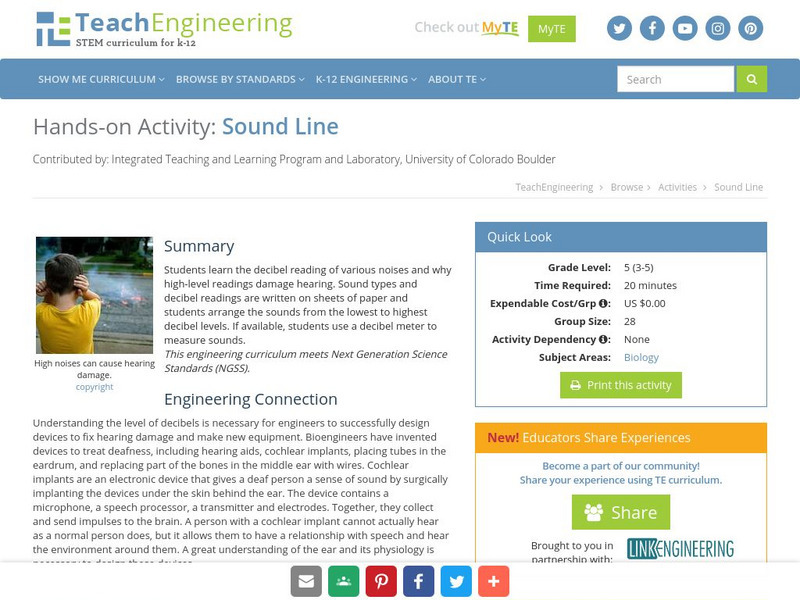
Teach Engineering: Sound Line
Students learn the decibel reading of various noises and why high-level readings damage hearing. Sound types and decibel readings are written on sheets of paper, and students arrange the sounds from the lowest to highest decibel levels....
TeachEngineering
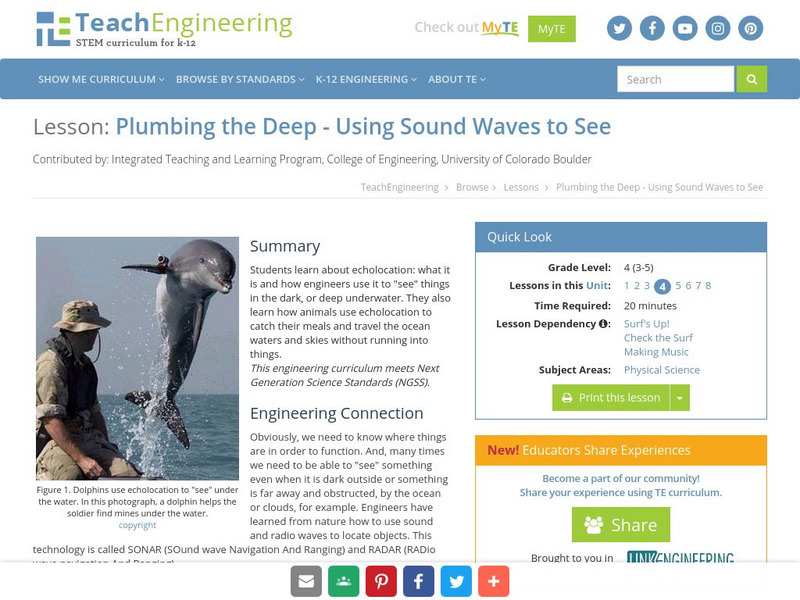
Teach Engineering: Plumbing the Deep: Using Sound Waves to See
In this lesson, students learn about echolocation: what it is and how engineers use it to "see" things in the dark, or deep underwater. Also, they learn how animals use echolocation to catch their dinner and travel the ocean waters and...

TeachEngineering
Teach Engineering: Simple Instruments
In this activity, students work with partners to create four different instruments to investigate the frequency of the sounds they make. Students may chose to make a shoebox guitar, water glass xylophone, straw panpipe or a soda bottle...
TeachEngineering
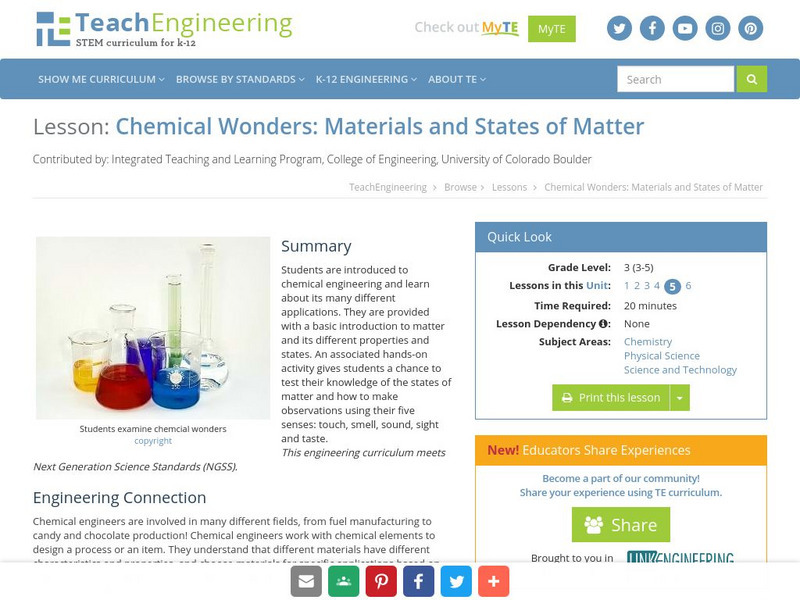
Teach Engineering: Chemical Wonders
Young scholars are introduced to chemical engineering and learn about its many different applications. They are provided with a basic introduction to matter and its different properties and states. An associated hands-on activity gives...

TeachEngineering
Teach Engineering: Solid, Liquid or Gas?
Students are given a variety of materials and asked to identify if each material as a solid, liquid or gas. They use their five senses - sight, sound, smell, texture and taste - to identify the other characteristics of each item.
TeachEngineering
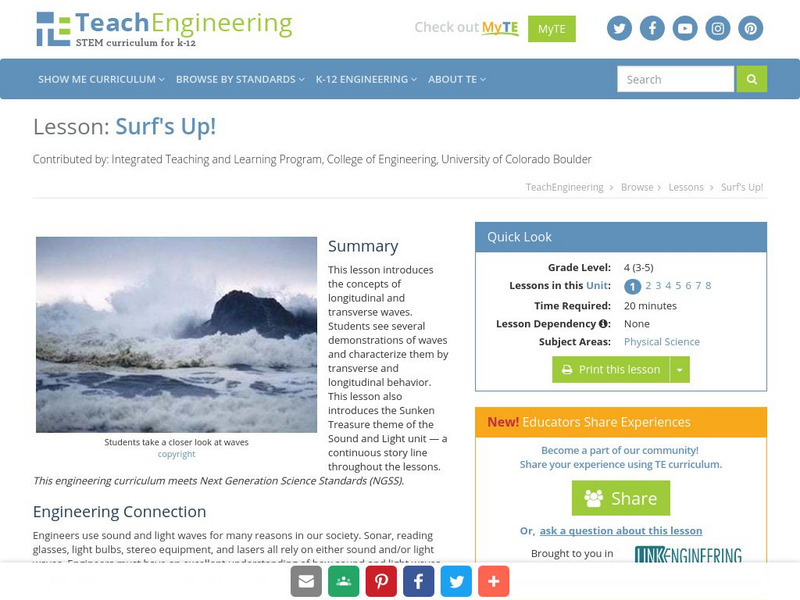
Teach Engineering: Surf's Up!
This lesson introduces the concepts of longitudinal and transverse waves. Young scholars see several demonstrations of waves and characterize them by transverse and longitudinal behavior. This lesson also introduces the Sunken Treasure...
University of Southern California
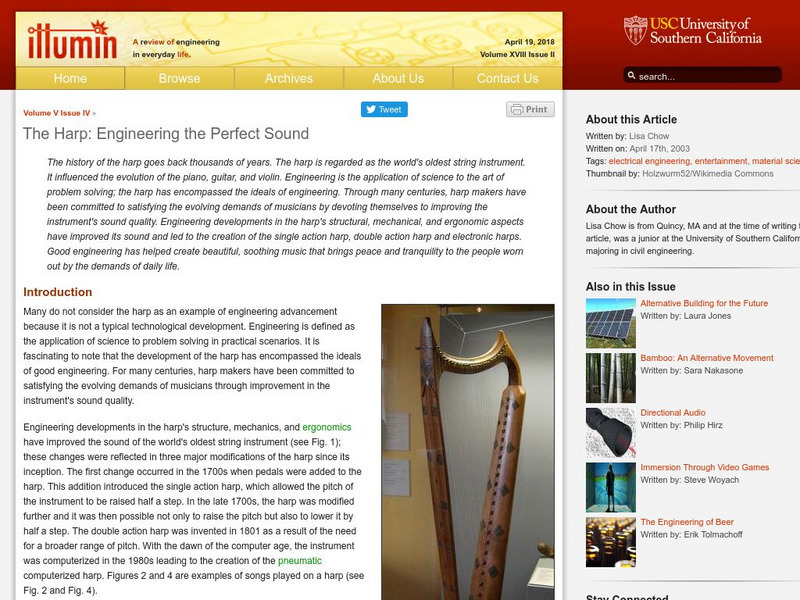
Usc Viterbi School of Engineering: Illumin: Harp: Engineering the Perfect Sound
Article describing the history and the construction of a harp. Includes a music sample, and an interactive harp. (Published Fall 2004)
Michigan Reach Out
Michigan Reach Out!: Drums (Sounds Like Science)
This site is provided for by Michigan Reach Out. Students experiment with the variables of force, pitch and volume after making a drum.

TeachEngineering
Teach Engineering: Wind Chimes
Using their knowledge of physics, students will build a wind chime. Mathematical computations will be done to determine the length of the pipes.

TeachEngineering
Teach Engineering: Energy
Through nine lessons, students are introduced to a range of energy types--electrical, light, sound and thermal-as well as the renewable energy sources of wind, hydro (water) and solar power. Subjects range from understanding that the...
TeachEngineering
Teach Engineering: Energy Forms and States Demonstrations
Demonstrations explain the concepts of energy forms (sound, chemical, radiant [light], electrical, atomic [nuclear], mechanical, thermal [heat]) and states (potential, kinetic).
TeachEngineering
Teach Engineering: Wait Program!
After completing an associated lesson, students test their understanding in two programming tasks that utilize LEGO MINDSTORMS NXT robots and sound/touch sensors. Students gain practice in the iterative design-program-test-redesign process.

Cosmo Learning
Cosmo Learning: Physics 240: Science and Engineering I
A collection of video lectures from a physics for science and engineering course taught at the University of Missouri-Kansas City. The course discusses the concepts of mechanics, wave motion, sound, heat and thermodynamics in thirty-five...
TeachEngineering
Teach Engineering: Beating the Motion Sensor
Lighting is responsible for nearly one-third of the electricity use in buildings. One of the best ways to conserve energy is to make sure the lights are turned off when no one is in a room. This process can be automated using motion...
TeachEngineering
Teach Engineering: Don't Bump Into Me!
Students' understanding of how robotic ultrasonic sensors work is reinforced in a design challenge involving LEGO MINDSTORMS NXT robots and ultrasonic sensors.
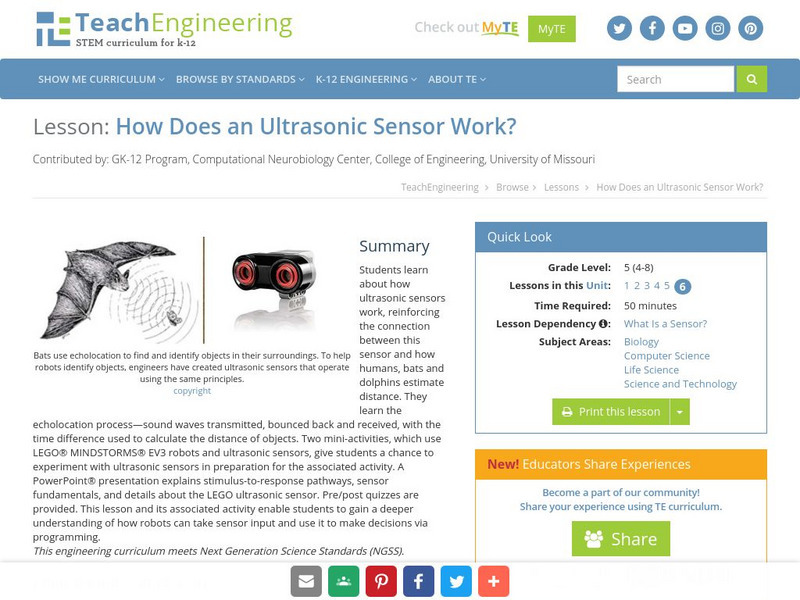
TeachEngineering
Teach Engineering: How Does an Ultrasonic Sensor Work?
Students learn how ultrasonic sensors work, reinforcing the connection between this sensor and how humans, bats, and dolphins estimate distance.

PBS
Pbs Teachers: Real Scientists: Audio Engineer
Discover how an engineer uses ultrasound to focus and aim sound waves with the "Audio Spotlight" that he developed.
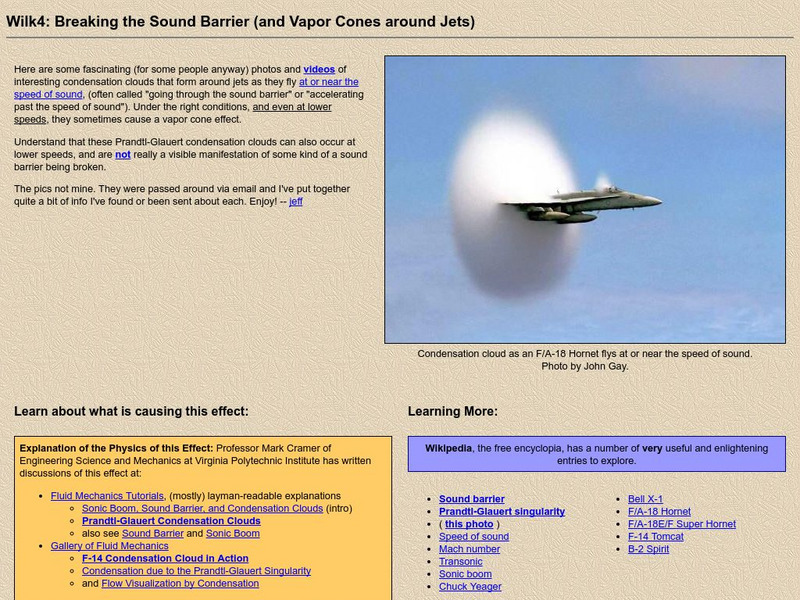
Other
Wilkinson Family: Breaking the Sound Barrier
This resource provides pictures and other information to show just what breaking the sound barrier means.