Hi, what do you want to do?






Curated OER
The Random Walk
Deep mathematical thinking is found with just a coin and a number line. Combining computing some probabilities in a discrete situation, and the interpretation of a function, this simple task gives learners a lot to think about on...

Curated OER
The Random Walk II
Deep mathematical thinking is found with just a coin and a number line. Combining computing some probabilities in a discrete situation, and the interpretation of a function, this simple task gives learners a lot to think about on...

Wake Forest University
Authentic Activities for Connecting Mathematics to the Real World
Check out the handout from a presentation that contains a collection of high school algebra projects connecting a variety of mathematics to the real world. Activities range from simple probabilities to calculus. The activities...

Curated OER
Mathematics Activities from Diverse Cultures
Connect probability and odds with different games from around the world. Pick from games like Dreidel, Mancala, and a Navajo stick game called Ashbil. All 12 games include probability questions to encourage a discussion before or after...

Curated OER
Rating Systems
Your favorite sports team is ranked #1. How do the powers that be determine this rating? Learn how ratings are mathematically computed using probability concepts, from the Elo Rating System for chess to the Rating Percentage Index for...

Stats Monkey
Everything I Ever Needed to Learn about AP Statistics I Learned from a Bag of M and M's®
Candy is always a good motivator! Use this collection of M&M's® experiments to introduce statistics topics, including mean, standard deviation, nonlinear transformation, and many more. The use of a hands-on model with...

Curated OER
Breakfast Before School
Are the events "I eat breakfast" and "I am late for school" independent events? Assess learners' understanding of independence in a simple context with this short activity. Use as an opener, as part of an assignment, or discuss together...

Curated OER
Alex, Mel, and Chelsea Play a Game
This short probability question may look simple at first, but it is actually quite complex! Learners must understand independent events in context and must take into account several different scenarios. Use as an individual assignment...

Illustrative Mathematics
How Many Cells Are in the Human Body?
Investigating the large numbers of science is the task in a simple but deep activity. Given a one-sentence problem set-up and some basic assumptions, the class sets off on an open-ended investigation that really gives some...

Illustrative Mathematics
Identifying Rational Numbers
Eight different numbers are listed for mathematics masters to analyze. They simply tell if each number is rational or irrational. They can also explain their reasoning. A simple and straightforward activity that is a handy tool for...

Teach Engineering
Light vs. Heat Bulbs
Careful, that light bulb is hot! Compare heat and light energy using a simple light bulb. The exercise addresses energy conservation and presents actual calculations to determine the most cost-effective light bulb.

Illustrative Mathematics
Voting for Two, Variation 2
John won the election, but by how much more? Your learners will calculate how many votes each candidate received in order to determine the difference. Use with other lessons provided in the series to practice different variations of this...
University of Cambridge
University of Cambridge: Maths and Sports: Arsenal Collection: Football Formations
How many different football team formations can you find? This activity provides an engaging real-life context to investigate simple combinations, and is aimed at Key Stage 3 students.
Annenberg Foundation
Annenberg Learner: Math in Daily Life: Playing to Win
A simple explanation of the link between math and winning odds at a casino. Learn about determining probability through two examples and about other ways we "play the odds" in real life. A second part of this article, "Place Your Bets:...
National Council of Teachers of Mathematics
Nctm: Figure This: Vcr
This resource presents an interesting challenge for the serious mathematician with strong reasoning skills. Explore proportional reasoning, probabilities, fractions, and ratios in this challenge to figure out if you always get six hours...
University of Cambridge
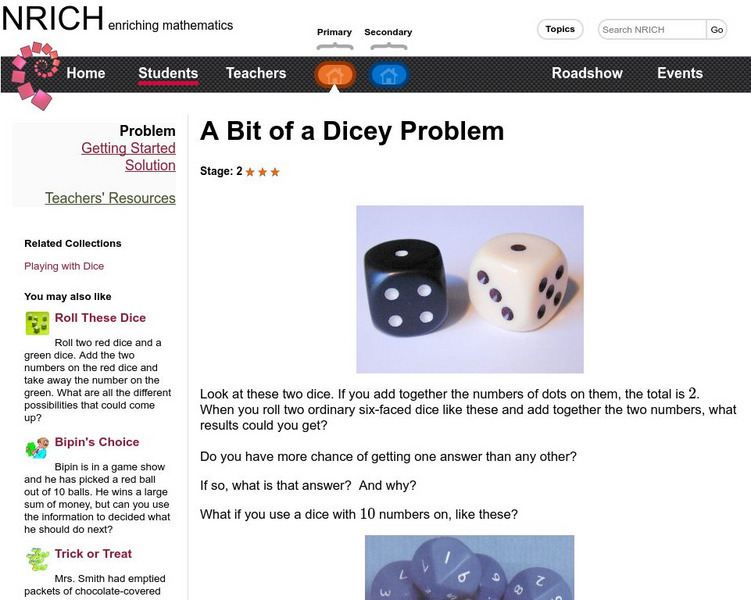
University of Cambridge: Nrich: A Bit of a Dicey Problem
Short website offers a look into the theoretical probability of tossing dice. Several questions related to the throwing of dice are included.
University of Cambridge
University of Cambridge: Nrich: In a Box
This probability problem encourages the learner not only to arrive at a solution, but also to defend it.
Hopelink
Hopelink: Teaching Percentages
Students can brush up on percentage skills with this lesson and calculate percentages using the "Percent Tricks method." For students to successfully use this method, they must have the ability to multiply and divide whole numbers.