Hi, what do you want to do?






Curated OER
Ladybugs, Ladybugs, Ladybugs
Those lovely ladybugs are so cute, and so very useful! Use a short unit to explore insect anatomy, the ladybug life cycle, and the help ladybugs provide organic farmers. The unit is comprised of four short thirty-minute lesson plans that...

Curated OER
Something Fishy in Ontario
Students create a diorama of the habitat of the fish of their choice, along with a research paper. They research habitats, the factors which affect specific habitats, and how fish adapt to different habitats in order to meet their unique...

Curated OER
Sustainability and Extinction
Galapagos Penguins are the only penguins on earth that live north of the equator (in the wild). In this last lesson plan a discussion on how the Galapagos islands developed their populations and diversity sparks the introduction. Two...

Cornell Lab of Ornithology
Life In A Nest: Exploring Life Cycles With Bird Cams
Why read about it when you can watch it happen? Bird cams make it possible for learners to experience the life cycle of a bird in real time! An engaging set of lessons provides activities to connect their learning to bird cam...

Curated OER
Watch Them Grow
Students explore the growth of plants and animals. Through research and observation, students create a habitat for specific plans and animals. As a group, they examine the similarities and differences of living things. Students identify...

Curated OER
Anthropogenic Biomes
If you teach a man to fish, he will never go hungry—or he will overfish and permanently damage the ecosystem? Address the traditional biomes as well as the human-included ecosystems and contrasts the biotic and abiotic factors in each....

NASA
Engineering Design for Human Exploration
What would it take to live on the lunar surface? Small groups build model rockets in order to simulate launching a habitat into space and rebuilding it. Divide the class into groups to design and build a model of a lunar habitat. The...

Curated OER
Habitats of the World
Students complete a unit of eighteen lessons that cover climate, geography, location, plants, and animals of each of the five habitats. They are also introduced to habitat destruction and discuss ways to protect the environment. They do...

Curated OER
Interesting Insects
Students discover the characteristics of insects. They explore insects through cooperative learning, group projects, hands on activities, and poetry. They gain knowledge of insect life cycles, habitat, and physical characteristics.

Curated OER
Exploring Habitats
Students analyze the difference between the human habitat and the different habitats of animals in the six lessons of this unit. The students' imaginations and literature are used to explore important aspects of the living environments...

TeachEngineering
Teach Engineering: Life Science
This unit covers the processes of photosynthesis, extinction, biomimicry and bioremediation. In the first lesson on photosynthesis, students learn how engineers use the natural process of photosynthesis as an exemplary model of a complex...
Friends of Algonquin Park
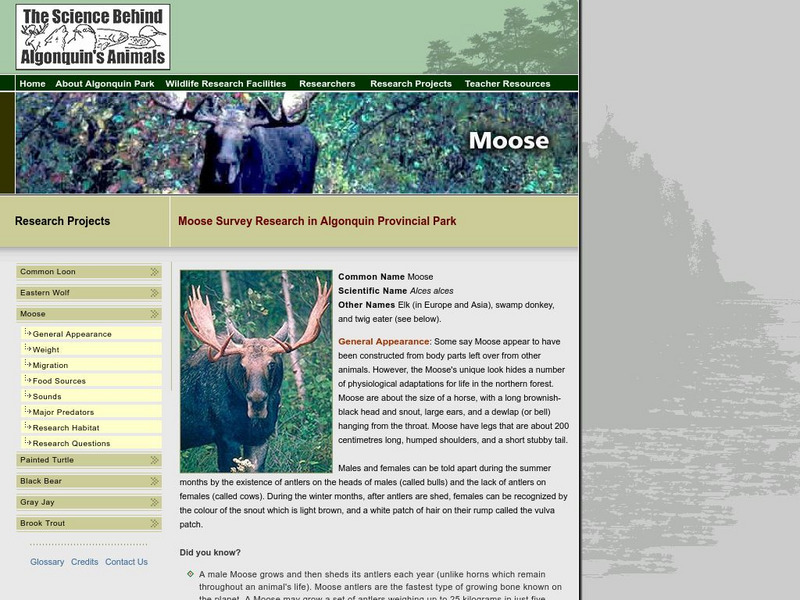
The Science Behind Algonquin's Animals: Moose
Information is provided on the moose, its general appearance, weight, migration, food sources, habitat, and major predators. This is excellent information for a student research project.
Science Buddies
Science Buddies: M&m Survival Challenge
In the wild, there are two types of animals: the hunters and the hunted. A good predator is always on the prowl for fresh prey. What can an animal do to stay off of the menu? Find out how some animals use camouflage, and why sometimes it...
Friends of Algonquin Park
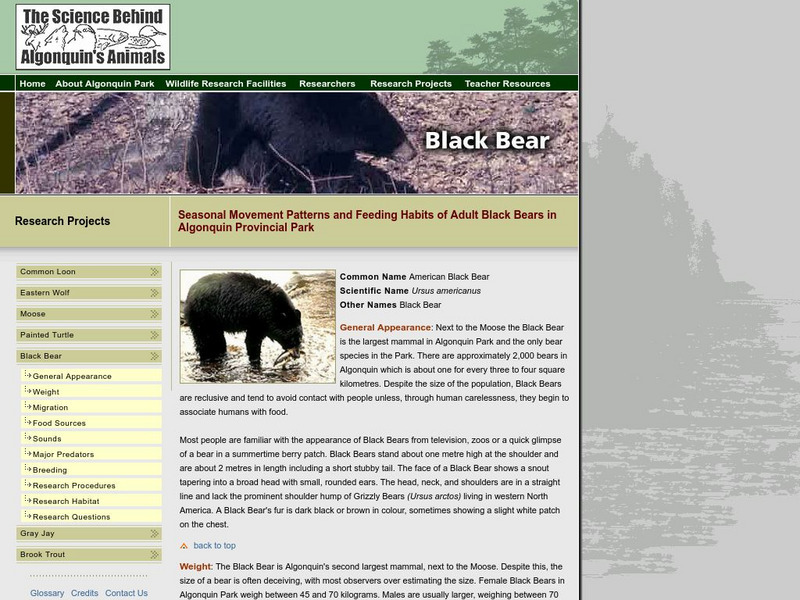
The Science Behind Algonquin's Animals: Black Bear
Known as the American Black Bear or commonly the Black Bear, information is detailed on its appearance, weight, migration patterns, food sources, major predators and breeding. This is an excellent resource for the student researcher.
Friends of Algonquin Park
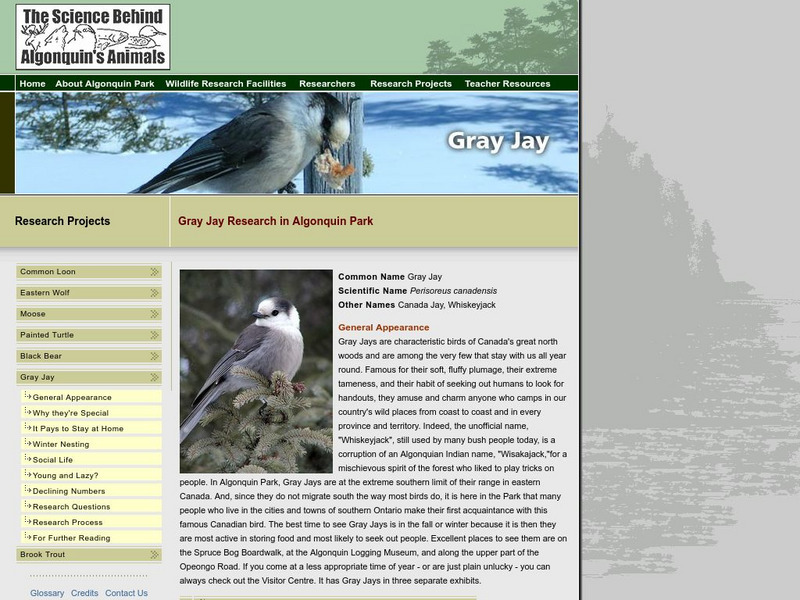
The Science Behind Algonquin's Animals: Gray Jay
The Gray Jay is found in Canada's north woods and is one of the few birds that stay all year round. Learn about its appearance, why they are special, nesting, and social life along with other interesting facts.
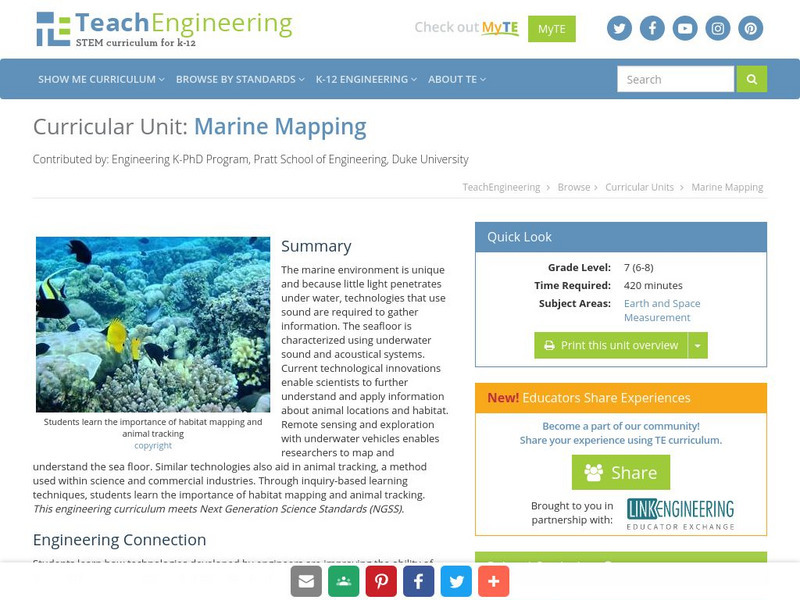
TeachEngineering
Teach Engineering: Marine Mapping
The marine environment is unique and requires technologies that can use sound to gather information since there is little light underwater. The seafloor is characterized using underwater sound and acoustical systems. Current...