Hi, what do you want to do?






Core Knowledge Foundation
Classification of Animals Tell It Again!™ Read-Aloud Anthology
Animal classification is the theme of a three-week read-aloud anthology. Scholars listen to and discuss a reading and complete extension activities throughout nine lessons. Writing opportunities delve deep into the process of writing an...

Columbus City Schools
Get Your Organisms Organized
From large to small, show your class how to organize them all! Included within the guide is everything you need to take their knowledge of classification from the cellular to the species level. The worksheets focus on...

Intel
Insects: The Good, The Bad, The Ugly
What would the world be like with no insects? Ponder this question using a research-based STEM unit that encourages scholars to investigate insects from both a beneficial and hazardous perspective. They learn about insect behaviors,...

Lerner Publishing
Meet the Dinosaurs
Take your class of youngsters on a prehistoric adventure with this four-lesson series on dinosaurs. Accompanying the Meet the Dinosaurs books by Don Lessem, these lessons engage children in writing their own dinosaur books,...

Homeschool Share
Lion Lapbook
Is your class in the mood for a fantastic set of lion-themed activities? Foldables, worksheets, writing prompts, and simple-to-read information are yours for the taking! Intended to accompany a unit on lions, this resource provides...

Curated OER
Everything in Its Place: Science Classification
Students investigate the system of classification for living things through the sixteen lessons of this unit. The five kingdoms of monerans, protists, fungi, plants, and animals form the basis of several experiments as the similarities...

Curated OER
Classy
Students explore the classification system in this seven lessons unit. The diversity of life forms and their characteristics are examined using a microscope. Kingdoms, classes, and families are investigated.

Curated OER
Write On! Step by Step Paragraph and Report Writing
Students plan and write paragraphs while integrating other core subject areas. In this paragraph writing lesson, students complete 5 lessons to practice writing paragraphs. Students incorporate various core subjects into their paragraph...
E-learning for Kids
E Learning for Kids: Science: Easter Island: Why Do Young Grow Up to Look Like Their Parents?
Kevin and his grandfather, Omag are going to the zoo. Join them and learn all about animal classification and life cycles.
Scholastic
Scholastic: Study Jams! Science: Animals: Kingdoms of Life
A playful interactive introducing biology's five animal kingdoms. Watch the video, take a quiz, and review vocabulary.
Scholastic
Scholastic: Study Jams! Science: Plants: The Kingdoms of Life
A video, a karaoke song to sing along to, and a 7-question multiple-choice quiz on the topic of Kingdoms in the life classification system.

Extreme Science
Extreme Science: Animal Kingdom: Creepy Crawlies: Goliath Beetle
How do scientists know that the goliath beetle is the largest beetle? What's stopping them from getting even bigger? Find the answers to these questions and other interesting facts from Extreme Science.

CK-12 Foundation
Ck 12: Third Grade Science: Life Sci: Animal Characteristics and Classification
[Free Registration/Login may be required to access all resource tools.] Presents an overview of the major animals groups (mammals, birds, reptiles, amphibians, fish, arthropods, vertebrates, invertebrates, those having live births and...
E-learning for Kids
E Learning for Kids: Science: Caribbean Sea: Mexico: What Is Classifying?
Christina wants to classify all kinds of different things. Help her sort things into main groups.

E-learning for Kids
E Learning for Kids: Science: Antilles: How Can We Classify Animals?
Naomi teaches diving and meets all kinds of animals underwater. Join her and learn about grouping animals.

E-learning for Kids
E Learning for Kids: Science: Caribbean Sea: How Can We Classify Animals?
Welcome to Hideaway Island where five pirates need to find crews for their ships. Join in and learn about animals with backbones.

CK-12 Foundation
Ck 12: Life Science: Organization of Living Things
[Free Registration/Login may be required to access all resource tools.] When you see an organism that you have never seen before, you probably put it into a group without even thinking. If it is green and leafy, you probably call it a...

Georgia Department of Education
Ga Virtual Learning: Biology: Animals
Through video clips. informational text, interactive activities, and assessment opportunities, students study and learn about the classification of animals.
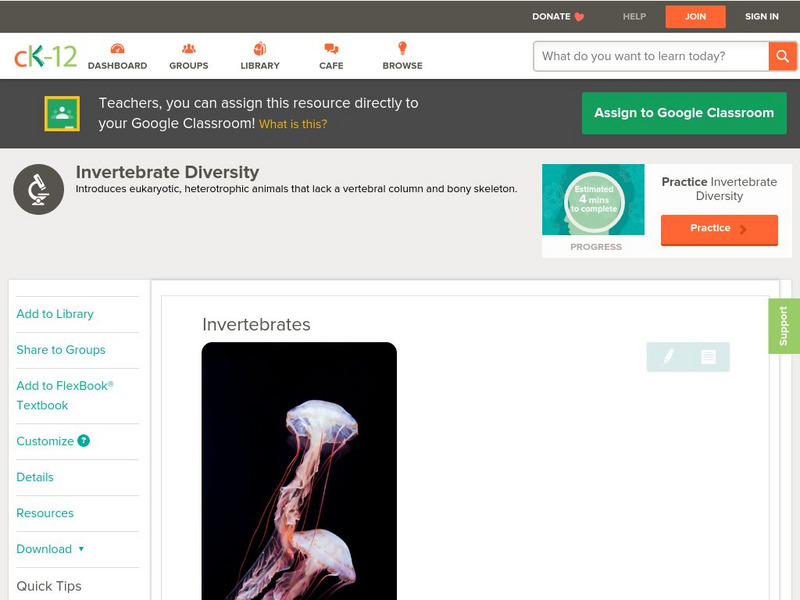
CK-12 Foundation
Ck 12: Life Science: Invertebrates
[Free Registration/Login may be required to access all resource tools.] Animals are also often identified as being either invertebrates or vertebrates. These are terms based on the skeletons of the animals. Vertebrates have a backbone...

Georgia Department of Education
Ga Virtual Learning: Ap Biology: Animals
This unit focuses on the unique structure and function of both invertebrate and vertebrate animals. Students review their understanding of animal diversity, and take a closer look at the various organ systems found in the animal kingdom.
Other
Science4 Us: Animals
In online and offline activities, students broaden their understanding of animals by learning to identify and classify animals into six categories: mammals, birds, fish, amphibians, reptiles, and invertebrates.