Hi, what do you want to do?






Illustrative Mathematics
Floor Plan
A multi-step problem has learners finding the actual area based on a scale drawing and then converting units at the end. Two different solution choices are listed depending on the preference on which step to start first. Both methods can...

Teach Engineering
What is a Nanometer?
Teams learn about the size of a nanometer by measuring objects and converting those measurements. A worksheet then tests the groups' abilities to use nanometers by having them determine the size of objects that are too small to...

Howard Hughes Medical Institute
What van Leeuwenhoek Saw
When van Leeuwenhoek saw cells and single-celled organisms for the first time, he knew these small things were a big deal! Share his discoveries with young learners through a narrated video, model-building activity, and scale study....

Education Development Center
Anita's Way to Add Fractions with Unlike Denominators
Could you develop your own way to add fractions with unlike denominators? An in-depth task has scholars examine a fictional conversation between several people in which they discuss a method of adding fractions with unlike denominators....

Curated OER
Mass vs. Weight
Why do you weigh more in space? Each individual in your class explores this question and others as they determine the mass and weight of different objects using two types of scales. They perform conversions and discuss their...

Indian Institute of Technology
Could King Kong Exist?
The title says it all: Could King Kong exist? Investigate how increasing the dimensions of an object affects its surface area and volume to mathematically conclude whether a creature with the weight and height of King Kong could actually...
Texas Instruments
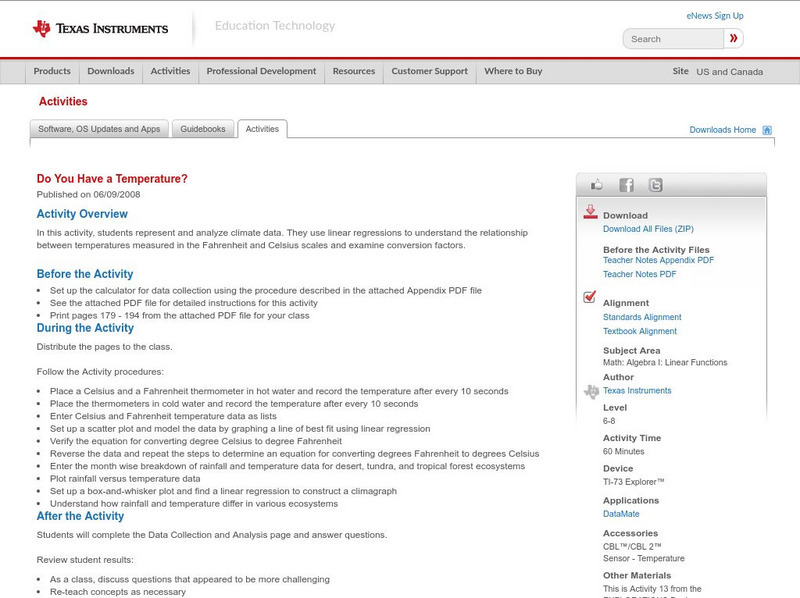
Texas Instruments: Do You Have a Temperature?
In this activity, students represent and analyze climate data. They use linear regressions to understand the relationship between temperatures measured in the Fahrenheit and Celsius scales and examine conversion factors.