Hi, what do you want to do?





Stanford University
Beyond the Bubble: History Assessments
[Free Registration/Login Required] A collection of innovative assessments, interactive rubrics, and annotated samples of student work with an emphasis on primary source documents for the use in a wide range of history concepts.

Library and Archives Canada
Nlc: Defining Primary and Secondary Sources
Libraries and archives hold documents and books that can be used for your research projects. Learn how to divide and identify them into primary and secondary sources in this tutorial.
Stanford University
Sheg: Document Based History: Reading Like a Historian: Battle of Little Bighorn
[Free Registration/Login Required] Students solve a problem surrounding a historical question by reading primary source documents. This historical inquiry lesson allows students to explore causes of the Battle of Little Bighorn by...
Stanford University
Sheg: Document Based History: Reading Like a Historian: Prohibition
[Free Registration/Login Required] Students read primary source documents to solve a problem surrounding a single historical question. This document-based inquiry lesson allows students to consider the 18th Amendment within the...
Stanford University
Sheg: Document Based History: Reading Like a Historian: Pocahontas
[Free Registration/Login Required] Students use primary source documents to investigate central historical questions. In this investigation, students use evidence to explore whether Pocahontas actually saved John Smith's life and...
Stanford University
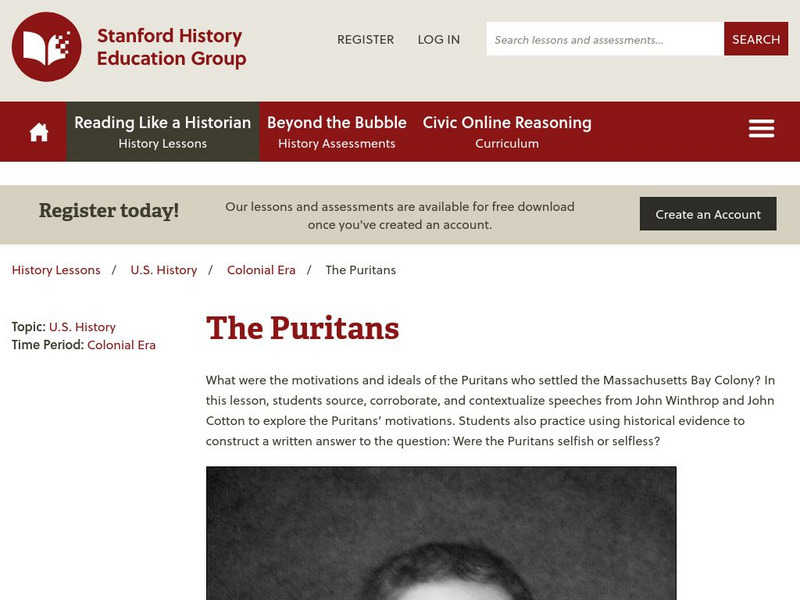
Sheg: Document Based History: Reading Like a Historian: The Puritans
[Free Registration/Login Required] Students solve a problem surrounding a historical question by reading primary source documents. This historical inquiry lesson allows students to source, corroborate, and contextualize speeches from...
Stanford University
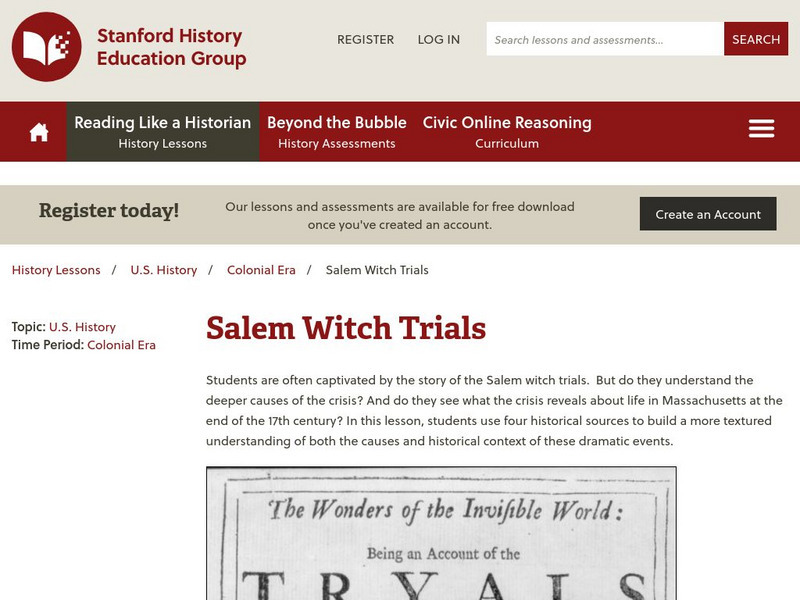
Sheg: Document Based History: Reading Like a Historian: Salem Witch Trials
[Free Registration/Login Required] Students read primary source documents to solve a problem surrounding a historical question. This document-based inquiry lesson allows students to use four historical sources to build a more textured...
Stanford University
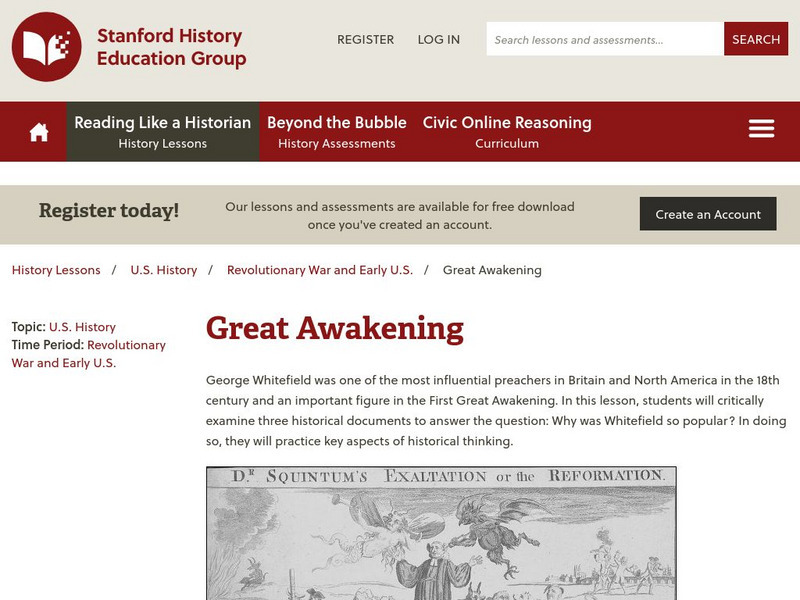
Sheg: Document Based History: Reading Like a Historian: Great Awakening
[Free Registration/Login Required] Students solve a problem surrounding a historical question by reading primary source documents. This historical inquiry lesson about the Great Awakening allows students to critically examine three...
Stanford University
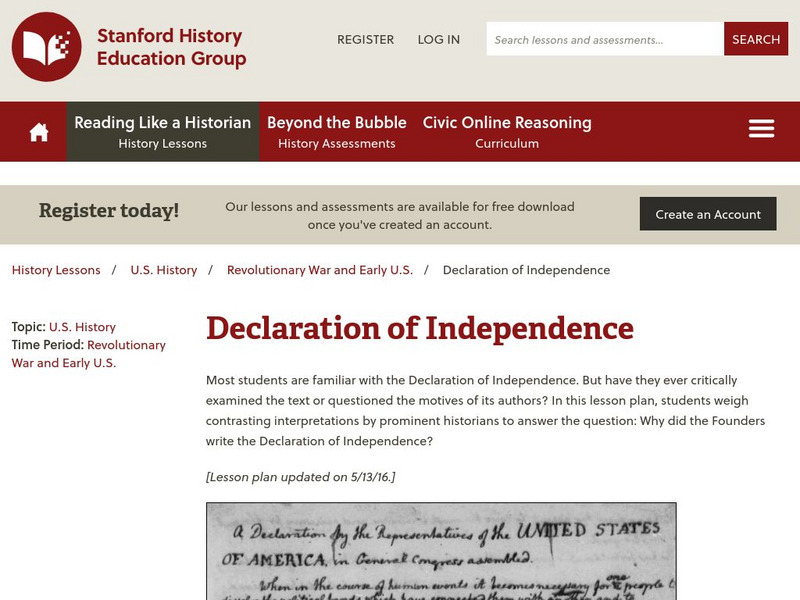
Sheg: Document Based: Reading Like a Historian: Declaration of Independence
[Free Registration/Login Required] Students use primary source documents to investigate central historical questions. In this investigation students weigh contrasting interpretations by prominent historians to answer the question: Why...
Stanford University
Sheg: Document Based History: Reading Like a Historian: Anti Suffragists
[Free Registration/Login Required] Students solve a problem surrounding a historical question by reading primary source documents. This historical inquiry lesson allows students to study a speech and anti-suffrage literature to explore...
Stanford University
Sheg: Document Based History: Reading Like a Historian: Japanese Internment
[Free Registration/Login Required] A lesson delving into the reasoning behind interning the Japanese-Americans following the Pearl Harbor attack. Students will explore primary source documents to draw their conclusions.
PBS
Pbs Learning Media: Election Central 2016: Elections Throughout History
This link from the Election Central 2016 website focuses on elections throughout history with the use of primary source documents such as campaign posters, newspaper headlines, and video clips from various Presidential elections...
National Archives (UK)
National Archives Learning Curve: Hitler
Three 1937 reports speak to the potential problems of a Hitler-led Germany. Primary source documents, cartoons, and historical documents address the question, "Was Hitler a passionate lunatic?" in this series of performance tasks.
US National Archives
Docsteach: The Voting Record of the Constitution
In this activity, students will analyze a primary source document to find relevant historical data and measure the degree of agreement and disagreement during the Constitutional Convention.
Google Cultural Institute
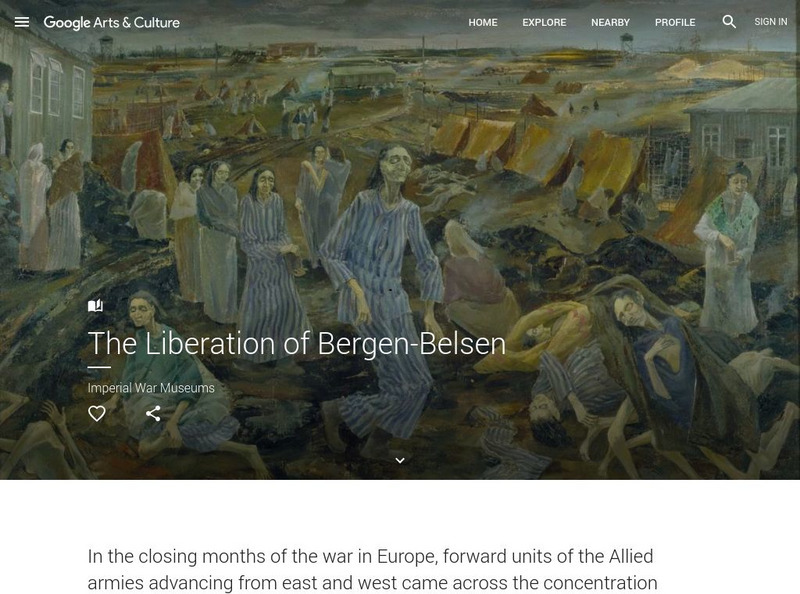
Google Cultural Institute: The Liberation of Bergen Belsen
A pictorial history of the liberation of the Bergen-Belsen concentration camp by British troops in April 1945 includes stories, quotes, and primary source documents.
Stanford University
Sheg: Document Based History: Reading Like a Historian: The Korean War
[Free Registration/Login Required] Students are given an opportunity to look at two textbooks recalling the same event, but one is written in and for North Korean schools and the other in and for South Korean schools. After reviewing the...
University of California
History Project: The Trial and Execution of John Brown
Using primary source documents, high school lesson plan focuses on John Brown, the events at Harper's Ferry, and his trial and execution. Included are excerpts from 16 primary source documents to aid in the research of writing this paper.
PBS
Wnet: Thirteen: Freedom: A History of Us. Printable Page
This article "Freedom: A History of US: Webisode 10, Segment 6: Hard Times," from Thirteen WNET New York, gives the reader an informative snapshot of the cause and impact of the Gilded Age depression of 1893. Students and teachers will...
US National Archives
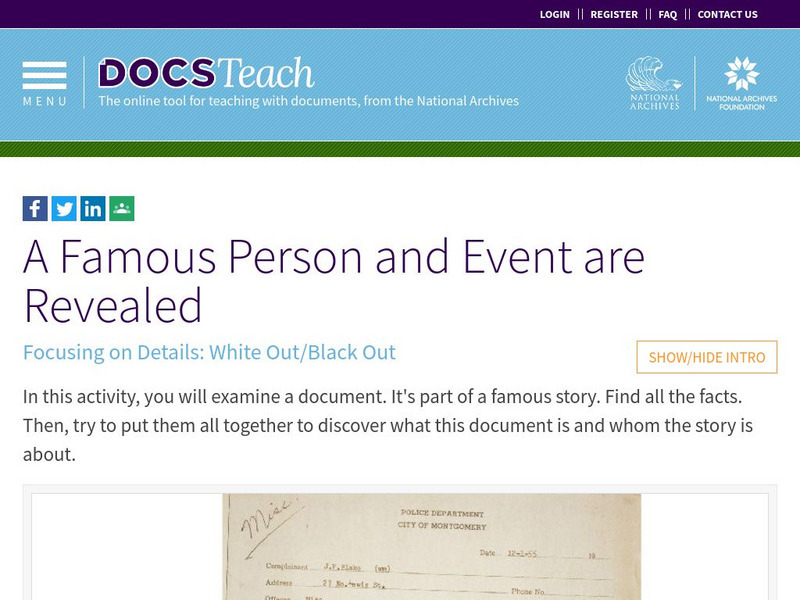
Docsteach: A Famous Person and Event Revealed: Examining an Arrest Record
This activity requires students to examine the arrest record of an un-named person. Students will analyze and evaluate the data contained in the document, applying prior knowledge, to discern what happened in the incident and the...
Choices Program, Brown University
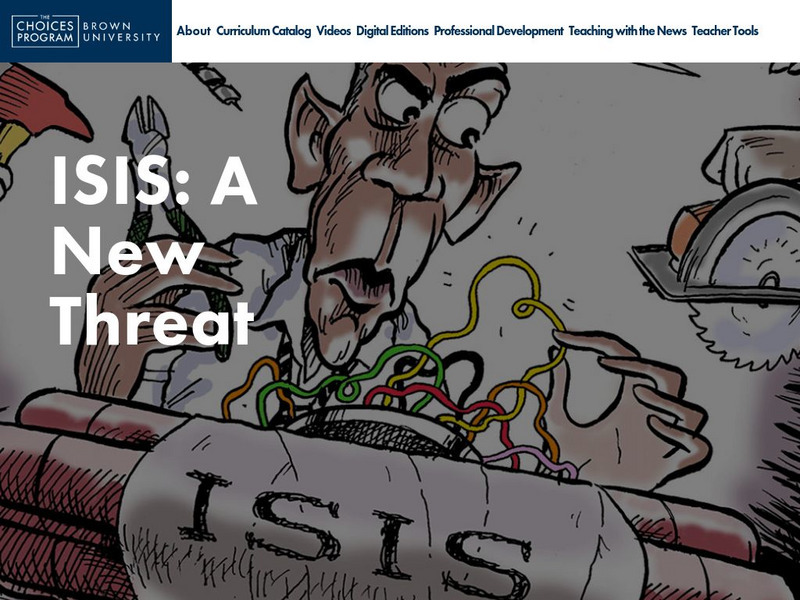
Choices: Teaching With the News: Isis: A New Threat
Learning module with comprehensive and relevant resources from which students explore the role of ISIS in the Middle East and U.S. response. Site inlcudes handouts, video, and primary source material for analysis and interpretation.