Hi, what do you want to do?






Mr. Hill's Science Website
Solar System Fact Sheet
Here is a fantastic, educational handout packed with information and facts not only about the planets in our solar system, but also regarding major moons and their surface features, dwarf planets, comets, and asteroids.

Laboratory for Atmospheric and Space Physics
Charting the Progress of New Horizons
In 2006, New Horizons began its mission to fly to Pluto. As it continues its journey, scholars track its progress with the help of an informative website, all the while reinforcing measurement concepts with the construction of a scaled...

Laboratory for Atmospheric and Space Physics
Looking to the Future
New Horizons set forth on a mission to Pluto in 2006. Ten years later, the spacecraft is still on its way. Here, enthusiastic scholars predict what they will be like—likes, dislikes, hobbies, etc.—when New Horizons arrives at its...

Curated OER
Our Solar System-- Fact File
In this space science worksheet, students read facts about the solar system. Students look at the diagram showing the position of the planets. Pluto is included as a planet here.

NASA
Nasa: Mission Science: What Is a Planet?
Find out about how planets have been classified historically, and what scientists use to study them.
University of California
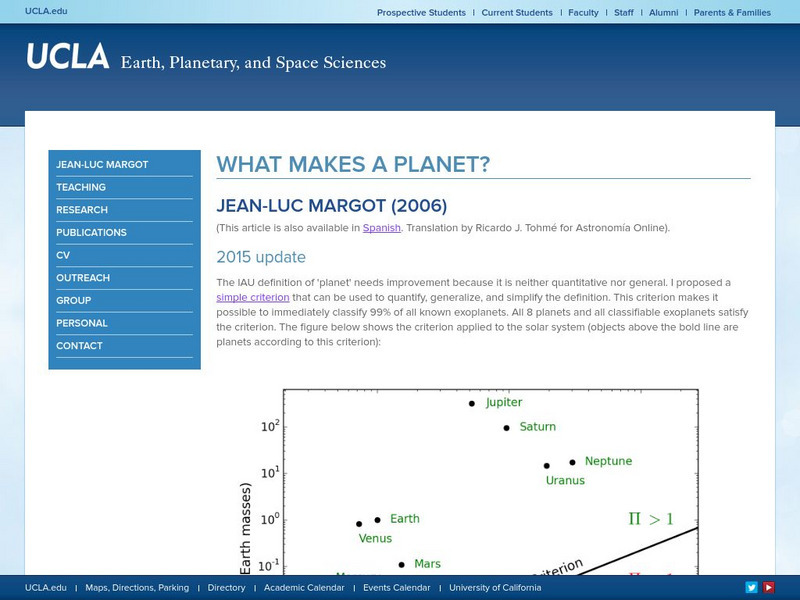
Ucla: What Makes a Planet
This detailed essay defines planets and compares the characteristics to those of Pluto. Orbital graphs and background information clarify the change in Pluto's categorization. A copy of IAU's Resolution 5 is also contained in this essay.
Other
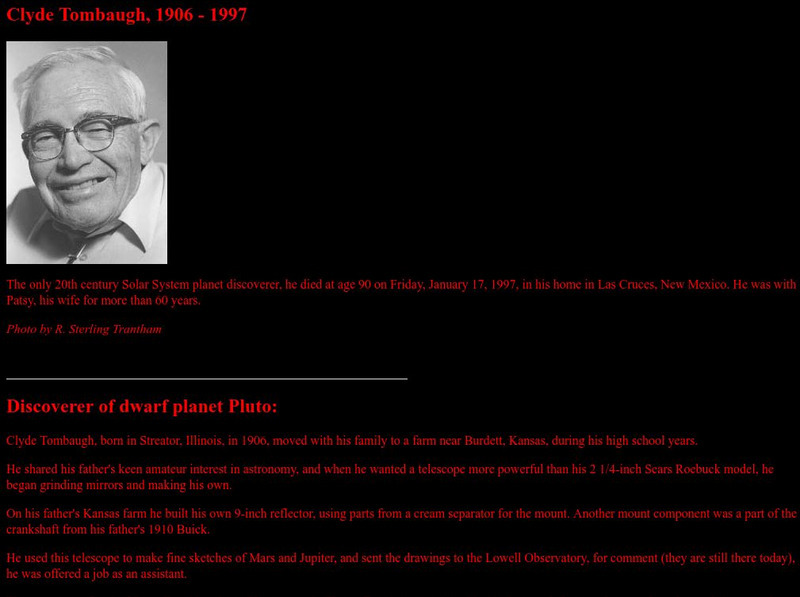
Observatorio Arval: Clyde Tombaugh
This is a biography page for the American astronomer and discoverer of Pluto, Clyde Tombaugh.
NASA
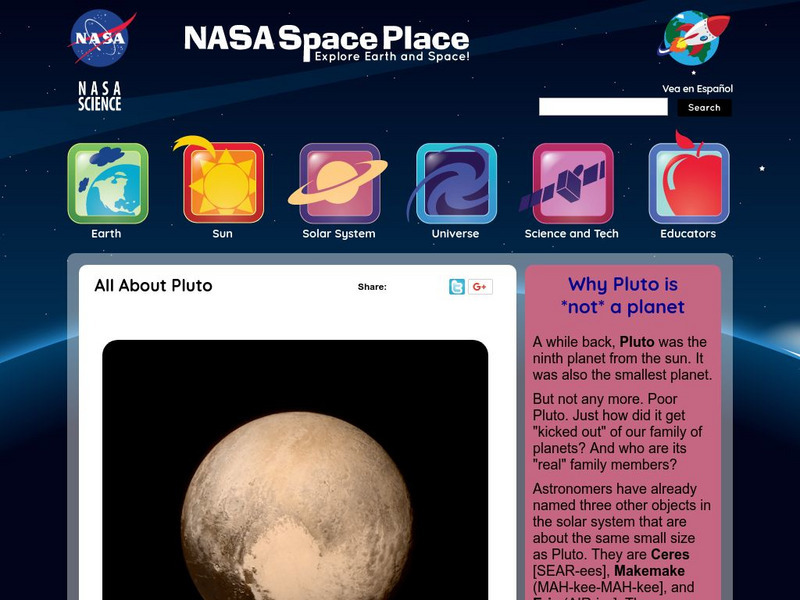
Nasa: The Space Place: Hail King of the Ice Dwarfs
This resource provides a nice overview of Pluto. Get information on Pluto's size, tilt, orbit and surface features. There is also a brief explanation of the "New Horizons" space probe.