Hi, what do you want to do?






California Academy of Science
Tropical Belt
Where in the world is the equator? Explore a world map with your class, coloring in oceans, continents, and rainforests while locating the three major lines of latitude: the equator, Tropic of Cancer, and Tropic of Capricorn. Discuss how...

Constitutional Rights Foundation
The Cold War: How Did It Start? How Did It End?
What is the difference between a Cold War and a Hot War? Scholars research the beginning of the Cold War. They analyze diary entries as well as excerpts from various events during the 45-year standoff. To finish, they prepare final...

NOAA
Why Should I Care?: Show How Increased Carbon Dioxide Makes the Ocean More Acidic
How does a change in pH affect the ocean ecosystem? Scholars explore the idea by making an acid-base indicator in part seven of the 10-installment Discover Your Changing World series. First, they explore impacts of carbon dioxide in...

Curated OER
The Seven Continents Scavenger Hunt
Who doesn't enjoy an engaging scavenger hunt? Here, scholars listen to, and discuss, the informative text, Where is my Continent? by Robin Nelson. They then explore the seven continents and four major oceans using...

PBS
Reading Adventure Pack: Oceans
Flotsam by David Wiesner and The Magic School Bus on the Ocean Floor by Joanna Cole, illustrated by Bruce Degen, begin a reading adventure pack focusing on oceans. With story listening and thoughtful discussion, scholars complete several...

NOAA
Please Pass the Salt
Salinity is the focus of two experimenters that work to answer the question, How does salt change the physical properties of water? Super scientists compare the freezing rate of salt and fresh water, combine the two waters to...

Wilderness Classroom
Ocean Life
Our oceans are composed of many complex relationships. Young oceanographers explore relationships between organisms, understand the world ocean's currents, and discover the effects of water pollution and how it behaves. There are...

PBS
Make a Balloon Globe
"We've got the whole world in our hands," is what your students will be singing after completing this fun geography activity. Using the included templates for the seven continents and a balloon, they create their very own globes.

Discovery Education
Motion in the Ocean
How do temperature changes affect ocean currents? Scholars explore convection currents by demonstrating the flow of water in a baking dish. They use ice, heat, and food coloring to see currents. Then, they draw conclusions about their...

K-State Research and Extensions
Water
How are maps like fish? They both have scales. The chapter includes six different activities at three different levels. Scholars complete activities using natural resources, learn how to read a map, see how to make a compass rosette,...

Super Teacher Worksheets
My Explorer Report
This is the perfect resource to accompany your class project on famous explorers! Learners detail basic information about their chosen explorer, his/her main events of exploration and means of transportation, and finally,...

NOAA
Earth Origami
After reading a brief history of Carl Skalak's journey on the open waters, scholars make a three-dimensional model of the Earth out of an Origami balloon using a printable decorated as the Earth.

American Museum of Natural History
Make Your Own Creatures of Light
Bioluminescent animals are the focus of a hands-on craft in which scholars create a scene of either a land or sea bioluminescent creature.

US Department of Energy
Bringing Climate Change Into the Classroom
High schoolers investigate the greenhouse effect and examine the potential effects of climate change in the Arctic. They construct a mini-greenhouse and test its effect on temperature, analyze historical climate statistics, and conduct...

American Museum of Natural History
Create a Coral Reef
Scholars create a diorama to showcase a vibrant coral reef. Six steps walk pupils through setting up the diorama box, crafting four different types of marine life, and putting it all together.

BrainPOP
Latitude and Longitude Differentiated Lesson Plan
Scholars warm-up their map skills with a discussion using location words to describe familiar places. An engaging video informs class members about latitude and longitude. Three leveled activities extend the learning experience for...

Curated OER
Those Who Have Come Before Me
Class members are transformed into explorers as they work in groups to locate hidden items and map their journey along the way. They then leave clues for other groups of students to follow, and ultimately discover how past explorations...

American Museum of Natural History
Rubber Blubber Gloves
Using gloves, shortening, tape, and a lot of ice, participants experience the feeling of having blubber. The experiment's eight steps follow an informative page about blubber and animals that have it.

Illustrative Mathematics
Mile High
What is the meaning of sea level? This resource helps your class understand the meaning of elevations above, below, and at sea level. Provides for good discussion on using positive and negative numbers to represent quantities in the real...
Museum of Science
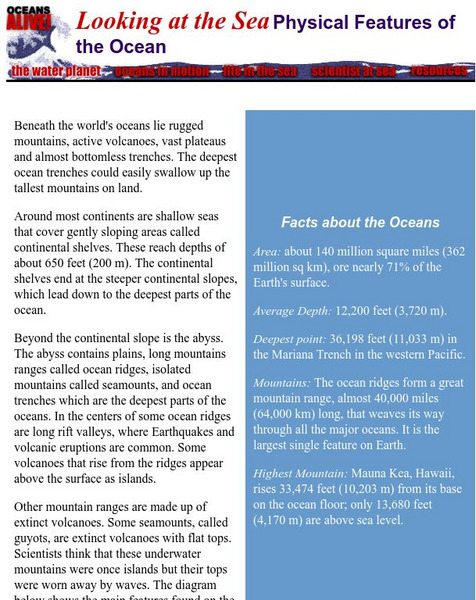
Oceans Alive! Physical Features of the Ocean
Oceans site explores the physical features that lie deep below the surface of our world's oceans.
Natural History Museum
Natural History Museum: The Oceans
This online exhibit from the Natural History Museum is home to ten units covering various aspects of the world's oceans including frozen oceans, deep oceans, barnacles, coral reef, deep-sea fish, sponges, vents, and more.
Read Works
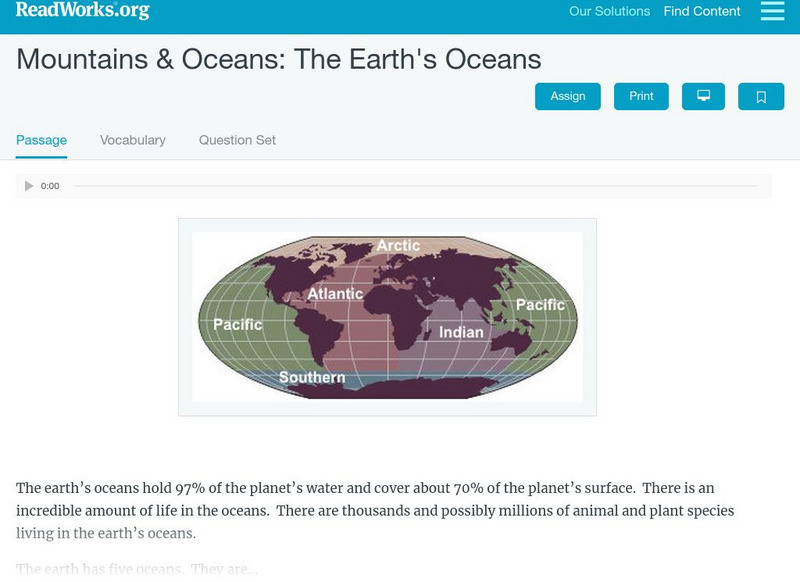
Read Works: Mountains and Oceans: The Earth's Oceans
[Free Registration/Login Required] An informational text about the oceans of the world. A question sheet is available to help students build skills in reading comprehension.
Other
Sea Turtle Conservancy: List of Sea Turtle Tracking Projects
Sea Turtle Conservancy is devoted to the conservation and tracking of sea turtles, this site links found along the left menu. Join a group, follow a tagged turtle via maps, learn about the challenges faced by the sea turtles, and the...

Read Works
Read Works: Sailing the Seas
[Free Registration/Login Required] An informational text about the Santa Maria, Christopher Columbus' ship. A question sheet is available to help students build skills in reading comprehension.