Hi, what do you want to do?






Constitutional Rights Foundation
Saved from the Gallows — the Trial of Leopold and Loeb
Was justice served for Bobby Franks? An informative article about the 1924 trial of Richard Loeb and Nathan Leopold includes an overview of the murder of Bobby Franks, the defense’s legal strategy, and excerpts of closing arguments from...

Alabama Department of Archives and History
"Scottsboro Boys": A Trial Which Defined an Age
Here's a must-have resource. Whether your focus is racism, the Great Depression, the "Scottsboro Boys" trial, or part of a reading of To Kill A Mockingbird, the information contained in the seven-page packet will save hours of...

University of Southern California
Deconstructing Genocide: The Ultimate Crime Against Humanity
There are eight stages of an atrocity known as genocide, and it's important to understand how they are represented so we can fight against it in the future. As young historians watch video clips of ten Jewish Holocaust survivors'...

Mississippi Department of Archives and History
Protesting Violence without Violence
The ultimate legacy of Emmett Till's violent death is its role in the non-violent roots of the Civil Rights Movement. A lesson plan compares contemporaneous articles with the lyrics of Bob Dylan's "The Death of Emmett Till" and prompts...

Curated OER
A Civil Action
Young scholars explore the roles of law enforcement officials, the news media, and civilians in crime prevention and criminal apprehension. They envision ways to build and strengthen community partnerships to address concerns about crime.

Curated OER
Essentials of the US Constitution
Students determine how the content of the U.S. Government enables the U.S. Government to function. They examine the roles and functions of the three branches of government and how the separation of powers and checks and balances affect...

Curated OER
Typecasting Roles
Students read and discuss various news articles where an element of surprise was present about the criminal and the crime. They research a news story, present the information in the form of a newscast, and write an opinion piece.

Curated OER
Shame on You!
Should public humiliation be an acceptable consequence for a crime? Have your middle schoolers engage in a round table discussion about the recent resurgence of the use of public humiliation as a punishment for crimes in the United...

Curated OER
Making a Case
Start the day by sharing opinions about human rights. Then, read "A Defiant Hussein Pleads Not Guilty to Mass Execution" with your middle and high school class. Your pupils research the specific charges in the case against Saddam...

Road to Grammar
Capital Punishment
Hold a brief discussion about the death penalty with your English language learners. The resource includes vocabulary words to examine, three different viewpoints for students to consider, and a list of discussion questions. The resource...

Facing History and Ourselves
American Responses to the Armenian Genocide
Young scholars examine World War I war crimes. In this world history instructional activity, high schoolers use primary and secondary sources to research and understand the action taken by the United States during the Armenian Genocide....

Curated OER
Covering the News
Learners compare the coverage of two crime stories Using local or national newspapers, news magazines and other reference materials, each group trace the "unfolding" of two crime stories: The Laci Peterson investigation plus one students

Curated OER
Genocide: Past & Present
Students visit the Holocaust Musuem through an interactive program. They examine Hitler's Final Solution and where concentration camps were located. They analyze how the situations in Auschwitz are similiar to Darfur.

Curated OER
The Ultimate Punishment
Young scholars discover information about the death penalty debate. They explore the history of the death penalty and how it has changed over time. They examine supporting and opposing viewpoints of the issue.

Curated OER
The 8th Amendment: The Death Penalty
Students take a closer look at the death penalty. In this U.S. government lesson, students watch a Discovery video about capital punishment in the United States and then compose letters to the editors of newspapers about their stance on...

Curated OER
Why Do We Suffer From The Rights Of Others?
Students examine how diversity within populations has caused problems. In groups, they develop their own definitions of racism and discrimination. They participate in role-plays in which they gather the appropriate techniques to deal...

Curated OER
Real Life Or Broken Mirror? Examining Media Representations of Teenagers
Students analyze representation of teenagers in the news and other media, discuss importance of media literacy in interpreting media portrayals of reality, and discuss and write about accuracy, or lack thereof, of media images of young...

Curated OER
The Armenian Genocide: The American Ambassador in Constantinople
Learners analyze America's reaction to the Armenian Genocide. They write a journal response, read and discuss text, compare/contrast reactions around the world to the Armenian Genocide and the genocide in Rwanda, and write an essay.

Curated OER
"Jazz is About Freedom": Billie Holiday's Anti-lynching Song Strange Fruit
Working in small teams, learners analyze a variety of primary source materials related to lynching (news articles, letters written to or written by prominent Americans, pamphlets, broadsides, etc.) in order to assess the effectiveness of...

Curated OER
Cartoons for the Classroom: Free Speech vs. Respect for Religion
In this historical events instructional activity, students analyze political cartoons about the First Amendment. Students respond to 3 talking point questions.
Digital History
Digital History: The Birth of American Popular Culture
American popular culture was many-faceted prior to the Civil War. Find out about the explosion of the number of newspapers and magazines, the many kinds of popular entertainment, and even phrenology as entertainment.
BBC
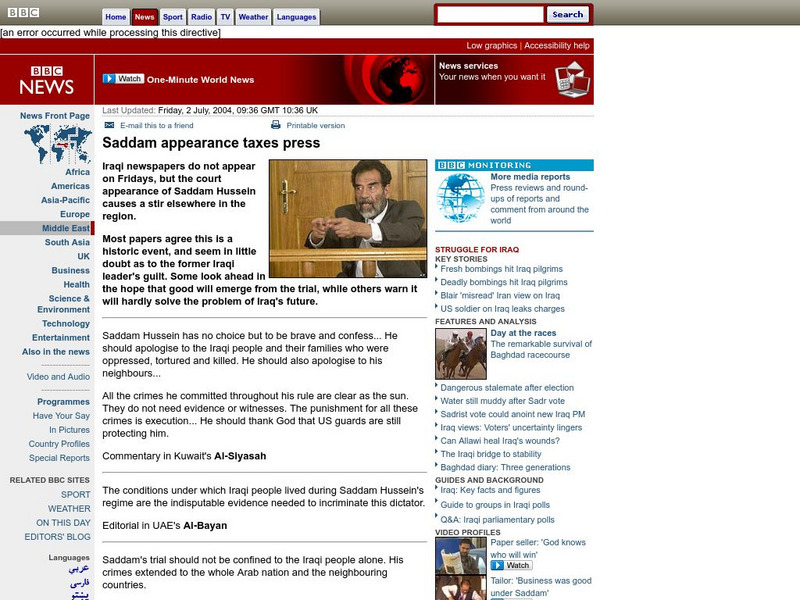
Bbc: Iraqi Press Reactions to Trial of Saddam Hussein
A series of excerpts taken from various Iraqi newspapers on their reaction to Saddam Hussein and his first appearance in an Iraqi court on July 1, 2004.
National Humanities Center
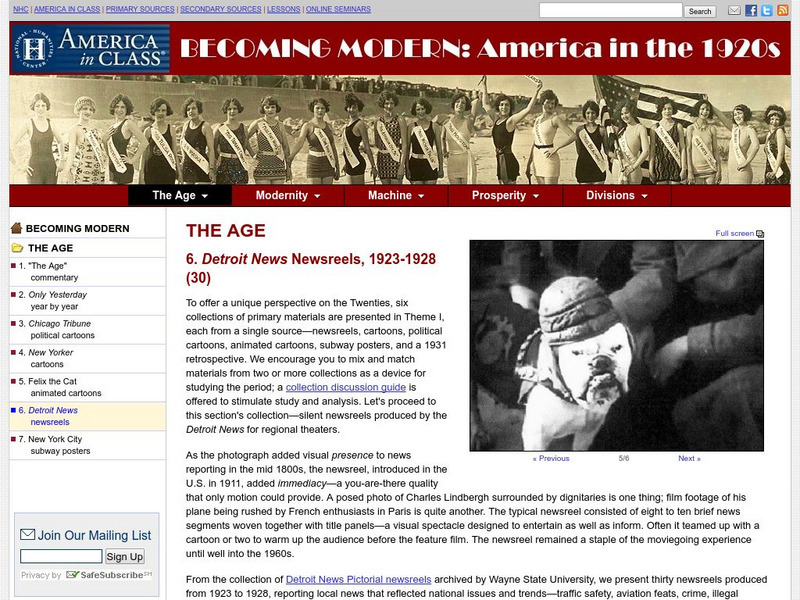
National Humanities Center: America in Class: America in the 1920s: Detroit News Newsreels
The National Humanities Center presents collections of primary resources compatible with the Common Core State Standards - historical documents, literary texts, and works of art - thematically organized with notes and discussion...