
Curated OER
Imperialism: J.A. Hobson (1902)
J.A. Hobson was a popular writer, economist, and critic of Imperialism. Learners will read a short excerpt from one of his publications and answer two, two-part questions regarding his views on Western imperialism in Asia. Tip: Ask your...

National Endowment for the Humanities
The New Order for "Greater East Asia"
Sometimes the New Order becomes synonymous with its implications for European countries, but what about its consequences for East Asia? The final instructional activity in a four-part series teaches scholars about World War II. High...

Curated OER
On the Road with Marco Polo: Marco Polo in China
Students trace Marco Polo's route into China and use the Internet to research major products fabricated in 13th century China. They discuss their findings and write a report on either: silk, porcelain, jade, lacquerware or tea.

Curated OER
Japanese Modernization and Imperialism
High schoolers examine the period in which Japan ended its isolationism with the rest of the world. Using the internet, they identify the reasons why Japan occupied and annexed Korea along with the country's reasons for going to war...

Curated OER
Gandhi's Salt March, A Simulation
Students examine Gandhi's Salt March. In this peace and tolerance lesson, students discuss the Salt Tax Levy that was imposed in India. Students then debate how the Indian National Congress should have handled the issue.

Curated OER
Munich: Peace in Our Time
Students examine the Munich Agreement. In this World War II instructional activity, students analyze the agreement made among Germany, the United Kingdom, France, and Italy. Students discuss the strengths and weaknesses of the agreement.

Curated OER
Late 19th Century U.S. Foreign Policy
Eleventh graders discover that many of the issues the United States faces today elicit the same type of political, philosophical and moral debate that has divided the country in the past.

Curated OER
Comparing Chinese And Japanese Ceramics
Students discuss the conception of beauty by considering and contrasting the
appearance and use of Chinese and Japanese ceramics in this lesson for the middle or high school classroom.

Curated OER
Unit on Gandhi and Ahimsa
Young scholars explore the history of Gandhi and his viewpoint and example of nonviolence. In this World History lesson, students complete numerous research assignments and activities over the course of nine lessons to expand their...

Curated OER
Gandhi’s 12 Vows: Training Warriors of Non-violence
Learners examine Gandhi’s ‘Walk n Talk’ strategy. In this lesson on civil disobedience, students evaluate Gandhi’s non-violent method of satyagraha as an effective mode of revolution.

Curated OER
On the Road with Marco Polo
Learners follow Marco Polo's route to and from China. They explore the geography, local products, culture, and fascinating sites of those regions. They record their findings.
Other
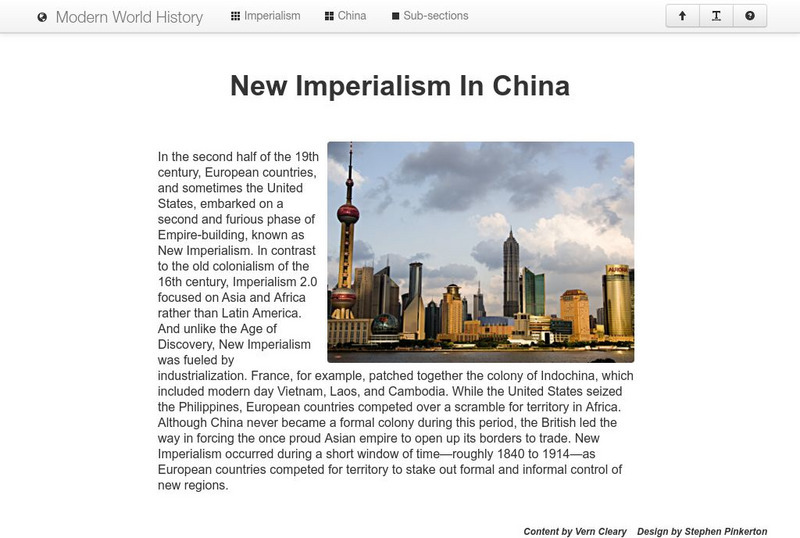
Modern World History: New Imperialism in China
Fueled by industrialization, European countries began empire building in the late 1800's. How did this affect China who was never formally colonized? Read this short introduction to imperialism in the late 1800's to see the consequences...
Tom Richey
Tom Richey: Modernization, Unification & Imperialism (1850 1914)
Study the modernization of Europe, the unification of Germany and Italy, and the New Imperialism in Africa and Asia with these resources. Find videos, lessons, and PowerPoint presentations.
OpenStax
Open Stax: American Foreign Policy 1890 1914: Economic Imperialism in East Asia
As America's economic prowess grew, it was able to harness this power to expand its imperialistic arm into China. This mutually beneficial relationship lasted until after World War II when China became a communist country.
![University of Illinois: Early Trade With China: The China Trade 1830 1860 [Pdf] Activity](https://static.lp.lexp.cloud/images/attachment_defaults/resource/large/FPO-knovation.png "University of Illinois: Early Trade With China: The China Trade 1830 1860 [Pdf] Activity")
University of Illinois
University of Illinois: Early Trade With China: The China Trade 1830 1860 [Pdf]
In the years following the American Revolution, speed was the most important consideration for any ship even if it came at the expense of cargo space. Sailing ships tended to be small and swift so that they could outrun and outmaneuver...
Other
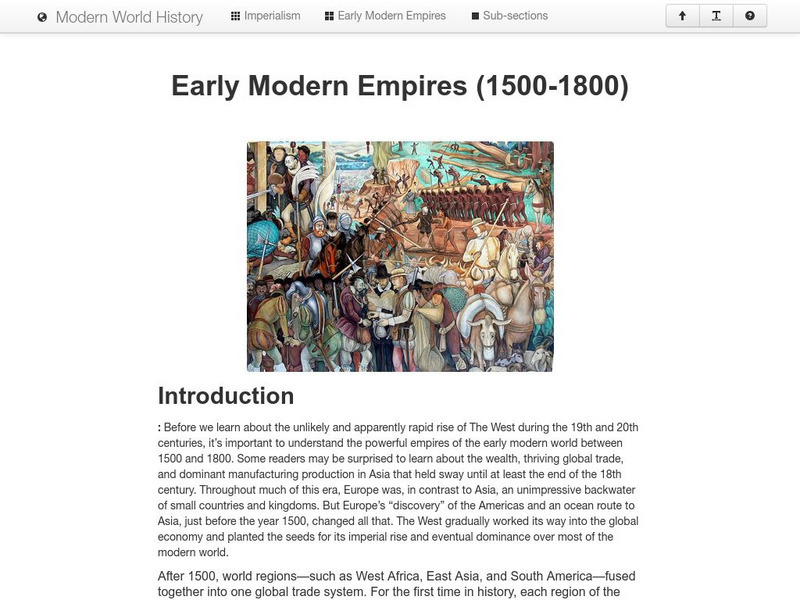
Modern World History: Early Modern Empires (1500 1800)
The roots of globalization began in the 15th century as modern empires began to thrive through trade. Asia was at its strongest during this time period, while Europe lagged behind until the discovery of America and an ocean route to Asia...
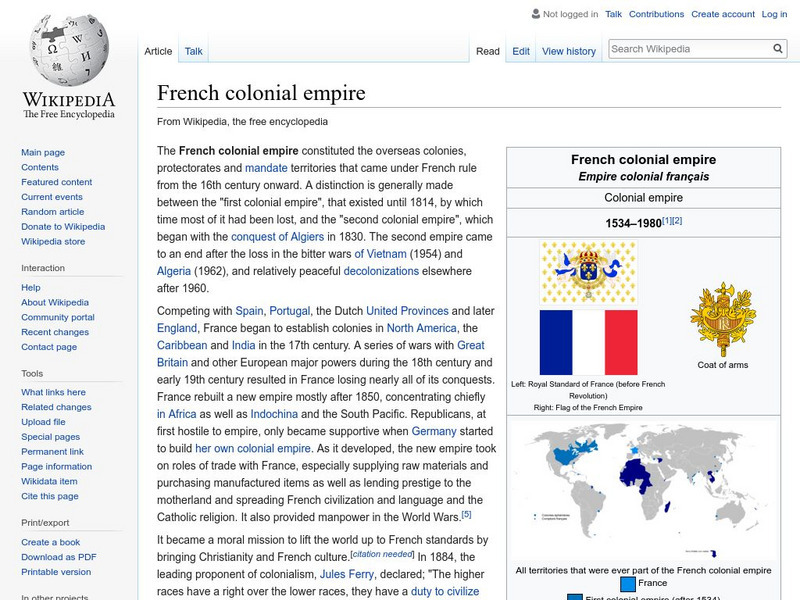
Wikimedia
Wikipedia: French Colonial Empire
A history of the French colonial empire from their efforts in Africa to those in southeast Asia. The article discusses the First French Empire in the New World, and the attempts to establish colonies during the Imperialism period of the...
Curated OER
Unesco: Viet Nam: Citadel of the Ho Dynasty
The 14th -century Ho Dynasty citadel, built according to the feng shui principles, testifies to the flowering of neo-Confucianism in late 14th century Viet Nam and its spread to other parts of east Asia. According to these principles it...