Hi, what do you want to do?





TeachEngineering
Teach Engineering: Washing Air
Students observe and discuss a simple model of a wet scrubber to understand how this pollutant recovery method functions in cleaning industrial air pollution.
TeachEngineering
Teach Engineering: The Dirty Water Project
In this activity, students investigate different methods (aeration and filtering) for removing pollutants from water. They will design and build their own water filters.

TeachEngineering
Teach Engineering: Truss Destruction
Students work within constraints to construct model trusses and then test them to failure as a way to evaluate the relative strength of different truss configurations and construction styles. Each student group uses Popsicle sticks and...
TeachEngineering
Teach Engineering: Marine Mapping
The marine environment is unique and requires technologies that can use sound to gather information since there is little light underwater. The seafloor is characterized using underwater sound and acoustical systems. Current...
TeachEngineering
Teach Engineering: Clean Up This Mess
Students are challenged to design a method for separating steel from aluminum based on magnetic properties as is frequently done in recycling operations. To complicate the challenge, the magnet used to separate the steel must be able to...
TeachEngineering
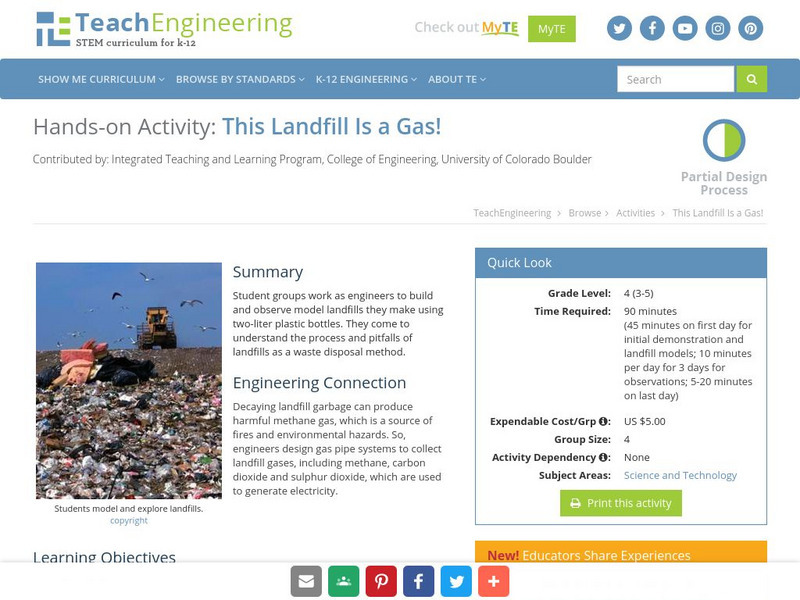
Teach Engineering: This Landfill Is a Gas!
In this activity, students work as engineers to build and observe a model landfill. They will understand the process and pitfalls of the use of landfills as a method for the waste disposal.
TeachEngineering
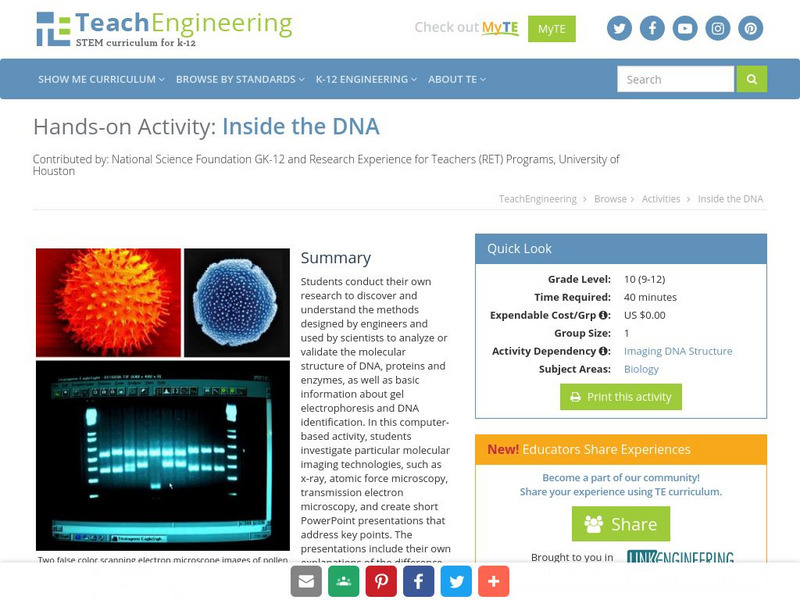
Teach Engineering: Inside the Dna
Students conduct their own research to discover and understand the methods designed by engineers and used by scientists to analyze or validate the molecular structure of DNA, proteins and enzymes, as well as basic information about gel...
OpenStax
Open Stax: Industrialization 1870 1900: From Invention to Industrial Growth
This section of the textbook describes how new inventions spurred industrial growth in the 19th century and discusses the business methods and models of Andrew Carnegie, John Rockefeller, and J. P. Morgan.
TeachEngineering
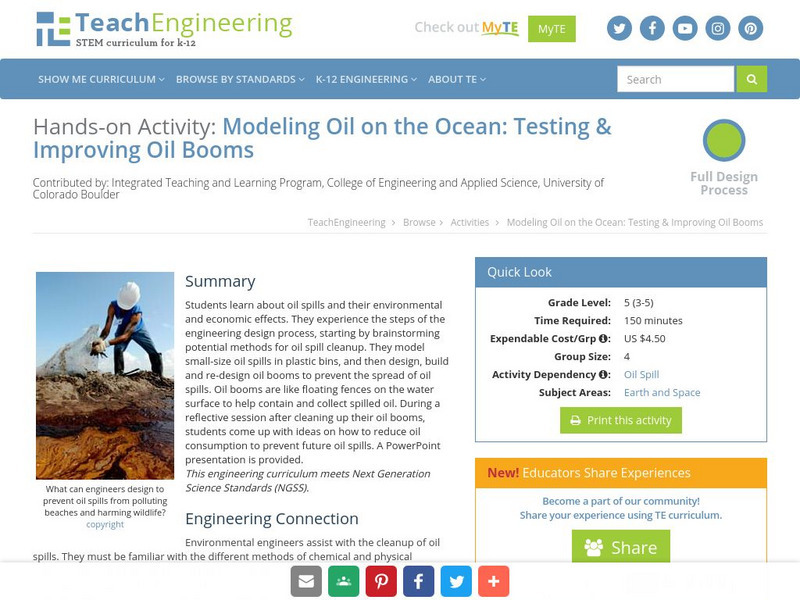
Teach Engineering: Oil on the Ocean
Students learn about oil spills and their environmental and economic effects. They experience the steps of the engineering design process as they brainstorm potential methods for oil spill clean-up, and then design, build, and re-design...
TeachEngineering
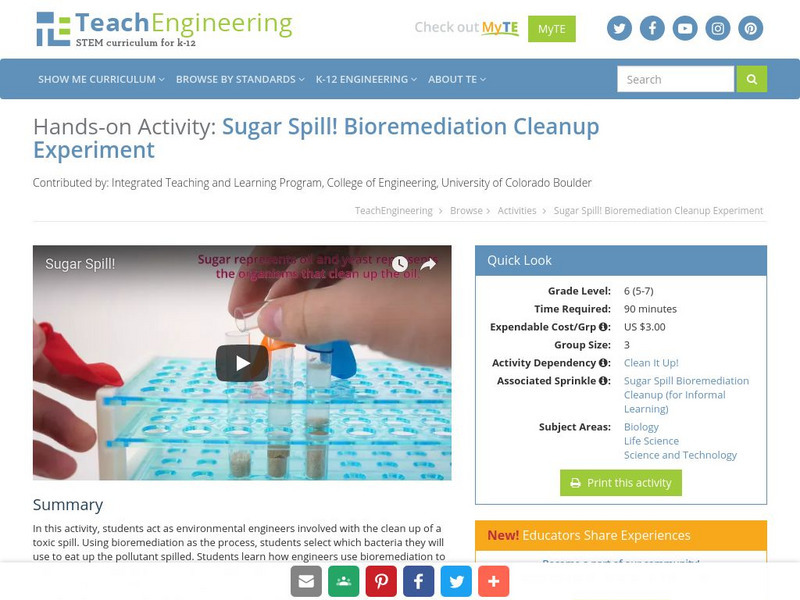
Teach Engineering: Sugar Spill!
In this activity, students act as environmental engineers involved with the clean up of a toxic spill. Using bioremediation as the process, students select which bacteria they will use to eat up the pollutant spilled. Students learn how...
TeachEngineering
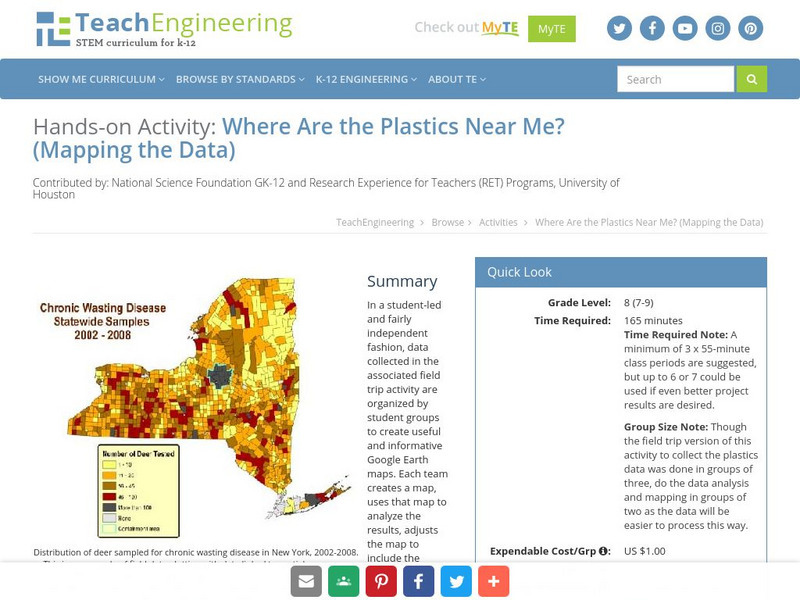
Teach Engineering: Where Are the Plastics Near Me? (Mapping the Data)
In a student-led and fairly independent fashion, data collected in the associated field trip activity are organized by student groups to create useful and informative Google Earth maps. Each team creates a map, uses that map to analyze...
TeachEngineering
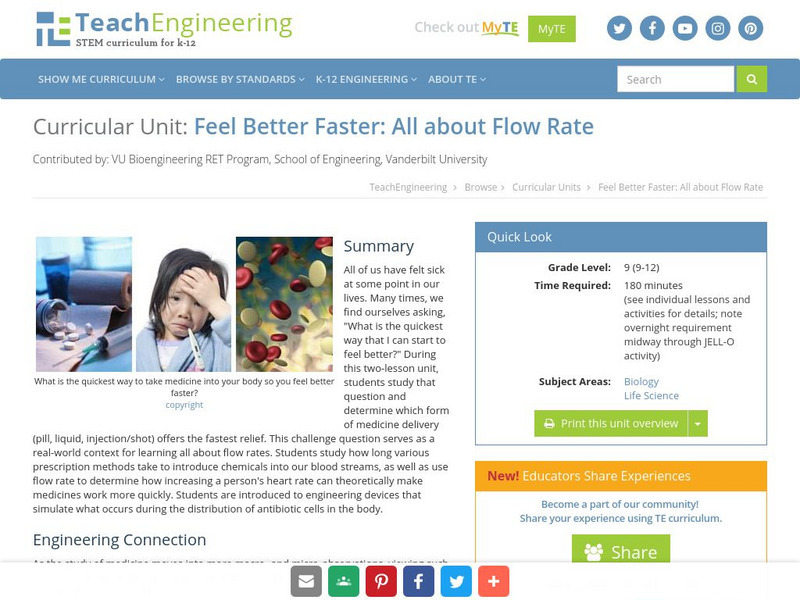
Teach Engineering: Feel Better Faster: All About Flow Rate
All of us have felt sick at some point in our lives. Many times, we find ourselves asking, "What is the quickest way that I can start to feel better?" During this two-lesson unit, students study that question and determine which form of...
TeachEngineering
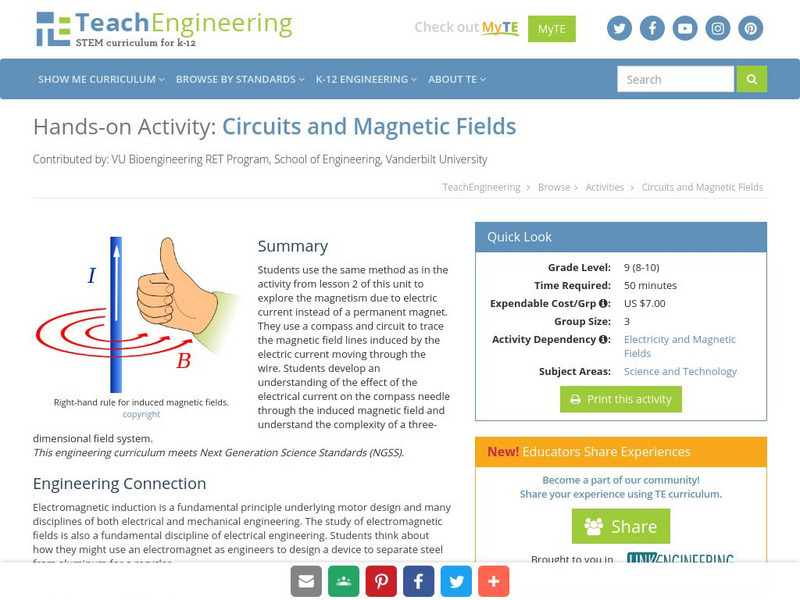
Teach Engineering: Circuits and Magnetic Fields
In this activity, students use the same method as in the activity from lesson 2 to explore the magnetism due to electric current instead of a permanent magnet. Students use a compass and circuit to trace the magnetic field lines induced...
TeachEngineering
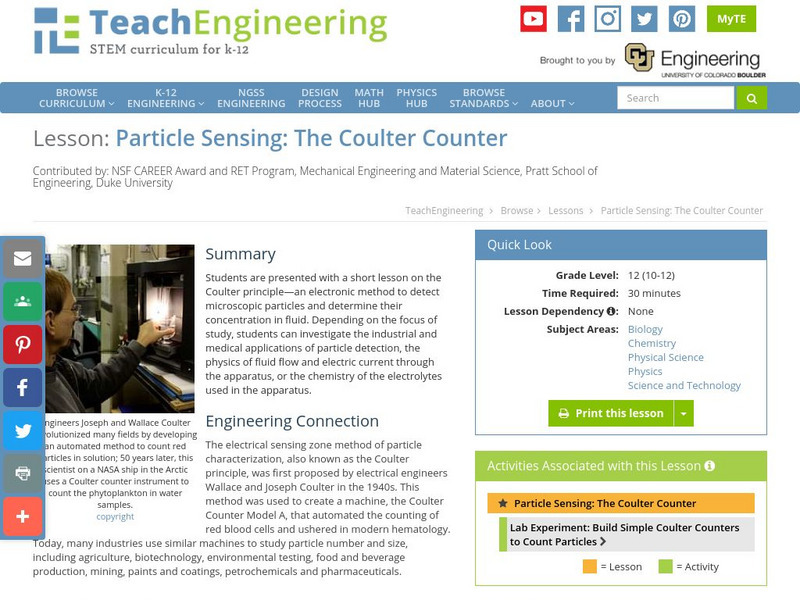
Teach Engineering: Particle Sensing: The Coulter Counter
Students are presented with a short lesson on the Coulter principle, an electronic method to detect microscopic particles and determine their concentration in fluid. Depending on the focus of study, students can investigate the...
TeachEngineering
Teach Engineering: Hidden in Plain Sight
Steganography is the science and art of hiding messages in plain sight so only the sender and intended recipient know the existence of a message. Steganography can be characterized as security through obscurity. Through this lesson,...
TeachEngineering
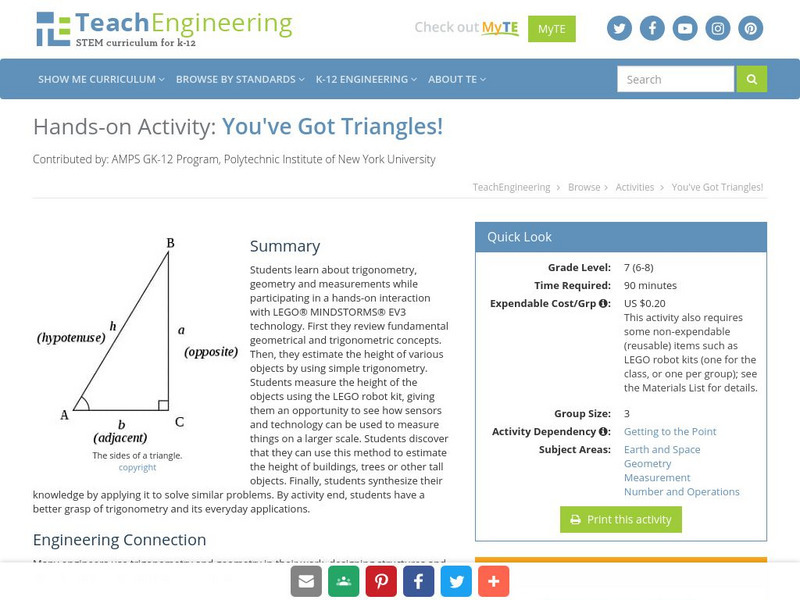
Teach Engineering: You've Got Triangles!
Students learn about trigonometry, geometry and measurements while participating in a hands-on interaction with LEGO MINDSTORMS NXT technology. First they review fundamental geometrical and trigonometric concepts. Then, they estimate the...
TeachEngineering
Teach Engineering: Let's Get Dirty
In a very hands-on activity, students observe and feel the differences between two cleaning methods, with and without hand soap, using coffee grounds to represent "dirt."Most of the dirt and bacteria on our hands is encased in a thin...
TeachEngineering
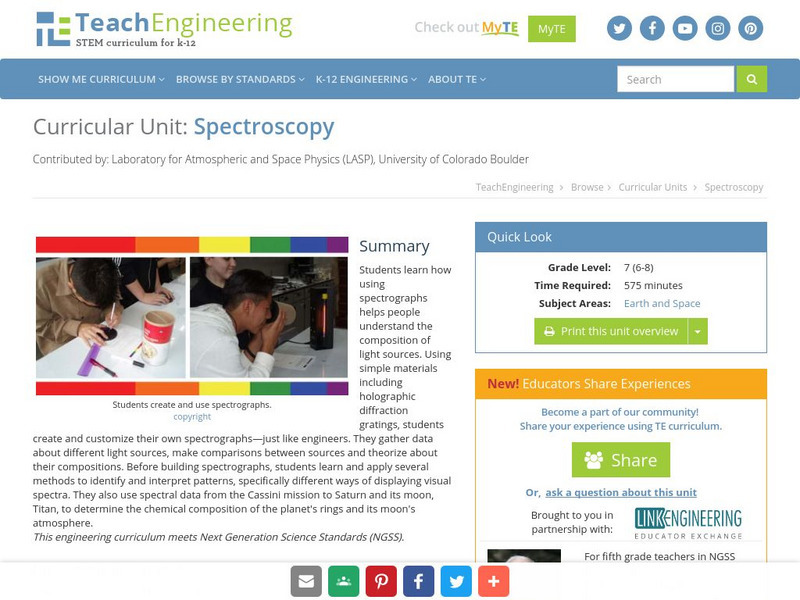
Teach Engineering: Spectroscopy
Students learn how using a spectrograph helps us understand the composition of light sources. Using simple materials and holographic diffraction gratings (available online at a variety of sites, including Edmund Scientifics and the...
TeachEngineering
Teach Engineering: Environmental Engineering and Water Chemistry
Students are introduced to the fundamentals of environmental engineering as well as the global air, land and water quality concerns facing today's environmental engineers. After a lesson and activity to introduce environmental...
TeachEngineering
Teach Engineering: Rolling Blackouts & Environmental Impact
The goal is for the students to understand the environmental design considerations required when generating electricity. The electric power that we use every day at home and work is generated by a variety of power plants. Power plants...
TeachEngineering
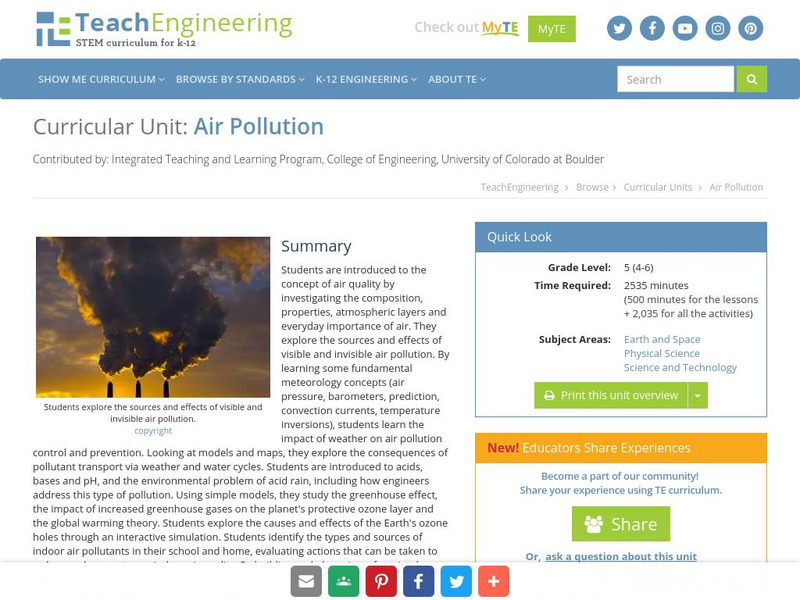
Teach Engineering: Air Pollution
Students are introduced to the concept of air quality by investigating the composition, properties, atmospheric layers and everyday importance of air. They explore the sources and effects of visible and invisible air pollution. By...
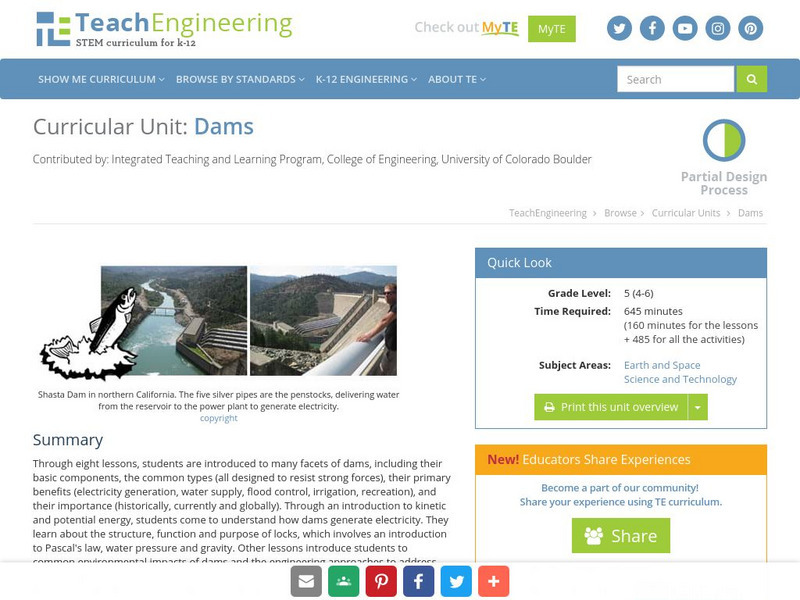
TeachEngineering
Teach Engineering: Dams
Through eight lessons, students are introduced to many facets of dams, including their basic components, the common types (all designed to resist strong forces), their primary benefits (electricity generation, water supply, flood...

TeachEngineering
Teach Engineering: Environment
Through 10 lessons and more than 20 hands-on activities, students are introduced to the concept of an environment and the many interactions within it. As they learn about natural and human-made environments, as well as renewable and...
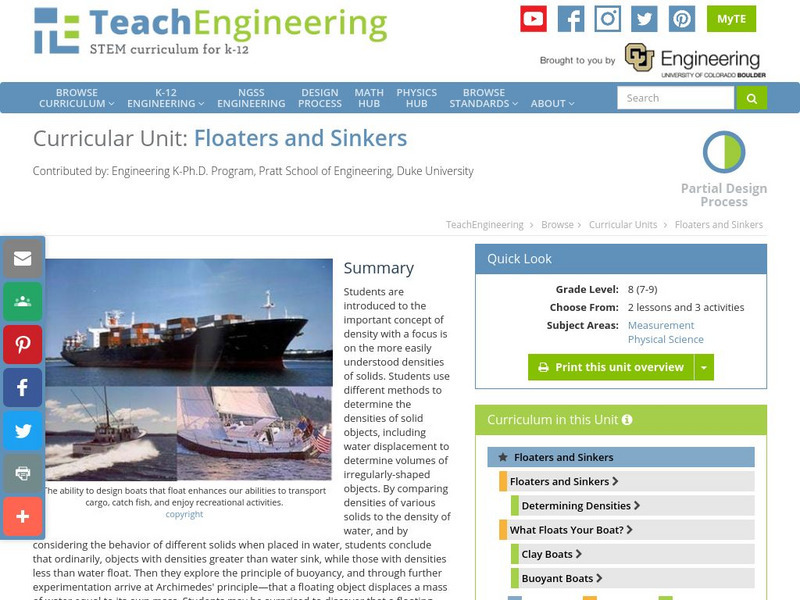
TeachEngineering
Teach Engineering: Floaters and Sinkers
Through this curricular unit, students are introduced to the important concept of density. The focus is on the more easily understood densities of solids, but students may also explore the densities of liquids and gases. Students devise...