Hi, what do you want to do?






Illustrative Mathematics
Longer and Heavier? Shorter and Heavier?
For many young children it seems obvious that longer objects are heavier than shorter objects. This assumption is put to the test as the class investigates the relationship between length and weight in a whole-group activity. Using a...

Exploratorium
Tired Weight
You don't need a scale to determine weight. This activity provides a way to use the concepts of air pressure and surface area to determine the weight of a vehicle by calculating the amount of weight each tire supports.

Illustrative Mathematics
Which Weighs More? Which Weighs Less?
Expand the the comparative language of young mathematicians with a hand-on weight measurement activity. Working independently or in pairs, children compare the weight of large wooden blocks to various other classroom objects, recording...

Curated OER
How Heavy
Break out the balances for this primary grade lesson on weight measurement. Using common elementary school manipulatives like unifix or snap cubes, young mathematicians determine the weight of four different classroom objects. A graphic...

Curated OER
Mass vs. Weight
Why do you weigh more in space? Each individual in your class explores this question and others as they determine the mass and weight of different objects using two types of scales. They perform conversions and discuss their...

National Nanotechnology Infrastructure Network
Is Measuring an Art or a Science?
Not only do future engineers learn the difference between accuracy and precision, they also get some hands-on experience using different measuring tools.

Teach Engineering
Portable Wheelchair Ramp Challenge
Ramp up the engineering design process in your classroom with an activity that challenges teams to design, build, and test a small-scale portable wheelchair ramp. The class develops design requirements, and teams test their designs...

Teach Engineering
What a Drag!
Stop and drop what is in your hand! Pupils investigate how form effects drag in the 12th part of a 22-part unit on aviation. Groups create equally weighted objects and determine which one falls the fastest by collecting data.

Indian Institute of Technology
Could King Kong Exist?
The title says it all: Could King Kong exist? Investigate how increasing the dimensions of an object affects its surface area and volume to mathematically conclude whether a creature with the weight and height of King Kong could actually...

Computer Science Unplugged
Lightest and Heaviest—Sorting Algorithms
How do computers sort data lists? Using eight unknown weights and a balance scale, groups determine the order of the weights from lightest to heaviest. A second instructional activity provides the groups with other methods to order the...

It's About Time
The Mu of the Shoe
What is mu? Emerging scientists explore the coefficient of sliding friction, or mu, and apply its concepts as they complete activities in the interesting lesson. They measure the sliding friction between soles of their own athletic shoes...

Illustrative Mathematics
How Thick Is a Soda Can II?
Science, technology, and math come together in this one combination exercise. Analyzing the common soda can from both a purely mathematical perspective and a scientific angle allows for a surprisingly sophisticated comparison of...

International Technology Education Association
Sizing Up the Clouds
How much rain can that cloud make? Through a simulation, the class estimates the amount of candy rain contained in different cup clouds. After probing the clouds using different methods, class members adjust their estimates. Participants...

DiscoverE
Bridges, Buildings and Beyond Activity Packet: Grades 6-8
Pour a solid foundation of engineering into the minds of future engineers. Scholars take part in three activities to learn about civil engineering. They build a model of a cable-stayed bridge, conduct an experiment to see the effects of...

Curated OER
Accurately Weighing Pennies I
Drawing from a scenario of the history of the penny, learners write and solve a system of linear equations from a context.

Teach Engineering
Maker Challenge: Adding Helpful Carrier Devices to Crutches
Make breaking a leg a less troublesome experience. Groups brainstorm designs for crutches that have devices that help carry items. They build prototypes of their devices to test out their designs.

Curated OER
Accurately Weighing Pennies II
Drawing from a scenario of the history of the penny, learners write and solve a system of linear equations from a context.

Curated OER
The Big Apple
This lesson has various activities that can be done simultaneously in groups or one at a time with the entire class. The activities center around New York and apples.
Texas Instruments
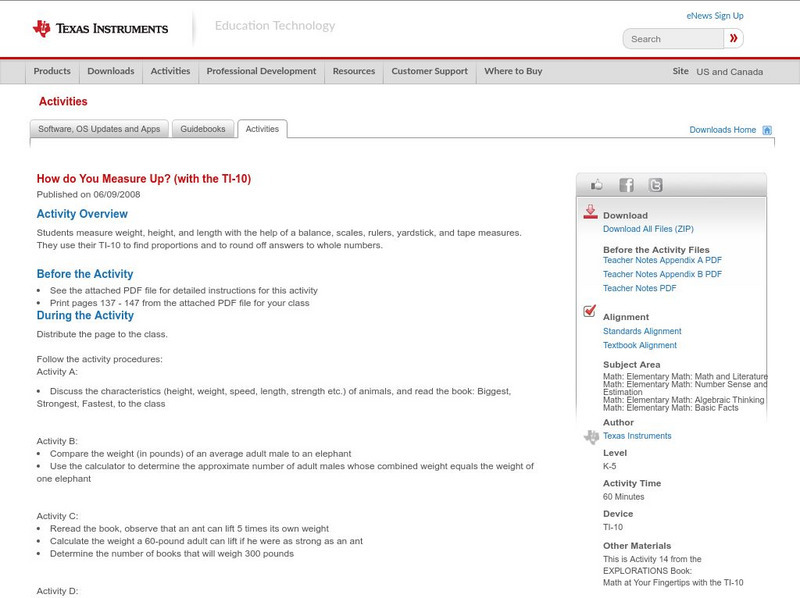
Texas Instruments: How Do You Measure Up? (With the Ti 10)
In this activity, students measure weight, height, and length with the help of a balance, scales, rulers, yardstick, and tape measures. They use their TI-10 to find proportions and to round off answers to whole numbers.

Other
Sorico: Describing and Comparing Measurable Attributes
The following unit can be used to teach measurable attributes. Students will describe and compare two objects with a measurable concept in common using direct comparison. Included are necessary vocabulary, a scavenger hunt, and links to...
TeachEngineering
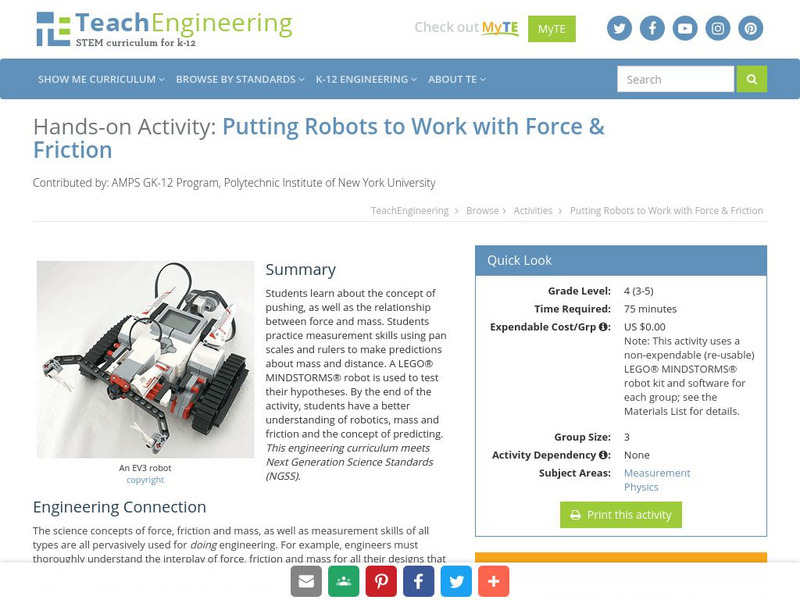
Teach Engineering: Putting Robots to Work With Force & Friction
Students learn about the concept of pushing, as well as the relationship between force and mass. Students practice measurement skills using pan scales and rulers to make predictions about mass and distance. A LEGO MINDSTORMS NXT robot is...
TeachEngineering
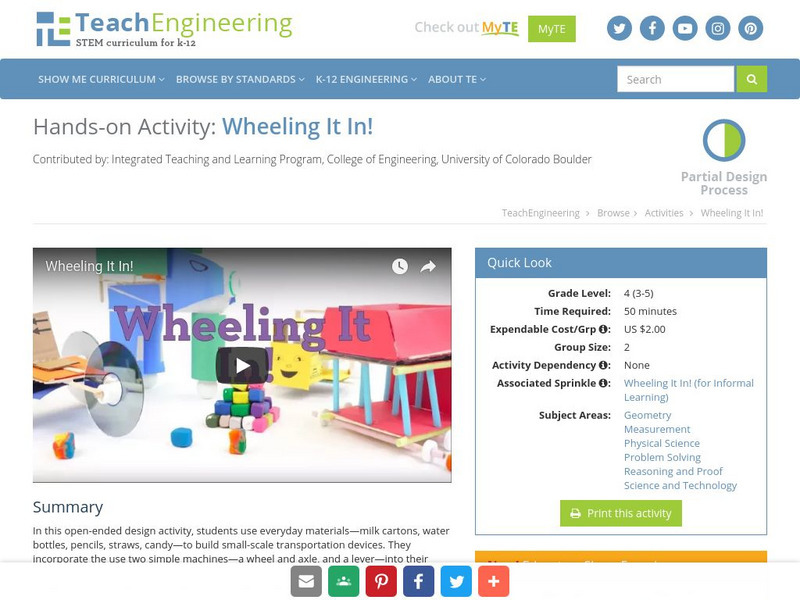
Teach Engineering: Wheeling It In!
In an open-ended design activity, students use everyday materials (milk cartons, water bottles, pencils, straws, candy) to build a small-scale transportation device. They incorporate the use of a wheel and axle, and lever into their...