Hi, what do you want to do?






Curated OER
The Meaning of Exponents
In this algebra worksheet, students calculate problems dealing with exponents as it relates to money and savings, bacterial growth and paper folding. There are 3 different sections with questions.

Curated OER
Symmetry and Tessellations
Sixth graders investigate tessellations and their origins. Students trace triangles to form a tessellation. They measure the angle of equilateral triangles. Students locate the line of symmetry, they create geometric squares,...

Curated OER
Prime and Composite Numbers with use of manipulatives (Elementary, Mathematics)
Students learn what prime and composite numbers are. They learn how to identify them by working in a group and demonstrating an understanding of one work problem with 100% accuracy using the manipulatives provided.

Curated OER
What do two-dimensional tessellations look like? Where in art can they be found?
Students explore the world of art and culture, including the works of M.C. Escher. They identify and create original tessellations. Students use a wealth of interactive multimedia applications. They explore the artistic representations...

Curated OER
Tessellation Lesson Plans
Students in second through eighth grades can fill their imaginations with repeating shapes!
Illustrative Mathematics
Illustrative Mathematics: G Co Building a Tile Pattern by Reflecting Hexagons
This task applies reflections to a regular hexagon to construct a pattern of six hexagons enclosing a seventh. The focus of the task is on using the properties of reflections to deduce this seven-hexagon pattern. Aligns with G-CO.B.6.
Illustrative Mathematics
Illustrative Mathematics: G Co Building a Tile Pattern by Reflecting Octagons
This task applies reflections to a regular octagon to construct a pattern of four octagons enclosing a quadrilateral. The focus of the task is on using the properties of reflections to deduce that the quadrilateral is actually a square....

Science Buddies
Science Buddies: Tiling With Spidrons
If art and math are both passions of yours, this project is meant for you! Spidrons are geometric forms made from alternating sequences of equilateral and isosceles (30 degrees, 30 degrees, 120 degrees) triangles. Spidrons were...
National Council of Teachers of Mathematics
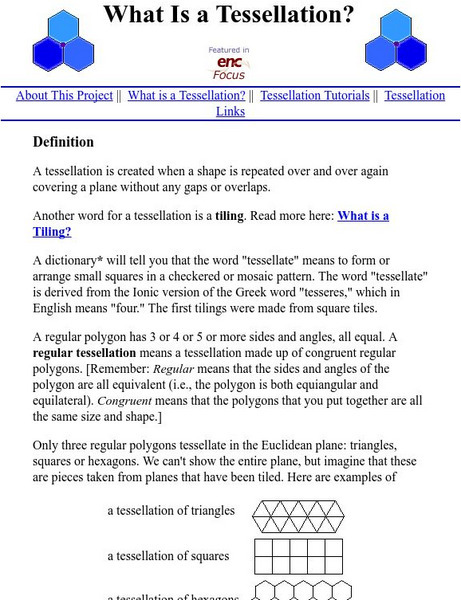
The Math Forum: What Is a Tessellation?
The Math Forum defines and illustrates geometric tessellation.

National Council of Teachers of Mathematics
The Math Forum: Making Patterns
Explore the literature connections, online activity, pencil and paper activity, and the manipulative investigation of patterns and geometric shapes on this page!
University of Regina (Canada)
University of Regina: Math Central: Manipulatives for the Upper Elementary (Gr. 4 6)
Many teachers find it more challenging to incorporate the use of manipulatives into their mathematics programs at the upper elementary or middle school grades. Activities using manipulatives are provided for grades four, five, and six...
National Council of Teachers of Mathematics
The Math Forum: Tessellation Tutorials
This site provides a wealth of tutorials regarding tessellation. Content ranges from basic definitions of what tessellation is, to the math behind it, to various learning activities.
University of Regina (Canada)
University of Regina: Math Central: m.c.escher: Mathematics and Visual Arts
This cross-curricular middle school unit integrates mathematics and visual art. Through the study of the M.C. Escher?s work, students explore tiling from both a mathematical and artistic point of view. Points for discussion and...

Illustrative Mathematics
Illustrative Mathematics: G Mg Hexagonal Pattern of Beehives
Beehives are made of walls, each of the same size, enclosing small hexagonal cells where honey and pollen are stored and bees are raised. This problem examines some of the mathematical advantages of the hexagonal tiling in a beehive....
Math Cats
Math Cats: Visit Tessellation Town on Tile Island!
Go to Tessellation Town on Tile Island and create a variety of tessellations.
Maths Challenge
Maths challenge.net: Kitchen Floor
A "one star" geometry problem that requires finding the visual pattern and applying logic with basic math skills to solve how many tiles are needed to complete the kitchen floor pattern.
University of Cambridge
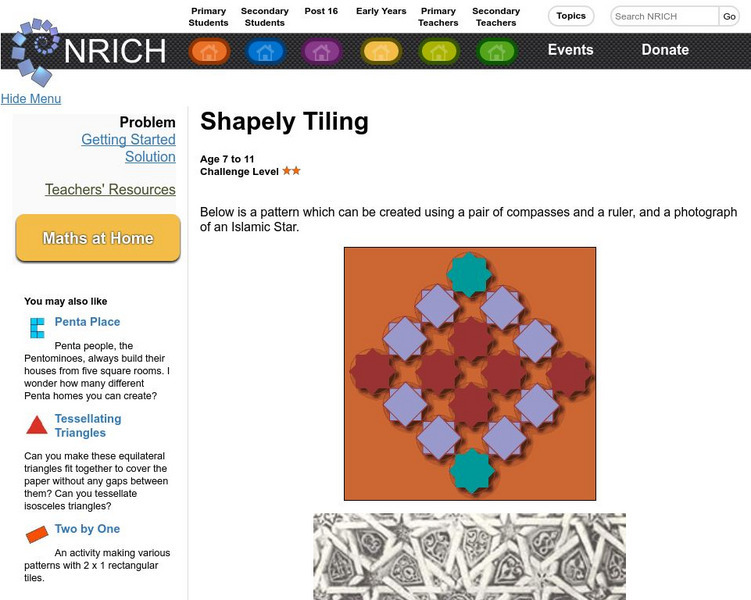
University of Cambridge: Nrich: Shapely Tiling
On this one page interactive website expand your logic, Motion Geometry and pattern recognition knowledge while working on this challenge. The solution is available to double check your solution.

PBS
Pbs Learning Media: Triangles
In this video segment [2:01] from Cyberchase, the CyberSquad finds that by arranging triangle tiles they are able to create a path that will allow them to cross a river of hot lava.
Wolfram Research
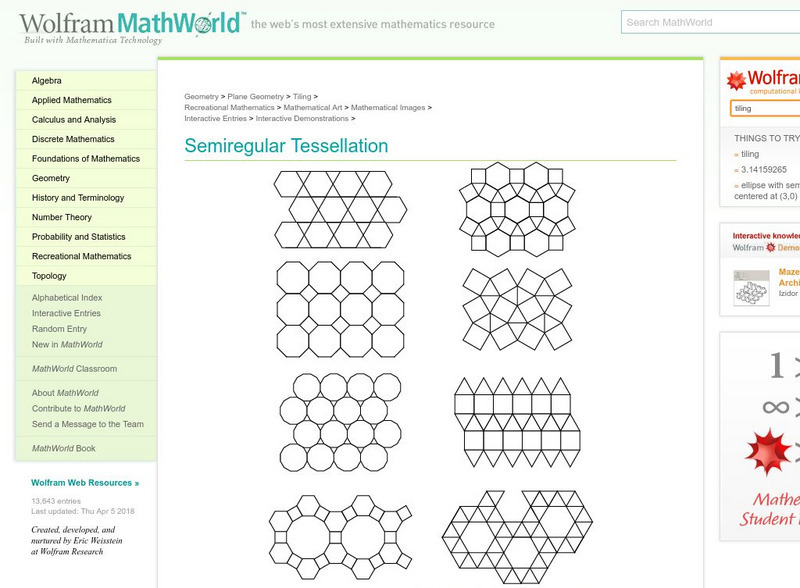
Wolfram Math World: Semiregular Tessellations
This one page Mathworld site has a number of examples of semiregular tessellations. A definition and a small amount of related information is given at the bottom of the page.
University of Cambridge
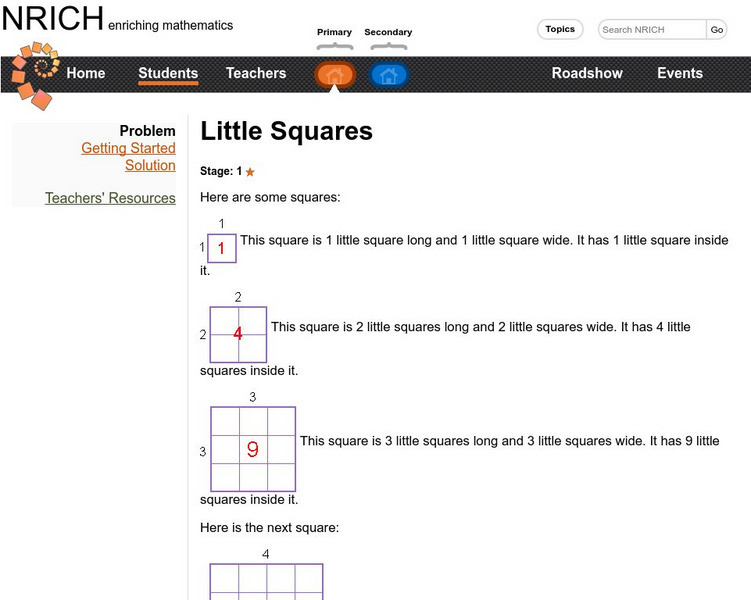
University of Cambridge: Nrich: Little Squares
What are square numbers? Use tiles at this one page website to discover the pattern of square numbers. See if you can solve the challenge. Once you have your solution you can check the solution given right at the website.
Other
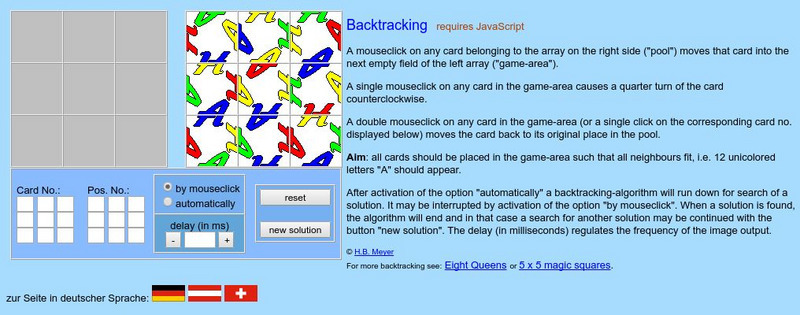
Backtracking: An Interactive Tessellation Game
Click on the squares to move the tiles and create the correct pattern. A fun way to explore the concept of tessellations.
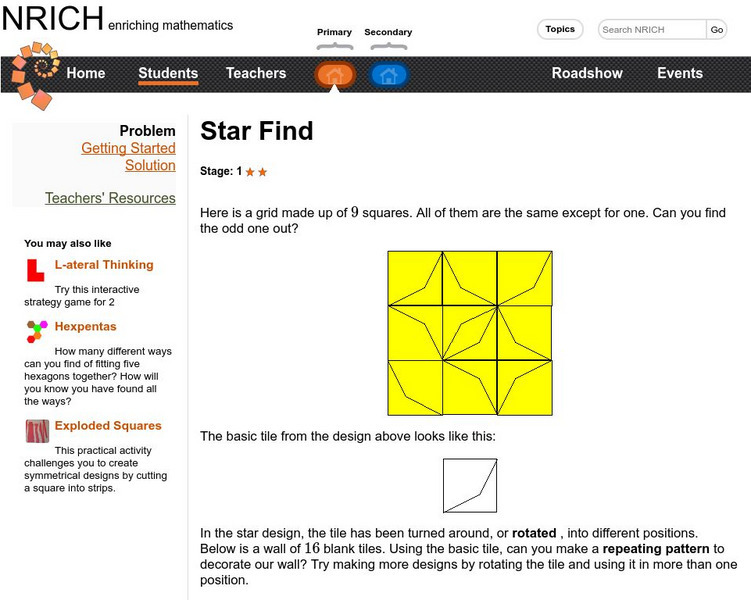
University of Cambridge
University of Cambridge: Nrich: Star Find
This one page website offers two interesting tiling problems. The solution is provided here as well.
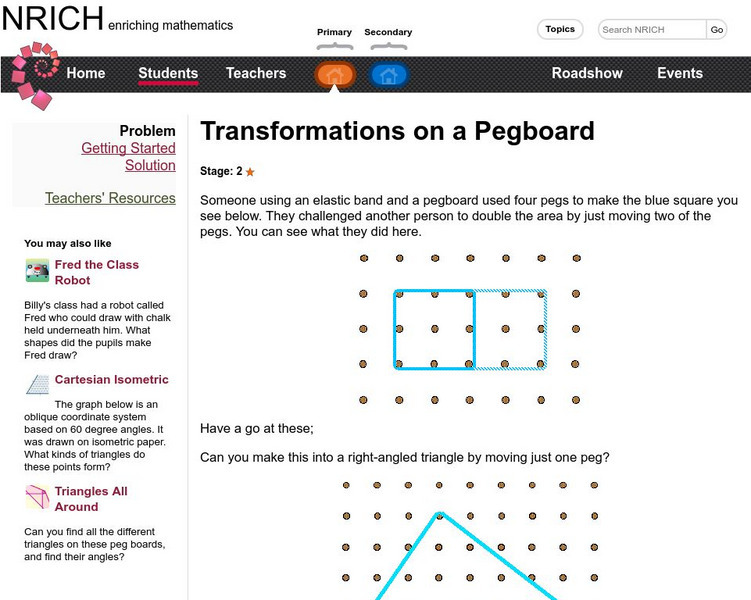
University of Cambridge
University of Cambridge: Nrich: Transformations on a Pegboard
This one page website can expand your logic, Motion Geometry and pattern recognition knowledge. The solution is available to double check your answers.

Cool Math
Coolmath: Coolmath4kids: Tessellations
Tessellations are explained and described at this website. Three basic rules are given for creating tessellations.