
It's About Time
The Electricity and Magnetism Connection
Magnets don't grow in fields, but magnetic fields are important to understand. The lesson covers the effect electricity has on magnetic fields. Scholars use a compass, magnets, and electrical wire to test magnetic fields and energy...

University of Notre Dame
Safe Science Lab Safety Awareness
Prepare young scientists for the ins and outs of lab safety with a thorough list of symbols, icons, and rules about staying safe during experiments. Additionally, the resource provides several assessment pages for kids to reflect on what...

It's About Time
AC and DC Currents
An informative physics lesson includes two teacher demonstrations, one on AC currents and the other on DC currents, allowing pupils to take notes while watching. The resource includes questions to assign as homework or...

It's About Time
Electromagnets
Young scientists build their own electromagnet and test it by picking up paperclips. Analysis questions evaluate knowledge at the end of the activity.
Florida State University
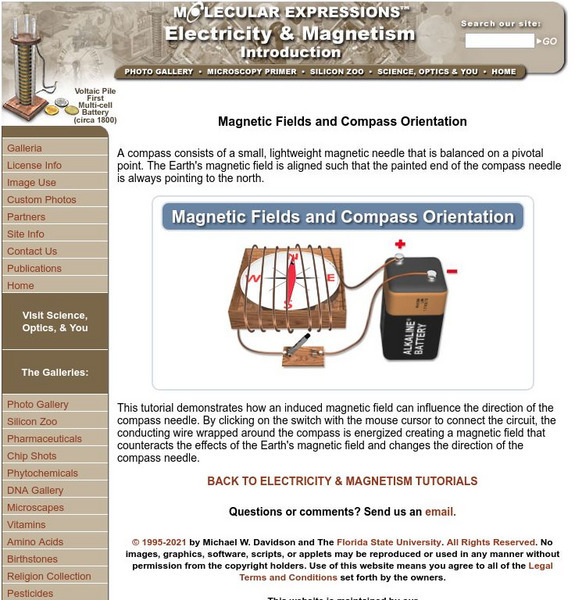
Florida State University: Molecular Expressions: Magnetic Fields and Compass Orientation
Simulate the creation of an induced magnetic field through the use of a simple electric circuit. An interactive demonstration is included.
Orpheus Books
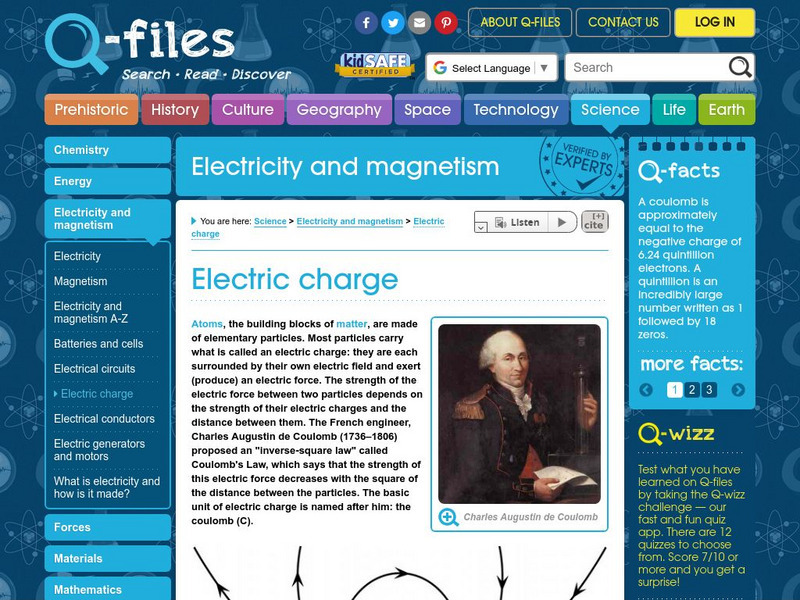
Q Files: Electricity and Magnetism: Electric Charge
Learn how electric charges work and about Coulomb's Law, which is used to calculate the strength of an electric force.
Georgia State University
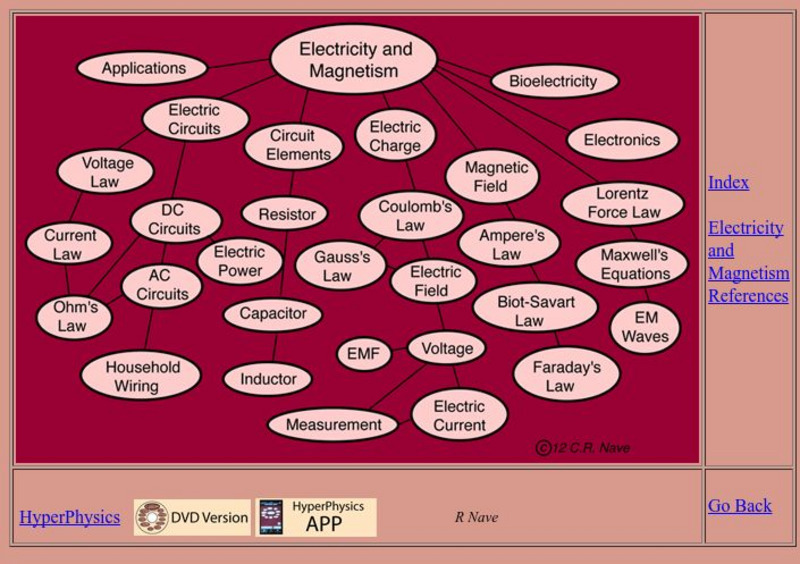
Georgia State University: Hyper Physics: Electricity and Magnetism
HyperPhysics is an exploration environment for concepts in physics by Georgia State University which employs concept maps and other linking strategies to facilitate smooth navigation. This section focuses on electricity and magnetism.
Physics4kids
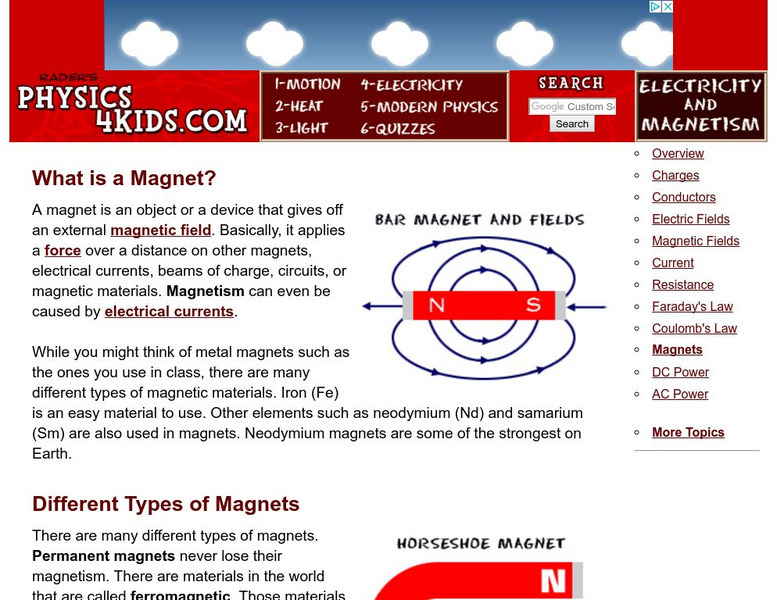
Physics4kids: Electricity and Magnetism: Magnets
Here is the site to help you learn all about magnetism and magnets! Find out what a magnet is and how it works. Click for additional details on charges, conductors, magnetic fields, currents, resistance as well as the Laws of Faraday and...
National High Magnetic Field Laboratory
Magnet Academy: Timeline of Electricity and Magnetism: 1820 1829
Hans Christian Orsted's accidental discovery that an electrical current moves a compass needle rocks the scientific world; a spate of experiments follows, immediately leading to the first electromagnet and electric motor.
National High Magnetic Field Laboratory
Magnet Academy: Timeline of Electricity and Magnetism: 1800 1819
Alessandro Volta invents the first primitive battery, discovering that electricity can be generated through chemical processes; scientists quickly seize on the new tool to invent electric lighting. Meanwhile, a profound insight into the...
National High Magnetic Field Laboratory
Magnet Academy: Timeline of Electricity and Magnetism: 1775 1799
Scientists take important steps toward a fuller understanding of electricity, as well as some fruitful missteps, including an elaborate but incorrect theory on animal magnetism that sets the stage for a groundbreaking invention.
National High Magnetic Field Laboratory
Magnet Academy: Timeline of Electricity and Magnetism: 1830 1839
The first telegraphs are constructed and Michael Faraday produces much of his brilliant and enduring research into electricity and magnetism, inventing the first primitive transformer and generator.
National High Magnetic Field Laboratory
Magnet Academy: Timeline of Electricity and Magnetism: 1600 1699
The Scientific Revolution takes hold, facilitating the groundbreaking work of luminaries such as William Gilbert, who took the first truly scientific approach to the study of magnetism and electricity and wrote extensively of his findings.
National High Magnetic Field Laboratory
Magnet Academy: Timeline of Electricity and Magnetism: 1900 1909
Albert Einstein publishes his special theory of relativity and his theory on the quantum nature of light, which he identified as both a particle and a wave. With ever new appliances, electricity begins to transform everyday life.

Florida State University
Florida State University: Magnet Lab: Timeline of Electricity and Magnetism: 1750 1774
With his famous kite experiment and other forays into science, Benjamin Franklin advances knowledge of electricity, inspiring his English friend Joseph Priestley to do the same.
National High Magnetic Field Laboratory
Magnet Academy: Roland Eotvos
Vasarosnamenyi Baro Eotvos Lorand, better known as Roland Eotvos or Lorand Eotvos throughout much of the world, was a Hungarian physicist who is most recognized for his extensive experimental work involving gravity, but who also made...
National High Magnetic Field Laboratory
Magnet Academy: William Gilbert
William Gilbert was an English physician and natural philosopher who wrote a six-volume treatise that compiled all of the information regarding magnetism and electricity known at the time. The work included descriptions of many of...
National High Magnetic Field Laboratory
Magnet Academy: Wilhelm Weber
Find out more about German physicist Wilhelm Weber, who developed and enhanced a variety of devices for sensitively detecting and measuring magnetic fields and electrical currents.
National High Magnetic Field Laboratory
Magnet Academy: James Watt
The Scottish instrument maker and inventor James Watt had a tremendous impact on the shape of modern society. His improvements to the steam engine were a significant factor in the Industrial Revolution, and when the Watt engine was...

National High Magnetic Field Laboratory
Magnet Academy: William Thomson, Lord Kelvin
William Thomson, known as Lord Kelvin, was one of the most eminent scientists of the nineteenth century and is best known today for inventing the international system of absolute temperature that bears his name. He made contributions to...
National High Magnetic Field Laboratory
Magnet Academy: Nikola Tesla
Awarded more than 100 patents over the course of his lifetime, Nikola Tesla was a man of considerable genius and vision. He was reportedly born at exactly midnight during an electrical storm, an intriguing beginning for a man who would...
National High Magnetic Field Laboratory
Magnet Academy: Sulfur Globe 1660
In the 17th century, German scientist Otto von Guericke built and carried out experiments with a sulfur globe that produced static electricity.
National High Magnetic Field Laboratory
Magnet Academy: Felix Bloch (1905 1983)
Physicist Felix Bloch developed a non-destructive technique for precisely observing and measuring the magnetic properties of nuclear particles. He called his technique "nuclear induction," but nuclear magnetic resonance (NMR) soon became...
National High Magnetic Field Laboratory
Magnet Academy: Paul Lauterbur
Chemist Paul Lauterbur pioneered the use of nuclear magnetic resonance (NMR) for medical imaging. He developed a technique, now known as magnetic resonance imaging (MRI), in the early 1970s that involves the introduction of gradients in...
Other popular searches
- Electricity and Magnetism
- Electricity Magnetism
- Electricity/magnetism
- Electricity & Magnetism
- Electricity/magnetism Unit