Hi, what do you want to do?






PBS
Light Bulb Challenge
Efficiency equals money where homes are concerned. A comparative lesson asks learners to measure heat output of incandescent and compact fluorescent light bulbs. They follow their investigation with calculating the cost of using the two...

Teach Engineering
Light vs. Heat Bulbs
Careful, that light bulb is hot! Compare heat and light energy using a simple light bulb. The exercise addresses energy conservation and presents actual calculations to determine the most cost-effective light bulb.

Teach Engineering
Lighting in My Classroom Survey
How much energy does it take to light a room? Class members calculate the total wattage it takes to light the classroom. Through calculations, responsible scientists determine the cost of energy for the year, then figure out...
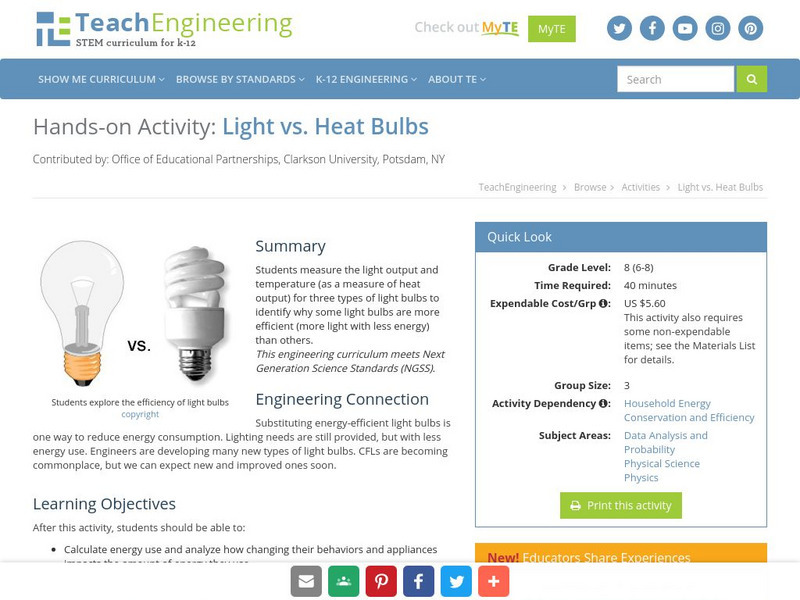
TeachEngineering
Teach Engineering: Light vs. Heat Bulbs
Students measure the light output and temperature (as a measure of heat output) for three types of light bulbs to identify why some light bulbs are more efficient (more light with less energy) than others.
Science Buddies
Science Buddies: Measuring Light Intensity Using the Inverse Square Law
You've probably heard that compact fluorescent light bulbs are more efficient than incandescent bulbs. More of the electricity they use goes into producing light, and less into producing heat than with incandescent bulbs. How much more...