Hi, what do you want to do?






Read Works
The What and Who of Elections
As citizens living in the United States, it is our civil duty to vote. But how does the voting process work? After reading a five-paragraph passage on the basics of elections and voting, young constituents respond to 10 questions...

PBS
Pbs Learning Media: Activism in the Civil Rights Movement
In this interactive lesson, students will learn about the historical background of racial segregation and the brave individuals and groups who stood up against segregation during the 1950s and 1960s.
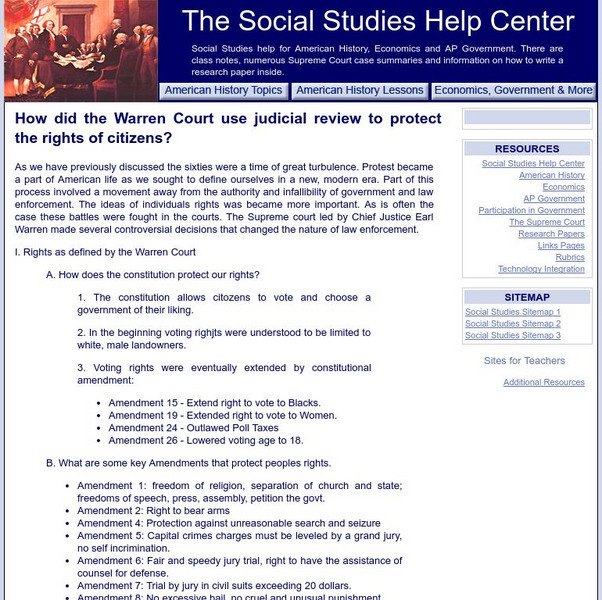
Social Studies Help Center
Social Studies Help Center:how Did the Warren Court Protect the Citizens' Rights
The Warren Court was a busy one. Read about the famous decisions made by that court in just a few years.
iCivics
I Civics: Minersville v. Gobitas (1940)
This mini-lesson covers the basics of the Supreme Court's decision that allowed schools to require students to salute the flag and recite the Pledge of Allegiance. Students learn about the First Amendment and how the interests of...
iCivics
I Civics: West Virginia State Board of Education v. Barnette (1943)
This mini-instructional activity covers the basics of the Supreme Court's decision that it was unconstitutional for a state to force students to salute the flag and recite the Pledge of Allegiance. Students learn how the interests of...
iCivics
I Civics: Hazelwood School District v. Kuhlmeier (1988)
This mini-lesson covers the basics of the Supreme Court's decision that established a school principal's right to censor student articles in the school newspaper. Young scholars learn about the limits on student free speech in a school...
iCivics
I Civics: Tinker v. Des Moines (1969)
This mini-lesson covers the basics of the Supreme Court's decision that extended First Amendment protections to students in the classroom. Students learn about the concept of symbolic speech and how students gained the right to engage in...
US National Archives
National Archives: To What Extent Was Reconstruction a Revolution? (Part 1)
Should Reconstruction be viewed as a revolution or not? Using primary source documents, students can weigh the evidence and come up with their conclusion. This instructional activity can be used as a whole class, small group, or...
Other
911 for Kids: Program Lesson Plan
This lesson plan includes when to call or not call 911. Included is a quiz with emergency and non-emergency scenarios you can use to help kids decide when the right time is to call 911. There are also tips on how to talk to the 911...
PBS
Pbs: Core Values of American Constitutional Democracy
A list of terms presented by PBS and Newshour of the values that make up the foundation of American constitutional democracy and the preservation of political and economic freedoms.
iCivics
I Civics: Miranda v. Arizona (1966)
This mini-lesson covers the basics of the Supreme Court's decision that prohibited a suspect's statements from being used as evidence unless the suspect has been advised of his or her rights to remain silent. Middle schoolers learn about...
iCivics
I Civics: Gideon v. Wainwright (1963)
This mini-lesson covers the basics of the Supreme Court's decision that gave defendants in state criminal courts the right to a lawyer. Students learn about the 6th Amendment right to a lawyer, why the right is important, and how the...
iCivics
I Civics: Plessy v. Ferguson (1896)
This mini-lesson covers the basics of the Supreme Court's decision that it was constitutional to keep black and white people segregated as long as the accommodations for each race were "equal." Students learn about the concept of...

Other
Objectivism: The Philosophy of Ayn Rand
This is Dr. Leonard Peikoff's website for his book "Objectivism: The Philosophy of Ayn Rand."

Other
Lease Guide: Who Should Lease?
This site provides information on leasing. Although there are many benefits to leasing it may or may not be right for a particular individual.