Hi, what do you want to do?






Physics Classroom
Polarization
Are your young physicists static-savvy? Test their skills using an engaging interactive from the Static Electricity series! Learners evaluate scenarios to determine how charges move between conductors and insulators, then identify...

Curated OER
Bring Your Classroom to Life with Educational Songs
Using music to get in tune with content has great benefits for learners!

Magic of Physics
Scale of the Universe I
From quantum foam to the universe itself, plus everything in between, what is the scale of the world around us? Inquisitive physicists grapple with the proportions of all things great and small using a fascinating interactive. Scholars...

IOP Institute of Physics
Physics in Concert
What do physicists and musicians have in common? A lot more than you might think. After first viewing a slide show presentation and completing a series of skills practice worksheets on the physics of light, sound, and...

American Institute of Physics
Dr. Gates and the Nature of the Universe
What do Russian nesting dolls have to do with physics? They make a great demonstration tool for explaining Dr. Sylvester James Gates, Jr.'s string theory to young scientists. A two-part lesson first introduces learners to Dr. Gates'...

Curated OER
The Hall of Physicist
Students study the history and scientific contributions of Albert Einstein. In this Albert Einstein lesson plan, students learn his history, research his scientific contributions, create a timeline of him and his work, and create a...

Curated OER
Go Ahead, Take a Guess! Estimating in the Real World
Learning how to use estimating to solve real life problems can be a great way for students to apply math skills.

Curated OER
Ocean Careers Exploration
Learners will work together in groups to gather information about careers in oceanography. They discover the need to have a diverse group of people on a team and then share their information with the class. Web links and materials are...

Urbana School District
Magnetism
The compass was first used in 206 B.C., but we didn't discover magnetic poles until 1263 A.D. Presentation begins with the history of magnetism before continuing on to magnetic fields, magnetic forces, electromagnets, currents,...

EngageNY
Euler’s Number, e
Scholars model the height of water in a container with an exponential function and apply average rates of change to this function. The main attraction of the lesson plan is the discovery of Euler's number.

Curated OER
Proper Nouns
Use this worksheet to help your class identify proper nouns. They circle the proper nouns in 16 sentences. Answer key is provided.

Curated OER
The Founder of Electromagnetism
Students identify and study the founder of electromagnetism. In this magnetism lesson students complete several experiments including building a galvanometer.

Curated OER
Climate And the Greenhouse Effect
Students demonstrate the greenhouse effect. They recognize that relatively small changes to our environment can stimulate significant climate changes. They determine that the "scientific method" is a process of testing hypotheses and...

Curated OER
Time Travel
Learners investigate the concept of time travel and quantum physics. They complete a Webquest, read excerpts from the book, 'The Time Machine,' play an online time traveler game, and read and evaluate newspaper articles about time.

Curated OER
Adjectives Sentence Gap Fill
In this ESL activity worksheet, students fill in the blanks in 8 sentences with the correct adjective from the provided word bank.

Curated OER
The Chemistry Connection
In this proteins worksheet, students read about the chemical compound, protein. Students determine where proteins are found in the body and how enzymes help the body react. Then students complete 3 short answer questions.

Curated OER
Critical Reading: Intelligence Augmentation
In this critical reading worksheet, students read a short passage regarding intelligence augmentation and then answer five questions based on the reading.

Curated OER
Marconi and the Radio: Reading Comprehension
In this reading comprehension activity, students read a selection, then complete 7 multiple choice questions. Students may click on an answer button for immediate feedback. Worksheet is labeled ESL, but is not exclusive.
Wikimedia
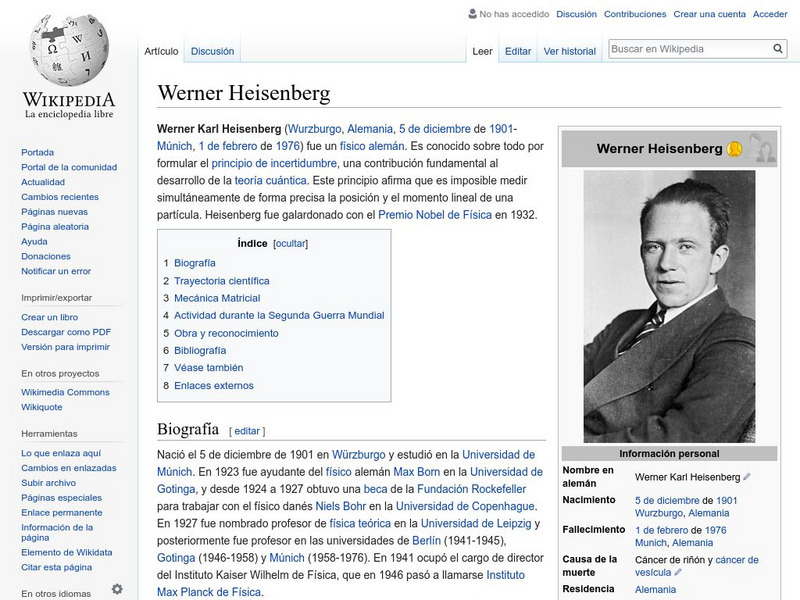
Wikipedia: Werner Heisenberg
In this Spanish-language entry, trace the life and accomplishments of Werner Heisenberg, the great physicist whose work with quantum mechanics resulted in earning the Nobel Prize.
Great Idea Finder
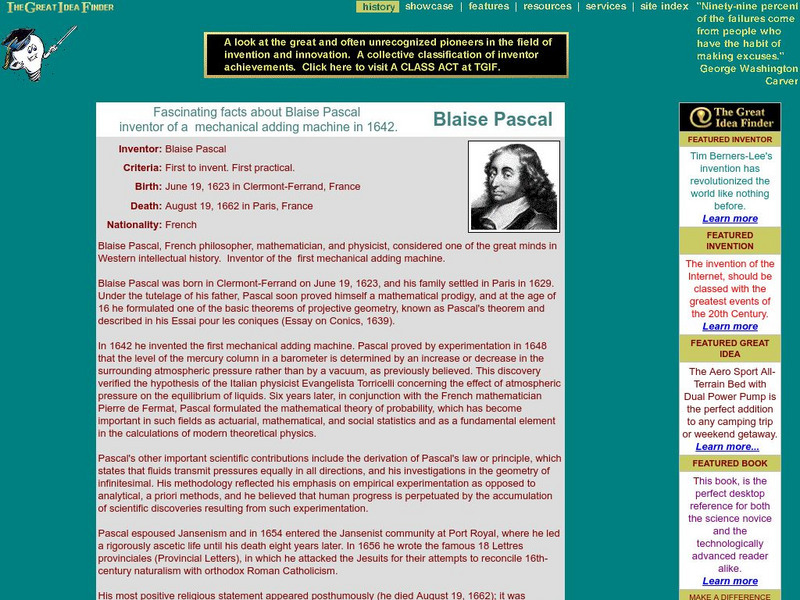
The Great Idea Finder: Blaise Pascal
Blaise Pascal (1623-1662), French philosopher, mathematician, and physicist, is considered one of the great minds in Western intellectual history. He also invented the first mechanical adding machine.
National High Magnetic Field Laboratory
Magnet Academy: Richard Feynman
Theoretical physicist Richard Phillips Feynman greatly simplified the way in which the interactions of particles could be described through his introduction of the diagrams that now bear his name (Feynman diagrams) and was a co-recipient...
National High Magnetic Field Laboratory
Magnet Academy: Sin Itiro Tomonaga
Japanese theoretical physicist Sin-Itiro Tomonaga resolved key problems with the theory of quantum electrodynamics (QED) developed by Paul Dirac in the late 1920s through the use of a mathematical technique he referred to as...

Wikimedia
Wikipedia: Max Planck
Discover the life and accomplishments of the great German scientist Max Planck. This site also provides links to sites explaining theories and scientific terms that are associated with Planck.

Other
Particles, Special Relativity and Quantum Mechanics
Quantum physics, despite its inherent weirdness, is thus far the best model physicists have for explaining the universe. This site gives a great overview of the principles of quantum mechanics and gives scenarios to help the reader...