Hi, what do you want to do?






Columbus City Schools
What’s Up with Matter?
Take a "conservative" approach to planning your next unit on mass and matter! What better way to answer "But where did the gas go?" than with a lab designed to promote good report writing, research skills, and detailed observation....

Steinhardt Apps
Kinetic Molecular Theory
Building off young chemists' knowledge of the states of matter, kinetic molecular theory is the focus of the unit. Eight days of lessons including multiple demonstrations, one lab experiment, directed instruction, and worksheets,...

NASA
States of Matter
Water, one of the basic needs of humans, is found in all three states of matter on Earth; no other planet—that we know of—possesses this quality. Here is a unit that allows learners to explore through experimentation what it...

University of Colorado
University of Colorado: Ph Et Interactive Simulations: Molecules and Light
Do you ever wonder how a greenhouse gas affects the climate, or why the ozone layer is important? Use the sim to explore how light interacts with molecules in our atmosphere.

Texas Education Agency
Texas Gateway: The Ideal Gas Law
By the end of this section, you will be able to state the ideal gas law in terms of molecules and in terms of moles; use the ideal gas law to calculate pressure change, temperature change, volume change, or the number of molecules or...
CK-12 Foundation
Ck 12: Gas Properties
[Free Registration/Login may be required to access all resource tools.] The following online tutorial describes how a gas can be compressed and identifies three factors that affect gas pressure. Students will describe the effects...

State University of New York
State University of New York: Kinetic Molecular Theory
This module simulates the behavior of a small number of gas molecules in a small box.
Texas Education Agency
Texas Gateway: Kinetic Theory: Atomic & Molecular Explanation of Pressure & Temp
By the end of this section, you will be able to express the ideal gas law in terms of molecular mass and velocity; define thermal energy; calculate the kinetic energy of a gas molecule, given its temperature; describe the relationship...
University of Colorado
University of Colorado: Ph Et Interactive Simulations: States of Matter
Watch different types of molecules form a solid, liquid, or gas. Add or remove heat and watch the phase change. Change the temperature or volume of a container and see a pressure-temperature diagram respond in real time. Relate the...
Vision Learning
Vision Learning: States of Matter
Did you know the ancient Greeks first identified the three states of matter? Read about how the molecules differ in solids, liquids, gases, and plasma. View photographs and watch how the molecules move in each state. If you're really...

University of Colorado
University of Colorado: Ph Et Interactive Simulations: The Greenhouse Effect
How do greenhouse gases affect the climate? Explore the atmosphere during the ice age and today. What happens when you add clouds? Change the greenhouse gas concentration and see how the temperature changes. Then compare to the effect of...
Texas Education Agency
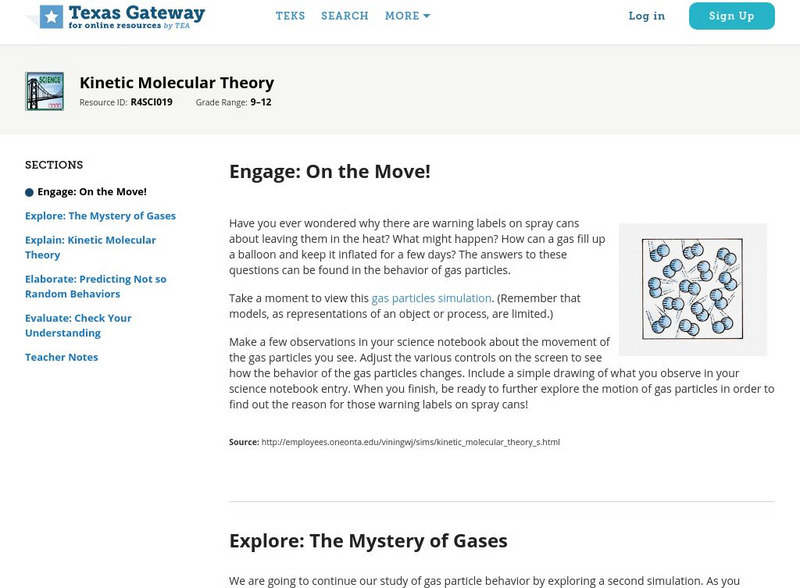
Texas Gateway: Kinetic Molecular Theory
[Accessible by TX Educators. Free Registration/Login Required] This resources allows students to explore the postulates of the Kinetic Molecular Theory in order to better understand why gas particles behave the way that they do.
University of Colorado
University of Colorado: Ph Et Interactive Simulations: States of Matter: Basics
After watching this simulation, students will be able to describe characteristics of the three states of matter. They will watch as atoms and molecules change between solid, liquid and gas phases.
Sophia Learning
Sophia: Kinetic Energy and States of Matter: Lesson 1
This lesson will compare the relative kinetic energy possessed by molecules in different states. It is 1 of 2 in the series titled "Kinetic Energy and States of Matter."
Sophia Learning
Sophia: Boiling, Freezing, Melting Point: Lesson 2
This lesson will introduce the phase changes that occur at the boiling, freezing, and melting points. It is 2 of 4 in the series titled "Boiling, Freezing, Melting Point."