Hi, what do you want to do?






What So Proudly We Hail
The Meaning of America: Self-Command
Even for one of the most accomplished men in American history, there was room for improvement. Challenge high schoolers to use Benjamin Franklin's Project for Moral Perfection to analyze text, make inferences, connect to historical...

Utah Education Network (UEN)
Classical Appeals and War Speeches
Discuss classical appeals of rhetoric through the speeches of Winston Churchill and FDR. Learners read, annotate, and analyze the speeches by the men before using a graphic organizer to track the use of ethos, pathos, and logos.

Curated OER
The New Deal
Students practice their reading comprehension skills by reading about Franklin Roosevelt and the New Deal programs. They answer questions related to the reading to test for comprehension.

What So Proudly We Hail
The Meaning of America: Enterprise and Commerce
Using Mark Twain's The Man That Corrupted Hadleyburg, invite your learners to consider the concept of virtue in a democratic society devoted to gain and self-interest. This stellar resource guides your class members through a close...

What So Proudly We Hail
The Meaning of America: Freedom and Individuality
What are the strengths and weaknesses of American individualism and independence? Explore these principles through a close reading of Jack London's To Build a Fire, and engage in high-level discussion with your class by analyzing the...

Curated OER
A Day of Infamy:Analyzing FDR’s Pearl Harbor Address
In 1941 FDR spoke out on the events at Pearl Harbor. The class will get to analyze word choice, word meaning, author's craft and structure by analyzing an actual draft of this speech. They will look critically at the words used,...

What So Proudly We Hail
The Meaning of America: National Identity and Why It Matters
Combining a close reading of a classic American text with the study of history can be a very powerful strategy, and this is most certainly the case with this resource using Edward Everett Hale's The Man without a Country. Consider themes...

Prestwick House
Writing Arguments in Response to Nonfiction
Emotional appeal or argument? That is the question. An informative lesson helps your class recognize the difference between a logical argument and an emotional appeal and learn how to craft an argumentative response. Writers develop a...

Curated OER
Lincoln is in the House! ("Name-Dropping" Poems and the Power of Connotation)
“What’s in a name?” Just about everything. Barack Obama, Vincent van Gogh, Justin Bieber. Famous names evoke a multitude of reactions and poets often use the names of famous people in their works precisely because names carry...

Shmoop
ELA.CCSS.ELA-Literacy.RI.9-10.10
Make sure that your pupils have mastered complex literary nonfiction by the end of the year and use this resource to help get them to that point. After a brief description of the Common Core standard, a list of age-appropriate...

ProCon
Minimum Wage
The first ever minimum wage in America was set at 25 cents per hour in 1938 and has been steadily, if slowly, increasing ever since. Using the provided website, pupils decide if the United States should further increase the federal...

Southern Nevada Regional Professional Development Program
Common Core Reading Standards: Understanding Argument
What does your class know about logical fallacies? They can find out quite a bit and practice identifying logical fallacies if you follow the steps and use the resources provided here! After reviewing ethos, pathos, and logos, ask small...

Curated OER
Primary and Secondary Sources
Students complete worksheets having to do with primary and secondary source documents. In this sources lesson, students define a primary source document, look at examples of primary and secondary sources. Students complete multiple...

Curated OER
Jane Goodall
Students read about Jane Goodall and complete discussion questions after they read about her. For this Jane Goodall lesson plan, students discuss questions as a group or write answers individually.
American Rhetoric
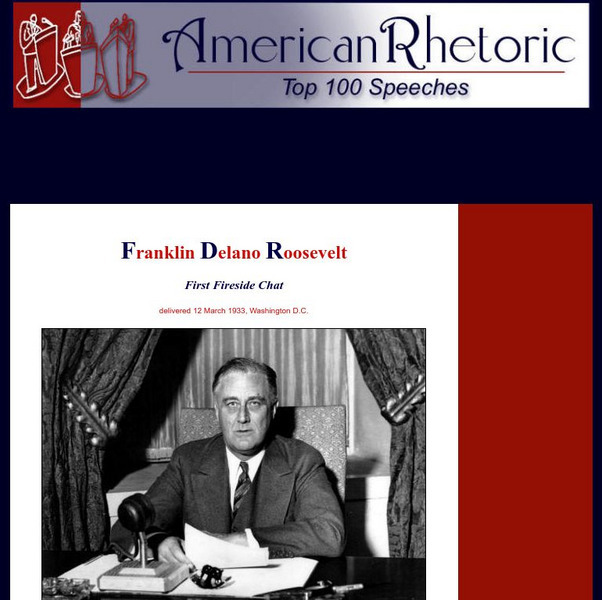
American Rhetoric: Franklin Delano Roosevelt: First Fireside Chat
This is the text and audio of President Franklin D. Roosevelt's first Fireside Chat "The Banking Crisis" on March 12, 1933, in Washington D.C.

American Rhetoric
American Rhetoric: Franklin Delano Roosevelt: First Inaugural Address
This is the text, audio, and video [7:04] of the swearing in and the first Inaugural Address of President Franklin Delano Roosevelt on March 4, 1933.
American Rhetoric
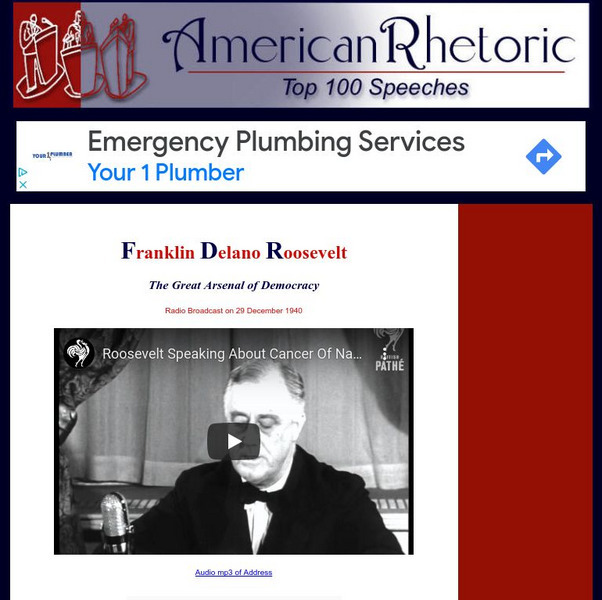
American Rhetoric: Franklin Delano Roosevelt: "The Great Arsenal of Democracy"
This is the text, audio, and video [7:40] of President Franklin D. Roosevelt's speech "The Great Arsenal of Democracy" delivered on December 29, 1940.

American Rhetoric
American Rhetoric: Franklin Delano Roosevelt: Pearl Harbor Address to the Nation
This is the text, audio, and video [3:08] of President Franklin D. Roosevelt's declaration of war against the Japanese the day after their attack on Pearl Harbor on December 7, 1941.
American Rhetoric
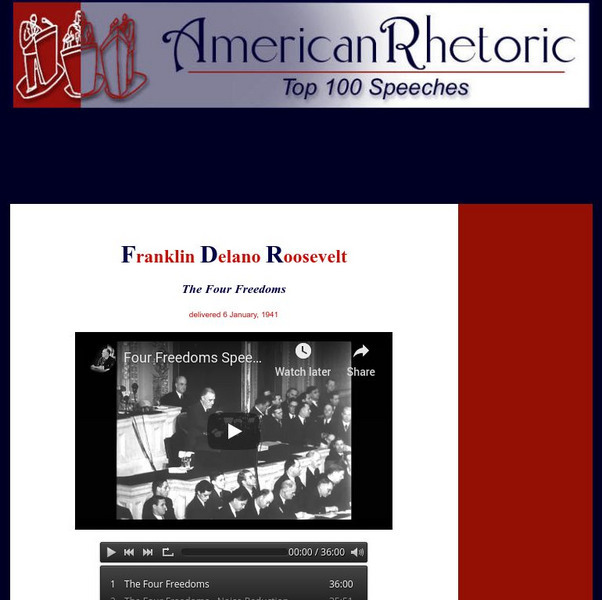
American Rhetoric: Franklin Delano Roosevelt: "The Four Freedoms"
This is the text and audio of President Franklin Roosevelt's speech to the 77th Congress entitled "The Four Freedoms" on January 6, 1941.

American Rhetoric
American Rhetoric: Franklin Delano Roosevelt: Commonwealth Club Address
This is the text of Franklin D. Roosevelt's speech to the Commonwealth Club on September 23, 1932, in San Francisco, California.
CommonLit
Common Lit: Fdr's First Inaugural Address
A learning module that begins with "FDR's First Inaugural Address" by President Franklin Delano Roosevelt, accompanied by guided reading questions, assessment questions, and discussion questions. The text can be printed as a PDF or...
CommonLit
Common Lit: Excerpt From "On Drought Conditions"
A learning module that begins with "Excerpt from "On Drought Conditions"" by President Franklin Delano Roosevelt, accompanied by guided reading questions, assessment questions, and discussion questions. The text can be printed as a PDF...
CommonLit
Common Lit: The Economic Bill of Rights
A learning module that begins with "The Economic Bill of Rights" by President Franklin D. Roosevelt, accompanied by guided reading questions, assessment questions, and discussion questions. The text can be printed as a PDF or assigned...
TES Global
Blendspace: Fdr Fireside Chats
A nine-part learning module with links to videos, websites, and images to use while learning about President Franklin Delano Roosevelt and his Fireside Chats.