Hi, what do you want to do?






TED Talks
Ted: Ted Ed: How to Think About Gravity
Video describes what gravity is and how it operates between two masses. Followed by a short quiz and a list of additional resources to explore. [4:44]

Physics Classroom
The Physics Classroom: Circular and Satellite Motion: Gravity More Than a Name
This tutorial is intended for students to strengthen their understanding of gravitation and understand the nature of this force.
CK-12 Foundation
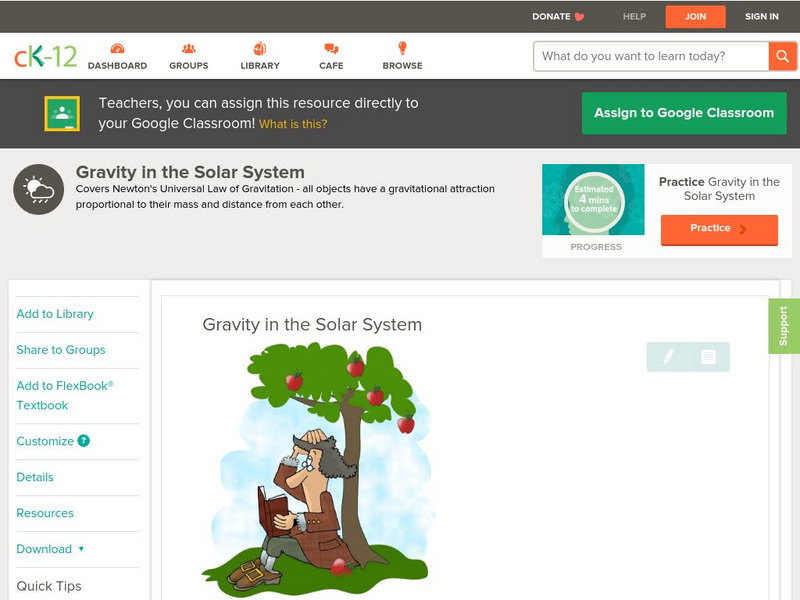
Ck 12: Earth Science: Gravity in the Solar System
[Free Registration/Login may be required to access all resource tools.] Understand the role of gravity in space.

TED Talks
Ted: Ted Ed: Would You Weigh Less in an Elevator?
Video that uses an elevator in motion to describe the relationship among weight, gravity, and relative motion. [3:36] Includes a short quiz and a list of additional resources to explore.

TED Talks
Ted: Ted Ed: How Does Work, Work?
In this video, Peter Bohacek explains the interplay between work and power and how it can be seen in the functioning of a clock. [4:31] Followed by a short quiz and a list of additional resources to explore.
Exploratorium
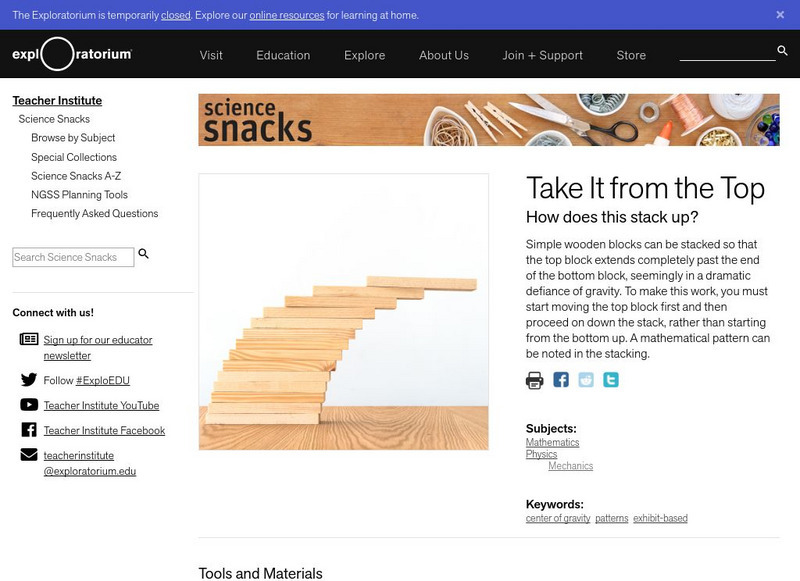
Exploratorium: Science Snacks: Take It From the Top
Students defy gravity by stacking blocks in different ways in this exercise. Other projects are linked to this lesson as well.
BBC
Bbc: Gcse Bitesize: The Life Cycle of a Star
This lesson focuses on the formation and life cycle of stars. Stars form when enough dust and gas clump together because of gravitational forces. Nuclear reactions release energy to keep the star hot. Some stars grow larger over time....

Khan Academy
Khan Academy: Start: How Do Computers Simulate the Motion of Virtual Particles?
In this instructional activity we'll explore how we use fairly simple physics to draw particles which move according to the forces we feel in the real world (such as wind & gravity).
Physics Classroom
The Physics Classroom: Static Electricity: Lesson 3: Inverse Square Law
Electrical force between two electrically charged objects is inversely related to the distance between the two objects. Investigate why this becomes the inverse square law of physics. Engage in the Coulomb's Law interactive and check...
Physics Classroom
The Physics Classroom: Circular and Satellite Motion: Energy in Satellites
Through interactive practice problems and illustrated examples, students explore energy relationships for satellites.
TeachEngineering
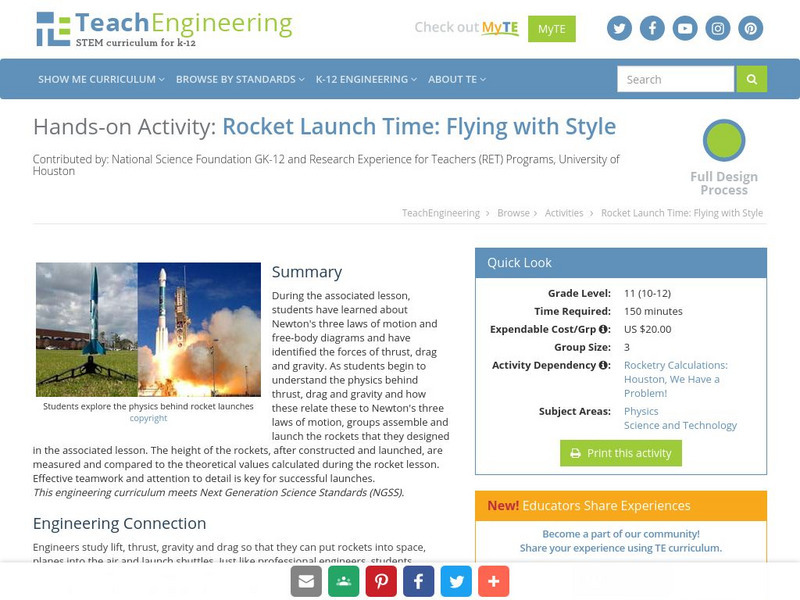
Teach Engineering: Flying With Style
As students begin to understand the physics behind thrust, drag, and gravity and how these relate these to Newton's three laws of motion, groups assemble and launch the rockets that they designed in the associated lesson.
TeachEngineering
Teach Engineering: Mechanics Mania
Through ten lessons and numerous activities, students explore the natural universal rules engineers and physicists use to understand how things move and stay still. Together, these rules are called "mechanics." The study of mechanics is...
Sophia Learning
Sophia: Gravitational Force & Newton's Second Law of Motion
This lesson explains how gravitational force is related to free fall, acceleration due to gravity, and Newton's second law of motion.
Science Education Resource Center at Carleton College
Serc: Marble Stop
In this two-part lesson, students will discover that no matter what the shape of the track, the marble will rise to the same vertical height. They will begin to understand the concepts of gravity, motion, and force.
TeachEngineering
Teach Engineering: Water and Dams in Today's World
Learners learn about the importance of dams by watching a video that presents historical and current information on dams, as well as descriptions of global water resources and the hydrologic cycle. Students also learn about different...
Physics Classroom
The Physics Classroom: 1 D Kinematics: The Big Misconception
An introduction to the ideas behind the misconception and misunderstanding of why all objects accelerate at the same rate. This explanation involves the concepts of force and mass.
TeachEngineering
Teach Engineering: Dams
Through eight lessons, students are introduced to many facets of dams, including their basic components, the common types (all designed to resist strong forces), their primary benefits (electricity generation, water supply, flood...