Hi, what do you want to do?






American Chemical Society
Evaporation Sensation
Where did the water go? Learners conduct an experiment to see how the difference in temperature affects evaporation rates. Scholars continue to investigate evaporation by comparing water and alcohol evaporation rates. Pupils experiment...

Exploratorium
The Dipping Bird
If you have or want to order the dipping bird demonstration, it is useful for showing how evaporation and changes in the pressure of a closed system cause cyclical motion. After teaching about pressure, consider setting this little guy...

American Chemical Society
The Energy of Evaporation
Do all liquids evaporate at the same rate? Young scientists observe the evaporation rate of three different liquids. They measure the time, the temperature, and the change in energy. After comparing the chemical formulas, scholars...

Discover Earth
Weather Stations
Transform your classroom into a fully functioning weather station with this series of hands-on investigations. Covering the topics of temperature, precipitation, wind patterns, and cloud formation, these activities engage young...

NOAA
The Climate Team: Make a Solar Heat Engine
Learners investigate how solar energy is converted into heat in part two of the 10-part Discover Your Changing World series. They build and test homemade solar cookers to boil water and cook rice. Pupils consider the impact of heat...

Teach Engineering
Dress for Success
Dressing for success is not always about looking sharp. Sometimes it is about staying warm and dry. Present your class with an activity that challenges groups of pupils to design a layered material for blizzard conditions. The teams test...
Texas Instruments
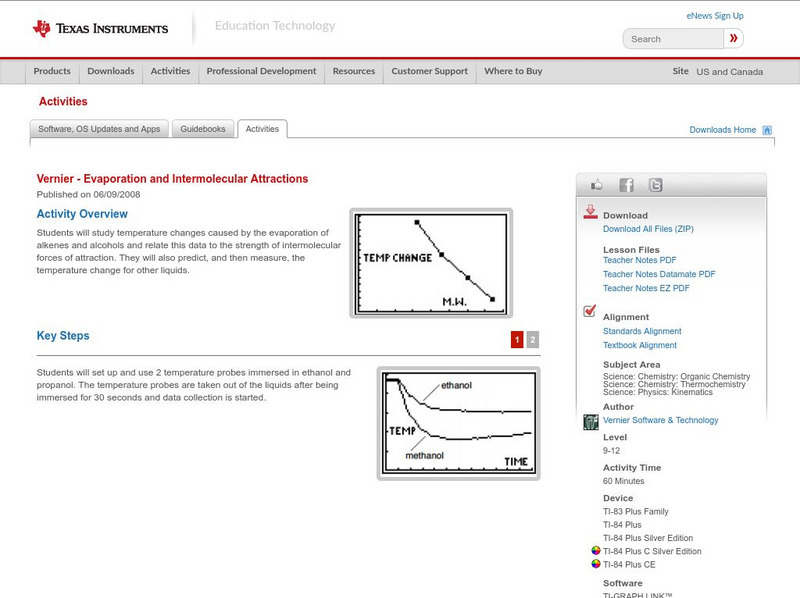
Texas Instruments: Evaporation and Intermolecular Attractions
Students will study temperature changes caused by the evaporation of alkenes and alcohols and relate this data to the strength of intermolecular forces of attraction. They will also predict, and then measure, the temperature change for...
TeachEngineering
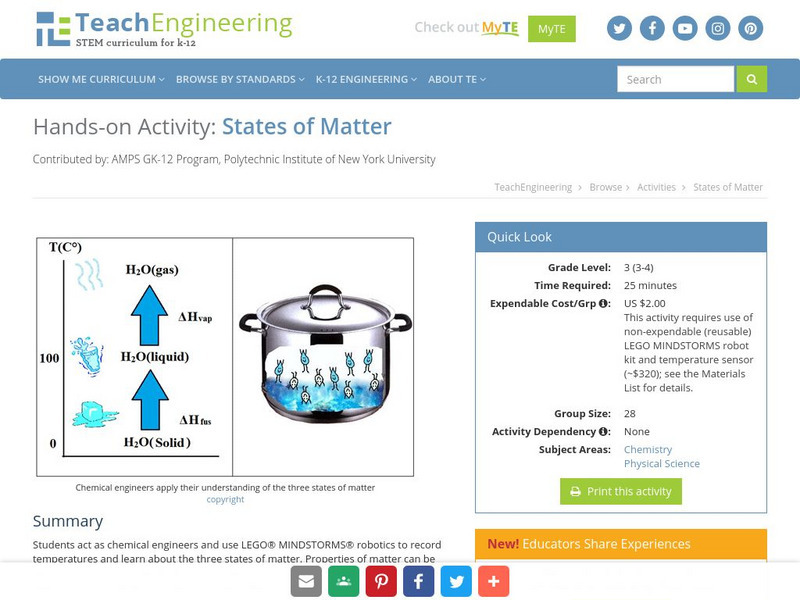
Teach Engineering: States of Matter
Students act as chemical engineers and use LEGO MINDSTORMS NXT robotics to record temperatures and learn about the three states of matter. Properties of matter can be measured in various ways, including volume, mass, density and...
Science Buddies
Science Buddies: What's the Fastest Way to Cool a Soda?
When you are craving an ice cold drink of soda, the last thing you want is to be stuck with a bunch of soda cans at room temperature. This fun science experiment sends you on a discovery to find the fastest way to cool soda with...
Texas Instruments
Texas Instruments: Wet Sand / Dry Sand
In this activity, Students can use temperature sensors to compare the heating rates of wet sand and dry sand. They will use the results of the experiment to understand more about the effects of evaporation.
PBS
Pbs Teachers:dimming the Sun
Conduct an experiment and investigate how air temperature, relative humidity, wind speed, solar radiation and precipitation affect evaporation. Graph the data collected during the experiment.