Hi, what do you want to do?






American Museum of Natural History
Planetary Mysteries
Get to know our little part of the vast universe. Learners read about the common and not-so-common facts about each of the planets in the solar system. The interactive lesson includes a large amount of information as well as a quiz to...

American Museum of Natural History
What is Astronomy?
Go study the universe. Pupils learn seven aspects about astronomy and astronomers. They begin to learn about constellations; distance and motion between objects; gravity; the electromagnetic spectrum; dark matter and energy; and teams of...

American Museum of Natural History
What's This? Life at the Limits
There are some amazing ways species evolve to survive. From large ears to sneezing salt, learners read about these interesting adaptations in an interactive lesson. Great to supplement an in-class lesson, it also works well as a remote...

American Museum of Natural History
Planetary Mysteries
A website all about planetary mysteries—it's a one-stop-shop for all things, stars, planets, and space travel. Scholars read an astronomy overview to discover the page's big ideas, then choose from the plethora of resources, including...
Science Education Resource Center at Carleton College
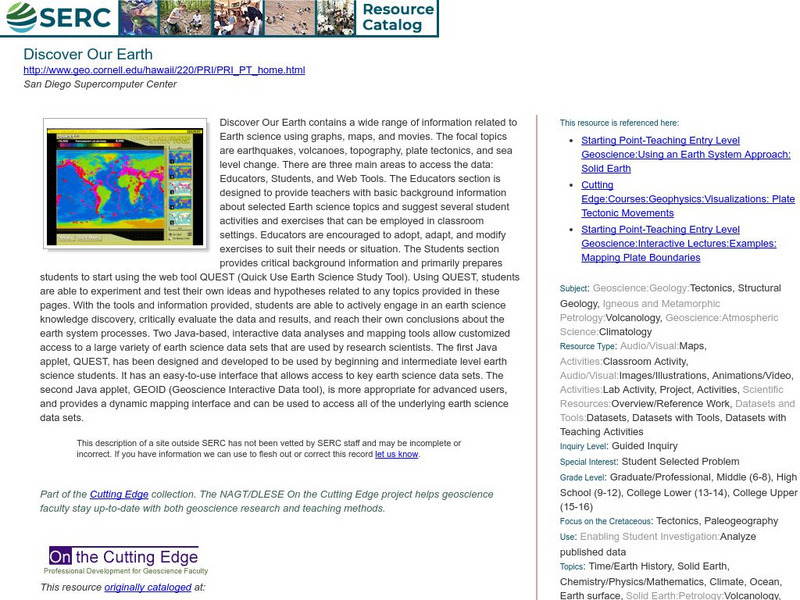
Serc: Discover Our Earth
Study earthquakes, volcanoes, topography, plate tectonics, and sea level change using graphs, maps, and movies. Engage in earth science knowledge discovery, critically evaluate the data and results, and reach conclusions about the earth...
National Earth Science Teachers Association
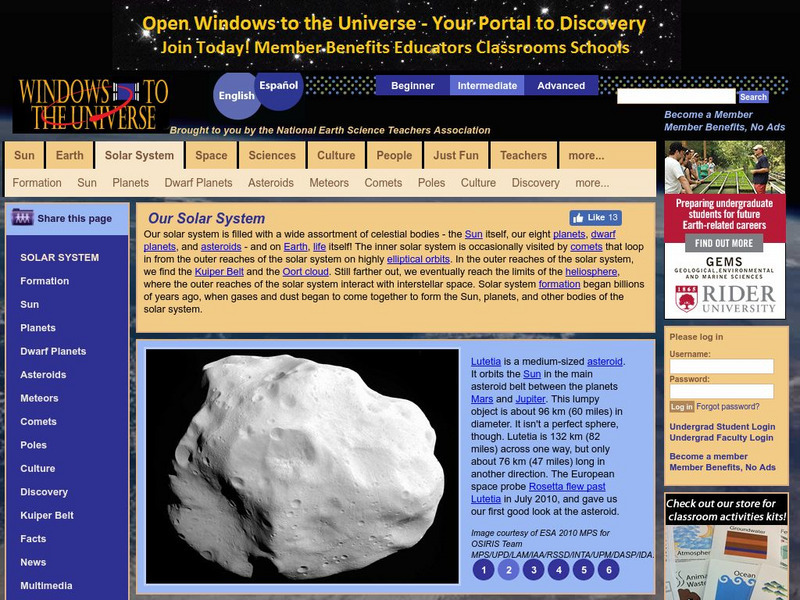
Windows to the Universe: Our Solar System
Our solar system is filled with a wide assortment of celestial bodies - the Sun itself, our eight planets, dwarf planets, and asteroids - and on Earth, life itself! The inner solar system is occasionally visited by comets that loop in...
Other
Space Science Institute: Alien Earths: Star and Planet Formation
Learn about the lives of stars, and how stars and planets form. The Interactive activity, 'Planet Families' requires Adobe Flash and cannot be launched.

Rice University
Rice University: Museums Teaching Planet Earth: What Is the Hydrosphere?
Focus is on the hydrosphere and contains the definition as well as characteristics of the ocean and the effect of the ocean on climate.
Enchanted Learning
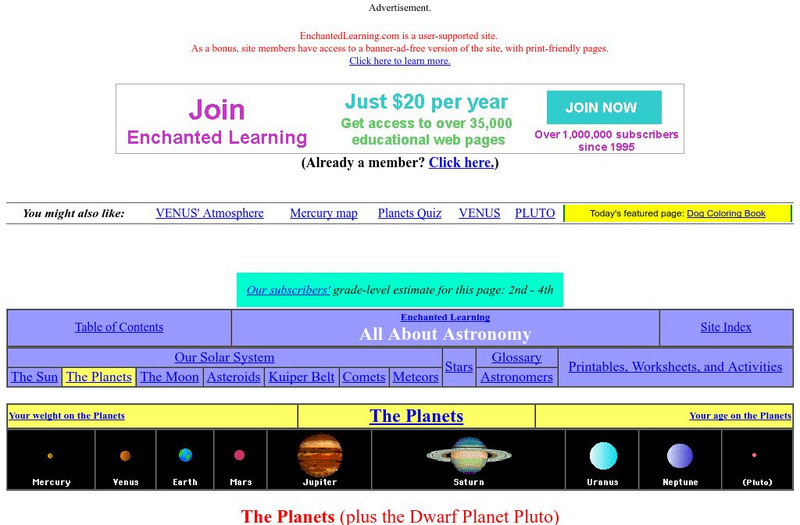
Enchanted Learning: The Planets
This survey of the planets includes all the basics, size, mass, atmosphere, length of day, and the like. It features interactive activities and learning exercises and compares all of the planets in colorful tables.

Smithsonian Institution
Smithsonian Institution: Time and Navigation
Explore navigation methods by sea, air, and space, what latitude and longitude mean, how GPS works, about satellite navigation, and learn about professional navigators. Includes a timeline of developments in navigation from 1280 to the...

Enchanted Learning
Enchanted Learning: Zoom Astronomy
Where is our Solar System? How far away is the sun? What makes up the sun? Find out all you want to know about our solar system. This is a comprehensive on-line site about space and astronomy. Check out all of the excitement!

Environmental Education for Kids
Eek!: Discover the Great Lakes
The Great Lakes include, Superior, Michigan, Huron, Erie and Ontario. These lakes form the largest fresh water system on earth and they are North America's greatest natural resource. Learn about the different lakes, how they formed,...