Hi, what do you want to do?






Curated OER
Worksheet 31
In this math worksheet, students investigate vectors and polar coordinates. They convert the paths of polar coordinates to Euclidian points.

Curated OER
Graphs
Students list their favorite cars and create graphs of their favorites. Students determine how the graphs would change as their choices change.

Curated OER
Can You Calculate the Speed of Your Pet?
Students analyze the formula for speed and velocity. They explore and demonstrate how to calculate the speed of wind up toy pets, average the speeds and identify the correct units of measure of speed.

Physics Classroom
The Physics Classroom: Acceleration
Topics covered include what acceleration is, the difference between constant and non-constant acceleration, acceleration in a free-falling object, the equation used to compute acceleration, and the difference between positive and...
TeachEngineering
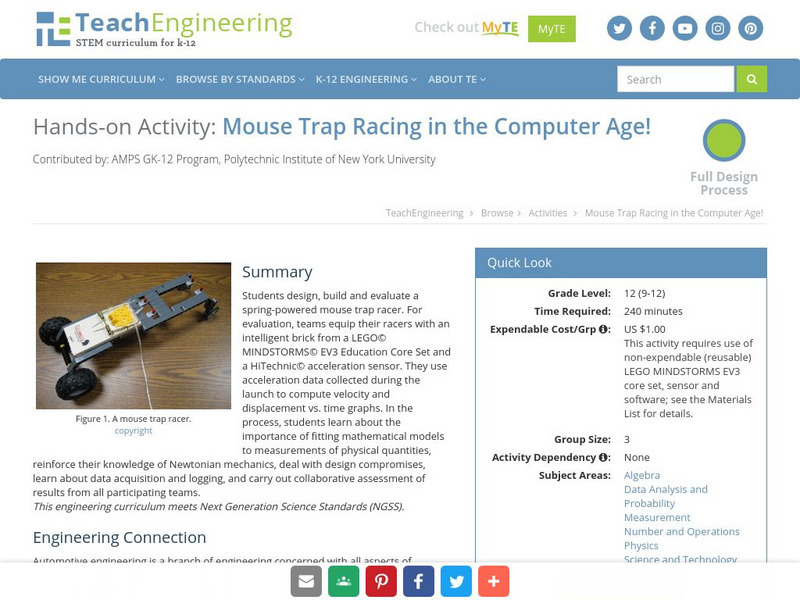
Teach Engineering: Mouse Trap Racing in the Computer Age!
Students design, build and evaluate a spring-powered mouse trap racer. For evaluation, teams equip their racers with an intelligent brick from a LEGO MINDSTORMS NXT Education Base Set and a HiTechnic acceleration sensor. They use...
TeachEngineering
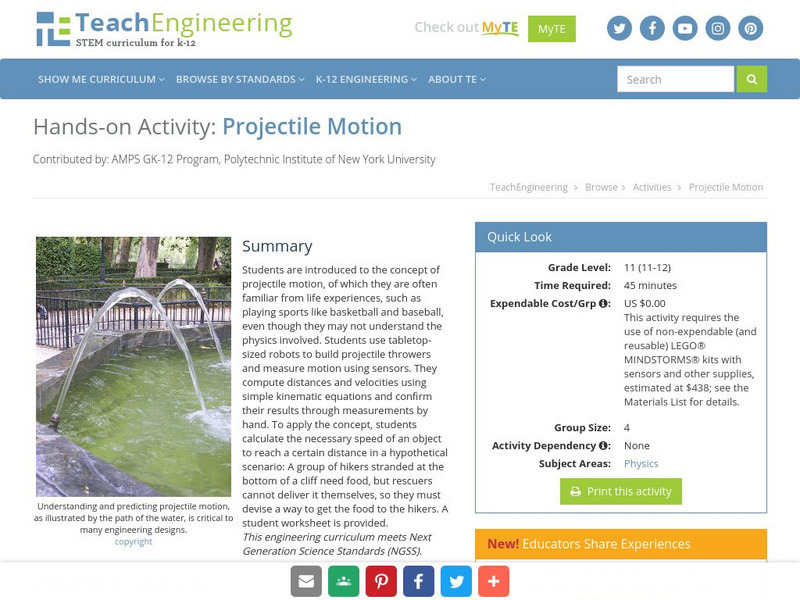
Teach Engineering: Projectile Motion
Students are introduced to the concept of projectile motion, of which they are often familiar from life experiences,such as playing sports such as basketball or baseball, even though they may not understand the physics involved. Students...

Other
International Linear Collider: Possible Benefits From Ilc Technology
Research with linear colliders may enormously benefit fields such as medicine, computing and the environment. Examples include medical proton therapy and the potential of being able to render nuclear waste harmless. A wonderful side...

Khan Academy
Khan Academy: Trig and Forces: The Pendulum
Using Newton's Laws of motion to calculate the acceleration of a pendulum as well as to compute and draw its position along the swing and move about the screen in a computationally based graphic system.

Khan Academy
Khan Academy: Interactive Vector Motion
Understanding and programming interactive vector motion by calculating an objects acceleration according to a rule stated in Algorithm 3-the object accelerates towards the mouse.

Khan Academy
Khan Academy: Newton's Laws of Motion
Making objects move around the computer screen and responding to a variety of environmental forces by understanding Newton's Laws of force and acceleration.

Khan Academy
Khan Academy: Angles and Units
The application of trigonometry concepts to calculate complex forces of angular velocity and acceleration is illustrated.

Khan Academy
Khan Academy: Step 2 (Spring Mass System)
This program simulates a particle connected to an anchor by a spring. Try changing the value of the k variable. Press "Restart" after changing the value. How does the length of the spring change as k increases? How does the speed of the...

Khan Academy
Khan Academy: Motion of Many Objects
Application of physics to graphic computer programming.