Hi, what do you want to do?






Teach Engineering
Density Column Lab - Part 2
Groups suspend objects within layers of liquids to determine the densities of different liquids and compare them to the densities of objects calculated in Part 1. The groups then carefully test their calculations by layering the...

Center for Learning in Action
Gases
Explore the properties of gases through one activity and two investigations in which super scientists observe the changes gas makes when encountering different conditions.

Illustrative Mathematics
Comparing Freezing Points
Subtracting negative numbers can be confusing to your middle schoolers. Here, they are able to draw a number line and put their answer in sentence form to check their understanding of negative numbers.

101 Questions
You Pour, I Choose
Tall and skinny or short and stout, which glass hold the most liquid? Learners analyze dimensions of cylindrical glasses to determine the one holding the greatest amount of liquid. They brainstorm the relevant dimensions before making...

Teach Engineering
All Fats Are Not Created Equal
Apply robotics to connect physical properties to chemical properties. Future engineers use robots to determine the melting points of various fats and oils. The robots can do this by measuring the translucency of the fats as they heat up.

NorthEast Ohio Geoscience Education Outreach
Introduction to Density
Seventh grade scientists weigh in on the concept of density. In a nutshell, they participate in the following activities:
Measurement of the mass and volume of fruit in order to compare densities
Measurement of the mass of oil and water...

Curated OER
Element Research Project
Students research elements on interactive Internet periodic tables, take notes using Inspiration software, and write descriptive paragraphs with graphics. They create presentations.
TeachEngineering
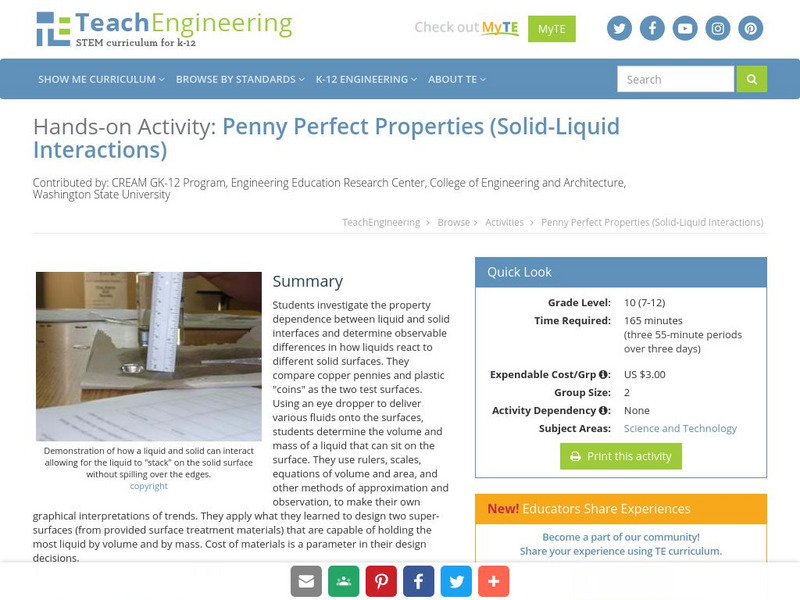
Teach Engineering: Penny Perfect Properties (Solid Liquid Interactions)
Students investigate the property dependence between liquid and solid interfaces and determine observable differences in how liquids react to different solid surfaces. They compare copper pennies and plastic "coins" as the two test...
Texas Instruments
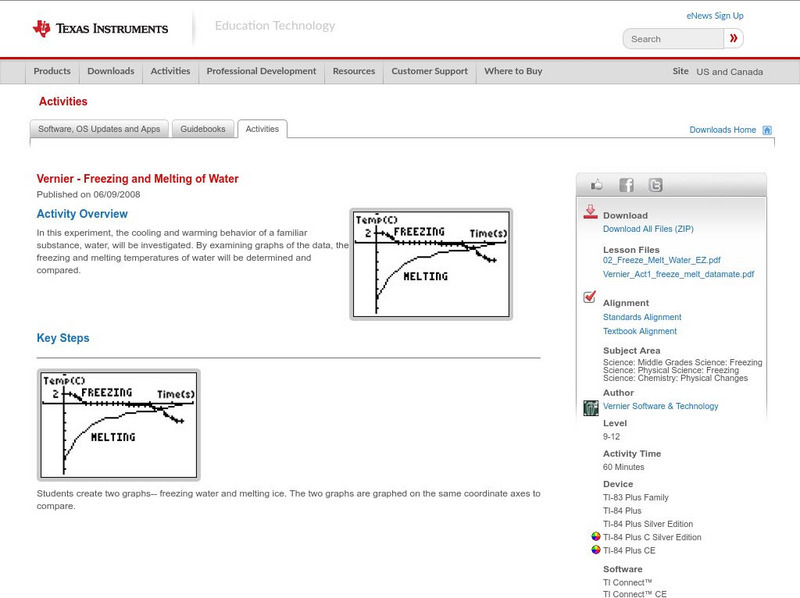
Texas Instruments: Freezing and Melting of Water
Freezing temperature, the temperature at which a substance turns from liquid to solid, and melting temperature, the temperature at which a substance turns from a solid to a liquid, are characteristic physical properties. In this...
TeachEngineering
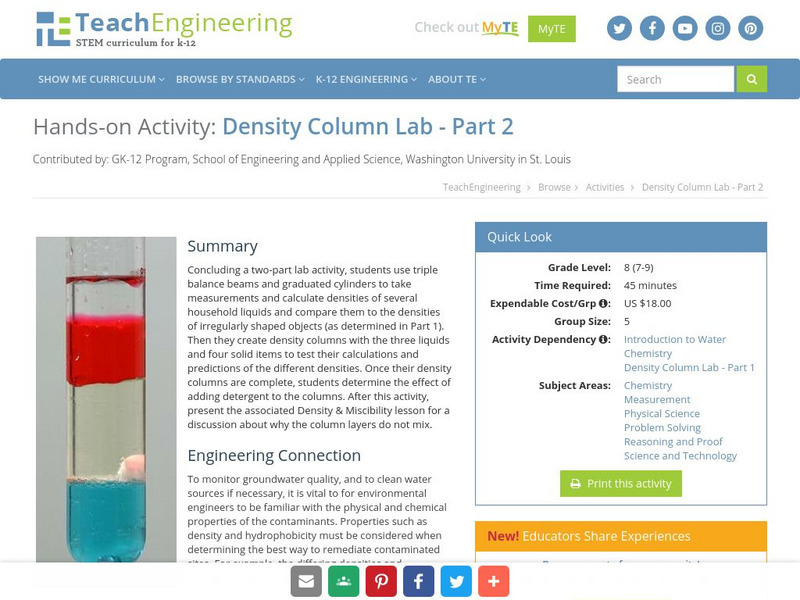
Teach Engineering: Density Column Lab Part 2
Concluding a two-part lab activity, students use triple balance beams and graduated cylinders to take measurements and calculate densities of several household liquids and compare them to the densities of irregularly shaped objects (as...
TeachEngineering
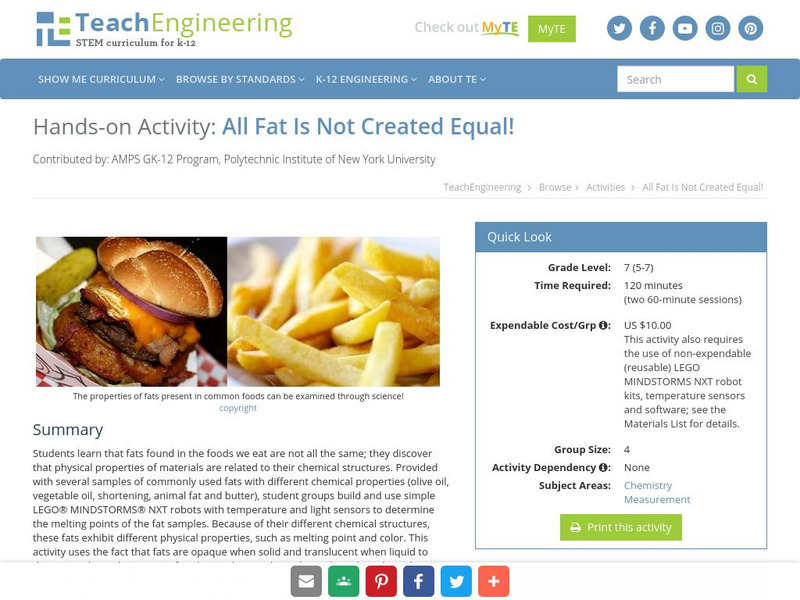
Teach Engineering: All Fat Is Not Created Equally!
Students learn that fats found in the foods we eat are not all the same; they discover that physical properties of materials are related to their chemical structures. Provided with several samples of commonly used fats with different...