Hi, what do you want to do?






Illustrative Mathematics
What Shape Am I?
Sharpen your pencil and grab a ruler, it's time to draw some quadrilaterals! Given the definition of a parallelogram, rectangle, and rhombus, learners draw examples and nonexamples of each figure. The three definitions are...

Illustrative Mathematics
Shape Sequence Search
Learning that size and orientation don't affect the classification of shapes is a big step for young mathematicians. Support children with developing this key understanding by looking at the array of shapes included in this resource. For...

Illustrative Mathematics
All vs. Only Some
All shapes have certain defining attributes that set them apart from others. In order to understand this, young mathematicians look at examples and non-examples of triangles, rectangles, and squares, working as a whole class to create...

Illustrative Mathematics
3-D Shape Sort
From the apple on your desk and the coffee cup in your hand, to the cabinets along the classroom wall, basic three-dimensional shapes are found everywhere in the world around us. Introduce young mathematicians to the these common figures...

Illustrative Mathematics
What is a Trapezoid? (Part 1)
Challenge your class to construct a definition for trapezoids. Looking at four examples and four non-examples, students individually create definitions and use them to classify an unknown shape. Allow for small group and whole-class...

Illustrative Mathematics
The Geometry of Letters
Use the alphabet as a tool for teaching your class about geometric figures. Break apart capital letters into line segments and arcs. Classify angles as right, acute, or obtuse. Identify parallel and perpendicular lines. An excellent...

Illustrative Mathematics
Lines of Symmetry for Quadrilaterals
Explore how lines of symmetry help define different categories of quadrilaterals. Looking at a square, rectangle, trapezoid, and parallelogram, young mathematicians discover that each shape has its own, unique symmetry. Encourage your...

Illustrative Mathematics
Are These Right?
Is that a right triangle or a wrong triangle? Young mathematicians look at eleven different shapes and use a measuring tool of their choice to determine which triangles have right angles. Consider cutting out sets of the shapes to...

Illustrative Mathematics
Lines of Symmetry for Triangles
What can symmetry tell us about triangles? After looking at four examples, learners will come to realize that lines of symmetry are different for equilateral, isosceles, and scalene triangles. Use this guided practice activity as an...

New South Wales Department of Education
Plant Features
Pine needles are actually modified leaves. In the 16th installment of 20, young scientists explore plants. Through an analysis of leaves — shape, veins, and edges — pupils see how to classify plants based on structural features.

Las Cumbres Observatory
Create a Hubble Tuning Fork Diagram
Add a little color to the universe. Learners recreate images of the galaxies using real data and Photoshop software. They display their images in a Hubble tuning fork diagram by classifying and categorizing their shapes.

Jackson Public Schools
Summer Reading Activities
Provide parents with the tools they need to bridge the summer learning gap with this collection of fun activities. Whether it's creating an alphabet poster with illustrations for each letter, playing a game of sight word concentration,...

American Museum of Natural History
Start a Rock Collection
Rocks hold evidence of Earth's past. A three-step guide describes the process of creating a rock collection. It provides a data collection sheet to make notes about each sample.

It's About Time
Organic Substances
Host an exciting lab in which learners burn fruit rinds to better understand hydrocarbons. A reading passage and analysis questions wrap up the lesson.

Space Race
Sensory Detectives
Test your learners' sensory awareness with three hands-on activities that ask pupils to use their other senses to identify and describe everyday objects hidden from sight.

Southwestern Medical Center
A Classroom Demonstration of Protein Folding
Does the mention of proteins and polypeptide relationships in your classroom result in mass confusion? Does the attempt to teach this important concept generate multiple questions and, at times, lead to a room filled with blank...

Curated OER
Trekking to Timbuktu: Restoring the Past
Students describe the environmental conditions that presently threaten Timbuktu. They explain what efforts are being made to restore the ancient mosques, describe the condition of the ancient manuscripts and tell what is being done to...

Curated OER
Timeline of Extreme Weather Events
Students research and chart extreme weather events on a timeline. In this extreme weather lesson, students interview older people who have experienced extreme weather events. Students complete a worksheet based on the information of the...
National Council of Teachers of Mathematics
Nctm: Illuminations: Cutting Corners
Students will use their knowledge of plane figure attributes to create and view shapes by cutting and rotating shapes to stimulate discussions on names and attributes of various shapes they do not regularly encounter.

CK-12 Foundation
Ck 12: Classification of Soild Figures: Naming Shapes
[Free Registration/Login Required] Students will click on the point of the word and drag it to the correct figure. Click challenge me to answer practice questions and click learn more to watch a video.

The Franklin Institute
The Franklin Institute: Classified
At this site from The Franklin Institute you can practice classifying objects according to physical structure and characteristics.

NumberNut
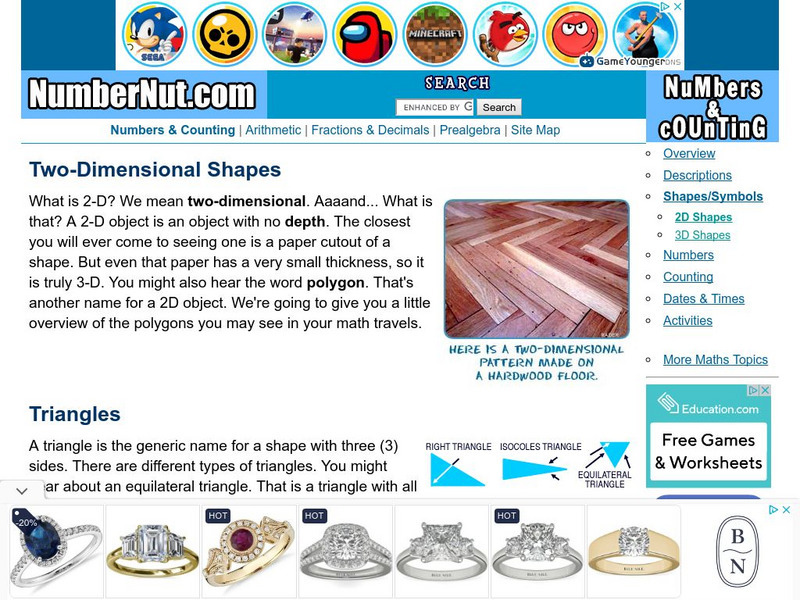
Number Nut: Shapes, Symbols, and Colors: 2 D Shapes
Did you know that two-dimensional shapes are also called polygons? This lesson describes the various 2-D shapes and includes two interactive games to reinforce skills.

Texas Instruments
Texas Instruments: Classifying Quadrilaterals
Students will be sent ordered pairs through lists using the TI-Navigator. These pairs will then be graphed as a line graph and students will classify the shape of the quadrilateral and justify their choice.
NumberNut
Number Nut: Shapes, Symbols and Colors: Two Dimensional Shapes
Describes, with illustrations, the basic two-dimensional shapes students will encounter in elementary Math.