Hi, what do you want to do?






National Institute of Open Schooling
General Characteristics of the p-Block Elements
The 20th installment in a series of 36 focuses on the characteristics of the p-block elements. Learners discuss, read about, and answer questions pertaining to the occurrence of these elements in nature, their electron configurations,...

National Institute of Open Schooling
Compounds of Carbon Containing Nitrogen
Amines are vital to humans because they help form amino acids, the building blocks of proteins. The 30th lesson in a series of 36 specifically focuses on the organic compounds that contain nitrogen. Learners classify amines and nitro...

National Institute of Open Schooling
Occurrence and Extraction of Metals
Steel is a man-made alloy or a mixture of metals. Lesson 18 in this series of 36 focuses on metals and their extraction from Earth. Individuals read about, discuss, and answer questions after learning how people find most metals, the...

National Institute of Open Schooling
Biomolecules
An informative lesson has learners read about, discuss, and study the classification, structure and importance of the following biomolecules: carbohydrates, proteins, lipids, nucleic acids, and enzymes.

National Institute of Open Schooling
Hydrocarbons
The vast majority of hydrocarbons humans use help fuel cars, homes, and provide energy. A comprehensive lesson teaches pupils all about hydrocarbons. From alkanes, alkenes, and alkynes to benzene, classes study the preparation of these...

National Institute of Open Schooling
Chemical Kinetics
Not all chemical reactions happen at the same rate because some, like explosions, occur quickly and some, like rusting, occur over time. Here, learners explore chemical reactions and their rates in the 16th lesson of 36. Through readings...

National Institute of Open Schooling
Environmental Concerns
Every year, more than 14 billion pounds of garbage is dumped into the oceans of the world, most of which is plastic and toxic to ocean life. Lesson 32 in the series of 36 focuses on environmental concerns, specifically pollution. Under...

National Institute of Open Schooling
Hydrogen and s-Block Elements
Lesson 19 in the series of 36 analyzes the element hydrogen and the s-block elements. Through readings, answering questions, and discussion, learners write about and explain their occurrence, physical and chemical properties, and...

National Institute of Open Schooling
Coordination Compounds
Cyanide, a coordination compound, is used in the extraction of gold and silver. Part 24 in the series of 36 delves into the world of coordination compounds. Classes learn, through readings, discussions, and answering questions, how to...

National Institute of Open Schooling
Mole Concept
Learners explore atomic measurement in the first activity in a series of 36. Through readings, activities, and questions, classes review standard SI units, learn about Avogadro's constant, and use it to help them calculate moles. They...

University of Georgia
Would Your Cat Eat This Stuff?
Processed foods use inorganic compounds for flavoring and preservation. This take-home laboratory challenges scholars to find 20 different compounds identified on the labels of foods to list on their data collection sheet. The activity...

National Institute of Open Schooling
Water Pollution
Fifteen million children under the age of five die each year due to diseases in their drinking water. Water pollution is the topic of lesson 34 in the series of 36. Scholars, through reading and discussing, study numerous aspects of...

National Institute of Open Schooling
Colloids
Classes explore colloids through readings and questions in lesson 10 in a series of 36. They learn everything from methods of preparation and properties to how to classify colloids. They finish the lesson by seeing how to apply...

Teach Engineering
Quantum Dots and the Harkess Method
The Fantastic Voyage is becoming close to reality. The class reads an article on the use of nanotechnology in the medical field and participate in a discussion about what they read. The discussion method helps class members become more...

National Institute of Open Schooling
The Liquid State
Due to surface tension, dew — a liquid, is spherical in shape. Learners explore the properties of liquids in activity seven in this series of 36. Beginning with its basic properties such as boiling point and moving through to surface...

National Institute of Open Schooling
Solutions
Aqua regia, or royal water in Latin, is a solvent that can dissolve solid gold and platinum into a solution. Activity nine in a series of 36 allows classes to learn, through readings and answering questions, what a solution is and the...

Curated OER
First Land Plants Found on Earth
In this first land plants worksheet, students read about the major events that allowed plants to evolve on Earth. Students read about the primary and secondary atmospheres, the formation of the ozone layer to protect from UV light and...
Frostburg State University
General Chemistry Online: Chemistry of Everyday Life
A collection of questions commonly asked to address where chemistry is found in everyday life. Find out how mood lipstick works and why chunks of pineapple can't be added to Jell-o.
Nobel Media AB
The Nobel Prize: Alfred Nobel His Life and Work
This resource provides information about Alfred Nobel, a scientist who contributed greatly to the world of chemistry. This article includes several pictures and details about Nobel's personal life and professional career.
Encyclopedia of Earth
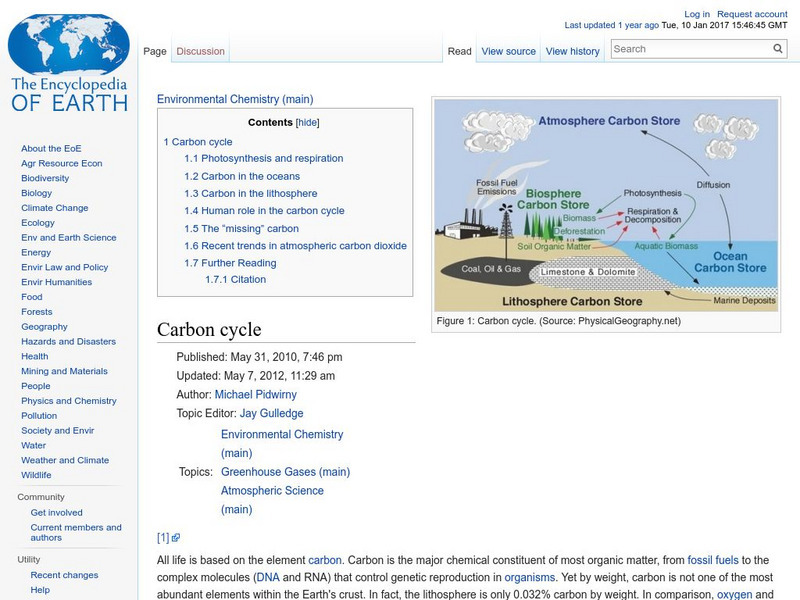
Encyclopedia of Earth: Environmental Chemistry: Carbon Cycle
Article explaining the importance of carbon as the basis for life, carbon dioxide's role in photosynthesis and respiration, carbon in the ocean and lithosphere, the impact of human activities on the carbon cycle, carbon that seems to be...

Encyclopedia of Earth
Encyclopedia of Earth: Physics & Chemistry: P H
Explains what pH is and its use in defining what acids and bases are. Also talks about the importance of pH for regulating metabolism in life forms. Includes a chart showing the pH values of common liquids. (Published: July 30, 2010)

Science Struck
Science Struck: Examples of Chemistry in Everyday Life
Gives examples of chemical interactions occurring in the human body, in the world around us, in foods, and in products we use.
NASA
Nasa: The Basics of Ocean Chemistry: Carbon, Circulation, and Critters
An explanation of ocean chemistry, supported by illustrations, for example, of the global carbon cycle in the 1980s and the annual carbon dioxide flux. The concentration of nutrients in the ocean is discussed for its impact on marine...
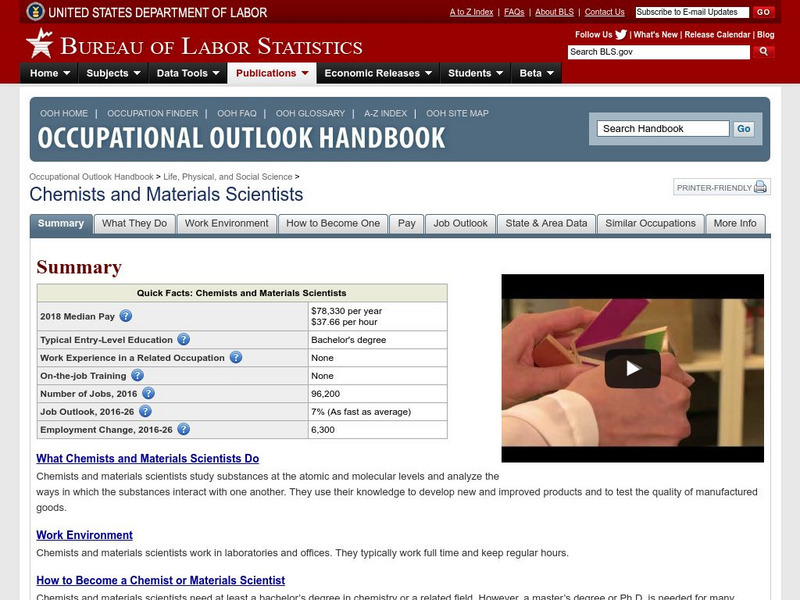
US Department of Labor
Bureau of Labor Statistics: Chemist
The BLS offers an overview of the career of a chemist. The website provides a general description of what being a chemist is like and includes information on the type of education and experience a chemist needs.
Other popular searches
- Biology Chemistry of Life
- Chemistry of Life Unit
- Chemistry of Life Worksheet
- Chemistry of Life Holt
- Chemistry of Life Answers
- The Chemistry of Life